Imago
Credits: Imago
Imago
Credits: Imago
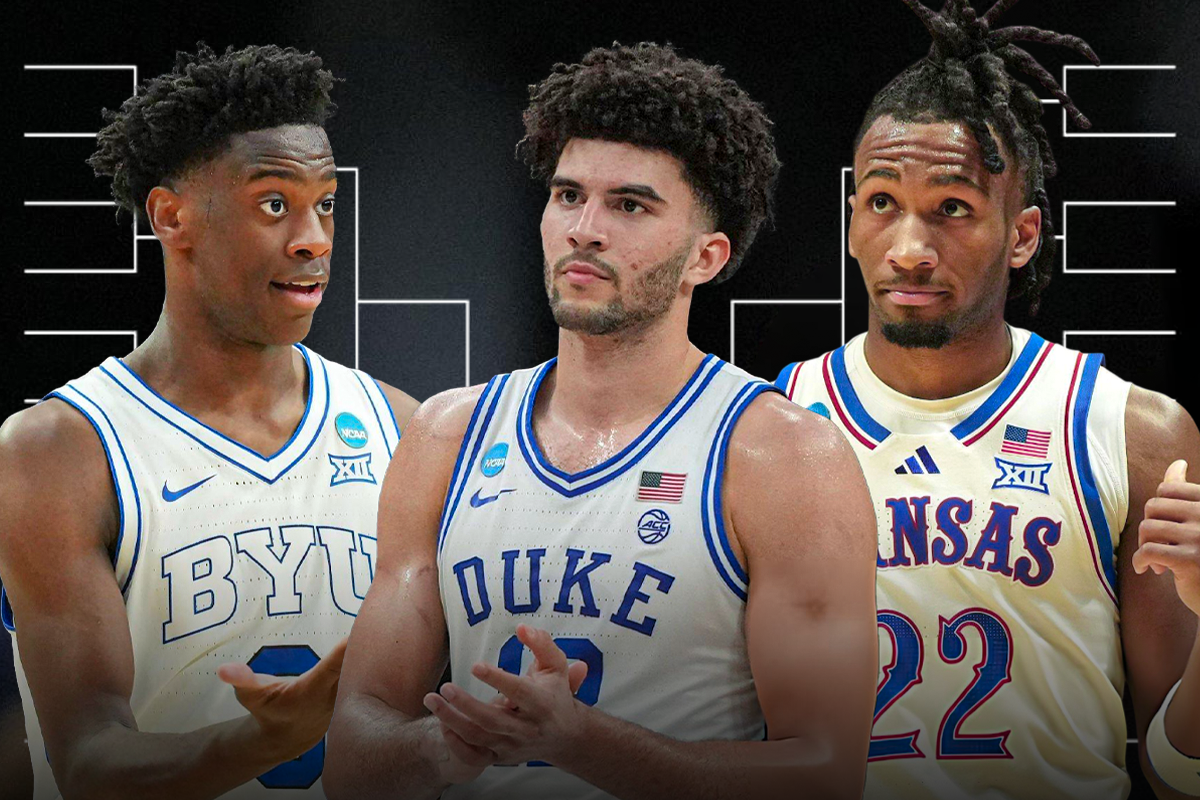
Cameron Boozer. AJ Dybantsa. Darryn Peterson.
Watch What’s Trending Now!
Three of the top names in arguably one of the strongest freshmen classes since 2005 and the inception of the one-and-done rule, which requires players to be 19 years old and one year removed from high school to be eligible for the NBA Draft.
All three will be hearing their names called early at this summer’s selection show. Yet all three generational talents are also home this weekend when the college basketball season wraps up the 2026 March Madness tournament in Indianapolis.
Dybantsa? The nation’s leading scorer dropped 35 points, but BYU still fell to Texas in the opening round. Peterson? Kansas got knocked out in the second round by St. John’s. Boozer? We’ll give Cameron a pass after Duke’s all-time collapse against UConn in the Elite Eight.
Now glance at the remaining teams in your bracket. Arizona, Illinois and Michigan, along with the aforementioned Huskies. Yes, each have their own one-and-dones, but none who rank among the consensus top-3 picks in the coming draft.
As we wrap up the 20th year of the one-and-done era, it’s worth asking: does having a superstar for one season actually pay dividends in March?
Like we always say, the numbers don’t lie. But in March, they don’t always tell the full story either.
THE RULE
The one-and-done rule is one of the most impactful results to emerge out of the NBA’s 2005 Collective Bargaining Agreement.
Before the mandate took effect, players could jump straight to the NBA Draft from high school. There were plenty of home run picks pre-rule. But for every Kobe Bryant, LeBron James and Kevin Garnett, there was a Kwame Brown, Ndudi Ebi and a slew of other players who simply couldn’t cut it in the league at a young age.
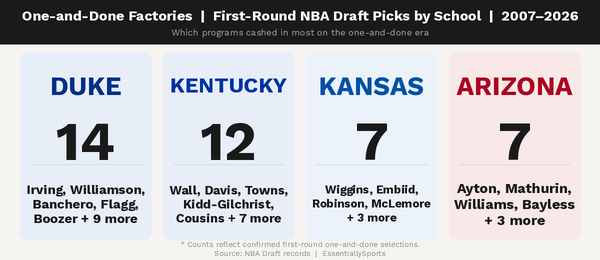
Duke (14) has sent the most one-and-done players to the first round, followed by Kentucky (12), Arizona and Kansas (7 each).
With 20 years of hindsight at our fingertips, let’s examine the correlation between one-and-dones and March hardware.
THE NUMBERS
The talent has never been the issue. Year after year, one-and-dones dominate headlines and highlight reels. However, when you zoom out, the results tell a different story—one where individual brilliance rarely translates into sustained March success.
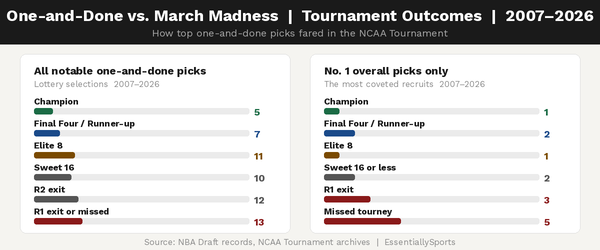
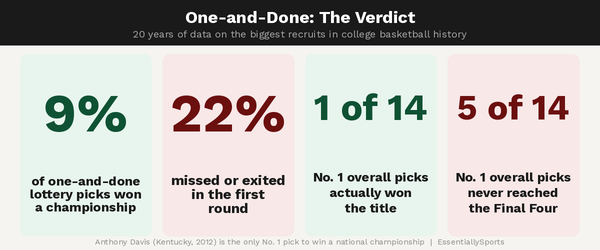
Across two decades, a pool of roughly 40 elite one-and-done prospects reveals a clear trend. Nearly 18 percent failed to reach the second round, if they made the tournament at all. Add another 27.5 percent who exited before the Sweet 16, and suddenly, nearly half never made a meaningful March run.
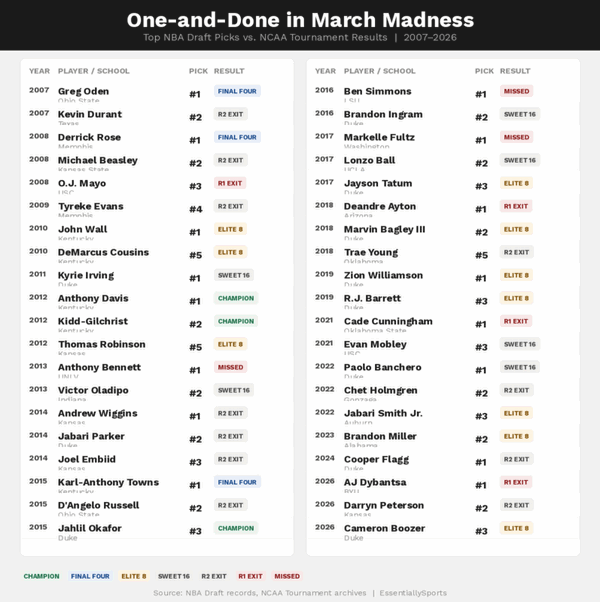
Another 27.5 percent failed to play beyond the second round, meaning nearly half of the one-and-dones of all-time never saw a Sweet 16. We’re looking at you, Rutgers, Ace Bailey and Dylan Harper.
There is one exception to the rule, and it’s one that might make you raise an eyebrow.
ANTHONY DAVIS
Since the dawn of the one-and-done era, just one of the 14 players to go No. 1 overall in the NBA Draft has won a national championship.
That’s Anthony Davis.
Davis was dominant for the title-winning 2012 Kentucky Wildcats and certainly worthy of the draft’s top slot.
But it should be noted that Davis wasn’t doing it alone. He operated within arguably the most loaded roster of the era, alongside Michael Kidd-Gilchrist (No. 2 overall pick) and multiple first- or second-rounders in Terrence Jones, Doron Lamb, and Marquis Teague.
Davis grabbed 16 rebounds and swatted six shots in the Wildcats’ 8-point win over Kansas, but he also shot just 1-for-10 from the field and scored only six points. That stat line says everything—the machine mattered more than the individual.
In fact, Kentucky tried to replicate that formula in 2015 with a loaded roster featuring five future NBA draft picks, including No. 1 overall pick Karl-Anthony Towns and lottery talents like Devin Booker and Willie Cauley-Stein. That team fell to Wisconsin in the Final Four.
Of all the one-and-dones, only three of them have won a national title, with Kidd-Gilchrist and Duke’s Jahlil Okafor (No. 3 pick, 2015) joining Davis.
REALITY CHECK
March Madness doesn’t particularly care if you’re a one-and-done or a redshirted senior.
Davis is in a very rare fraternity. Many other notable one-and-dones didn’t enjoy anything near his success.
Set your face to cringe.
Ben Simmons might be the clearest example of the disconnect. He was the consensus No. 1 pick and put up dominant numbers—19.2 points, 11.8 rebounds, and nearly five assists per game. However, none of that translated to team success, as LSU finished just 19-14 and missed March Madness entirely.
This isn’t unique to college basketball either. Even in the NFL, rookie quarterbacks taken No. 1 overall rarely lead teams to immediate Super Bowl success. Talent translates, but winning at the highest level almost always requires experience, structure, and time.
Then there’s Deandre Ayton, who looked physically unstoppable all season. Still, Arizona’s run ended abruptly in a first-round upset against No. 13 Buffalo.
And then there’s the most electric prospect of the era in Zion Williamson. The big fella had the immense talent and supporting cast surrounding him in R.J. Barrett, Cam Reddish and Tre Jones.
The New Orleans Pelicans didn’t seem to mind that Williamson and Duke lost to Michigan State in the Elite Eight and drafted him No. 1 overall.
BACKCOURT
The numbers are telling. But, as we all know, March Madness doesn’t care about seedings, your fandom and, above all, stats.
It’s impossible to discount how one-and-done players have elevated the game and the tournament. Kevin Durant and John Wall were must-see TV in March, even if Texas (2007) and Kentucky (2010), respectively, came up short in March.
The aforementioned 2015 Kentucky Wildcats reached the Final Four, while Jayson Tatum guided Duke (2017) to an Elite Eight berth, helping both programs reach their zenith in popularity and recruiting prowess. And although the program building and entertainment purposes are vital, they don’t equate to championship equity.
FULL CIRCLE
Boozer. Dybantsa. Peterson.
Dybantsa did his part with 35 points. Peterson battled health concerns all year and no one is going to accuse Boozer of phoning it in with 27 points and 8 boards in the Elite Eight.
The 2026 Final Four have built their squads without the help of a true top-3 prospect. UConn has succeeded by retaining a majority of its roster. Illinois is built around seniors and international players. Michigan loaded up via the portal and Arizona relied on a system that implemented a confluence of veterans and freshmen.
So after 20 years and 40 one-and-done players, the numbers paint a picture.
THE LANDING
The one-and-done rule has been a boon for the NBA. It’s created a talent pipeline that now has at least one year of higher experience under their belts, while also providing cornerstone players for many franchises.
The NBA has benefitted, but March Madness is a bit more nuanced and complicated.
Only one No. 1 pick has won an NCAA championship. And even then, he did it on a stacked squad that has yet to be replicated in 20 years.
The NBA gets its player, but a March Madness trophy? That appears to belong in someone else’s trophy case.
Written by

Edited by

Ved Vaze