
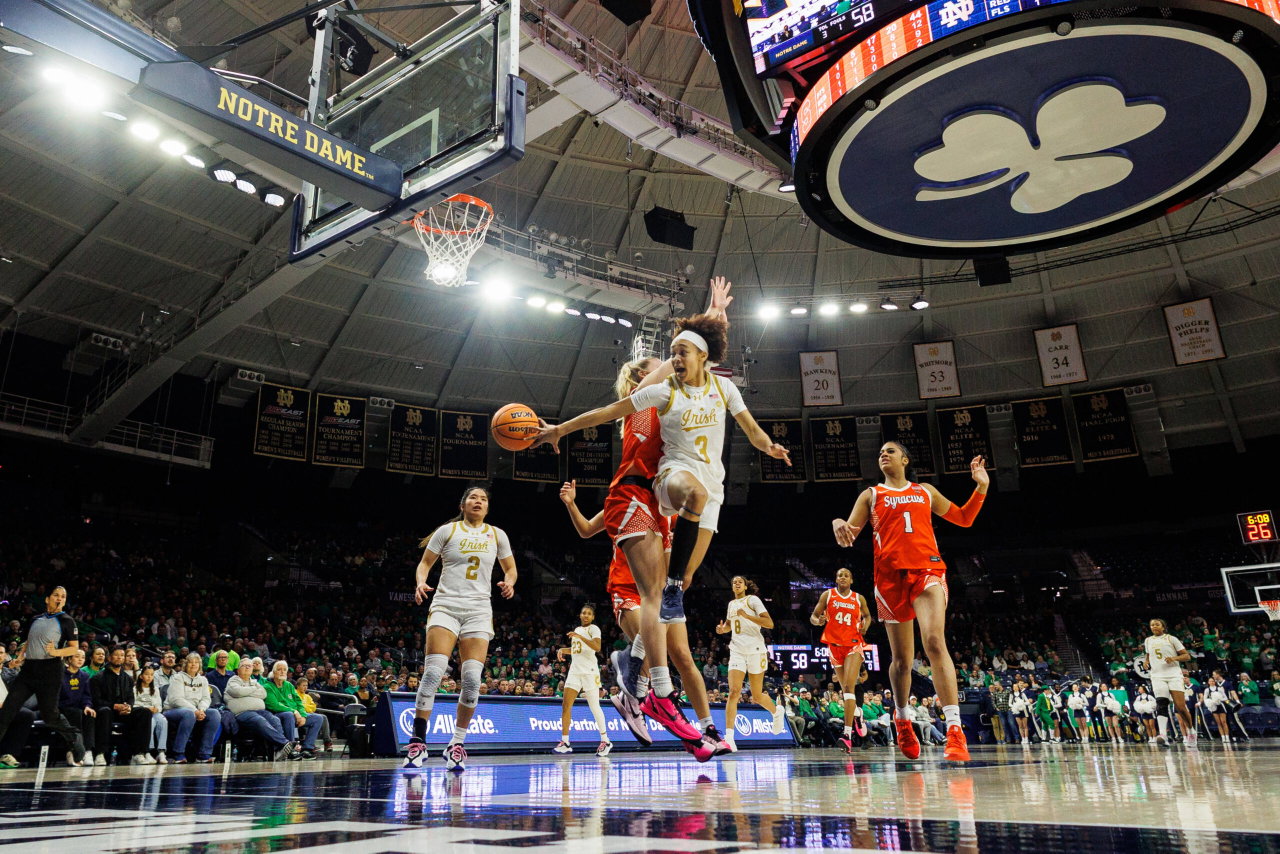
For Notre Dame freshman Jenica Lewis, every game is another opportunity to prove that a Type 1 diabetes diagnosis does not have to stand between a young athlete and their dreams. Diagnosed three years ago at the age of 14, just two days before starting her freshman year of high school, Lewis has refused to let the condition dictate how far she can go in basketball.
Watch What’s Trending Now!
And despite the daily, 24/7 challenges of managing an invisible autoimmune disease, from constant blood sugar checks and insulin pumps to unexpected highs and lows, she has continued to excel on the court. Now, she is competing at the collegiate level with the Notre Dame Fighting Irish, one of the most successful programs in women’s college basketball.
“It’s not sunshine and rainbows every day, but I’m still playing the sport I love when it could have been taken away…,” Lewis said, via South Bend Tribune’s Kyle Smedley.
Two days before starting her freshman year of high school in Johnston, Iowa, Lewis began experiencing severe headaches, extreme thirst, frequent bathroom breaks, and noticeable weight loss during summer workouts. Her father has Type 2 diabetes, so her mother, Shannon, recognized some of the warning signs. And despite Lewis initially resisting a doctor’s visit, a finger-prick test eventually confirmed that she had Type 1 diabetes.
In a room full of tears, including from her doctor, Lewis’s very first question was, “Can I still play basketball?” And with support from her family, doctors, and therapy, she gradually adapted to the 24/7 demands of monitoring her blood sugar and insulin levels. More importantly, she continued pursuing her basketball ambitions, going on to win three consecutive Iowa State championships and earn McDonald’s All-American honors.
And Lewis was not simply a role player on those championship-winning teams. She was one of the team’s biggest stars, averaging 20.5 points, 6.0 rebounds, 3.3 assists, and 2.7 steals per game during her senior season. By the time she graduated from high school, she had also established herself as one of the country’s top prospects, earning the No. 28 spot in the ESPNW SportsCenter NEXT 100 rankings.
When Lewis was being recruited, Notre Dame’s entire coaching, training, and medical staff met with her family to develop a detailed plan for managing her condition. Head coach Niele Ivey reassured Lewis’s mother, telling her, “I’m a mom, I understand.” The staff has also maintained regular check-ins with the family since Lewis arrived in South Bend. That support has undoubtedly helped her transition smoothly into college basketball with the Fighting Irish.
In the five games she has played so far, Lewis is averaging 12.0 points, 4.2 rebounds, and 4.0 assists per game off the bench. And on November 18, during Notre Dame’s Diabetes Awareness Night, she delivered a career-high 17-point performance, including five three-pointers, in the team’s 95-47 victory over Southern. Her parents were also in attendance to witness the special moment.
Certainly, if these early performances are any indication of what is to come, Lewis could eventually have her parents sitting in the WNBA stands in four or five years, cheering her on at the professional level, just like the trailblazers who have defied the odds before her.
WNBA and NBA Stars Who Have Thrived With Type 1 Diabetes
Living with Type 1 diabetes is already a significant challenge for the average person. Having to manage blood sugar levels amid the intense cardiovascular demands, physical exertion, and adrenaline spikes of professional basketball makes it even more difficult. However, despite these challenges, several players have defied the odds, made it to the professional ranks, and enjoyed successful basketball careers while managing the condition.
Lauren Cox, who was diagnosed at the age of seven, is one of the most notable examples. After winning an NCAA National Championship at Baylor University, she was selected third overall by the Indiana Fever in the 2020 WNBA Draft, becoming the first player with Type 1 diabetes in WNBA history. She went on to play across three WNBA seasons with the Fever, Los Angeles Sparks, and Connecticut Sun before continuing her professional career overseas, where she added further accolades, including WNBL Defensive Player of the Year honors in Australia.
In the NBA, Chris Dudley, who played in the league from 1987 to 2003, was the first player with Type 1 diabetes in NBA history. Diagnosed at the age of 16, Dudley defied expectations by playing 16 seasons as a defensive center for five teams, including the Portland Trail Blazers and New York Knicks. And after his playing career, he launched the Chris Dudley Foundation, which organizes basketball camps for young people living with Type 1 diabetes.
There have also been players like Adam Morrison, who played three active seasons in the NBA, earned All-Rookie Second Team honors with the Charlotte Bobcats, and won two NBA championships as a member of the Los Angeles Lakers, all while openly wearing an insulin pump on the sidelines. Gary Forbes is another example. Diagnosed at 19 during his freshman year at the University of Virginia, Forbes went on to play two seasons in the NBA with the Denver Nuggets and Toronto Raptors before embarking on a 12-year international professional basketball career.
It is now Jenica Lewis’s turn to become an inspiration to the next generation of young athletes who, like her, have to navigate the challenges of living with Type 1 diabetes while pursuing their sporting dreams. And she is already taking steps in that direction.
“I really want to be a mentor for those types of kids, to show them you can still do what you want,” Lewis said.
In March, before competing in her final high school state tournament, Lewis met eight-year-old Maren Peterson, a second-grader from Des Moines who also lives with Type 1 diabetes. And living by her personal motto, “Diabetes is part of my story, but it doesn’t define my dreams,” Lewis is actively using her platform to mentor children facing the same diagnosis.
Hopefully, she continues to thrive at Notre Dame, takes that inspiring journey to the professional level, and eventually finds herself in the WNBA, joining the trailblazers who have already shown that Type 1 diabetes does not have to stand in the way of a basketball dream.