
Imago
Dec 29, 2024; Columbia, South Carolina, USA; South Carolina Gamecocks head coach Dawn Staley directs her team against the Wofford Terriers in the first half at Colonial Life Arena. Mandatory Credit: Jeff Blake-Imagn Images
Imago
Dec 29, 2024; Columbia, South Carolina, USA; South Carolina Gamecocks head coach Dawn Staley directs her team against the Wofford Terriers in the first half at Colonial Life Arena. Mandatory Credit: Jeff Blake-Imagn Images
The Gamecocks have long ascended to the throne of college basketball royalty under Dawn Staley. Already a national champion, Olympic gold medalist, and perennial winner, the South Carolina head coach is adding yet another accolade to her resume—published author. Her memoir, Uncommon Favor, is a window into her journey from North Philly to national prominence. But Staley’s latest chapter isn’t confined to print. At a recent book event in Columbia, she pivoted from memory lane to the future of women’s basketball—and issued a demand that’s rattling the foundations of the sport’s media structure.


Staley, asked what she envisions for women’s sports going forward, didn’t hesitate. “I think we’re at our most popular state,” she told the audience on May 29. “We’re in high demand. I do feel like we need to capitalize right now.” It wasn’t just a coach speaking in abstractions. Her call came just days after returning from SEC meetings in Florida, where discussions about the future of college sports had been swirling.
Watch What’s Trending Now!
And when the crowd shouted “more money” as the next step, Staley didn’t flinch. “We should get more money from ESPN,” she said. “We’re in a television deal. When we signed the deal three or four years ago, we weren’t where we are today. Let’s go back to the table and let’s talk about where we are today. Let’s negotiate in good faith.”
The current deal—an eight-year, $920 million agreement was signed between the NCAA and ESPN in January 2024—includes rights to 40 championships, among them the Division I women’s basketball tournament. On paper, the deal marked progress: at $65 million per year, women’s basketball alone was valued about $30 million more than the entire previous package.
Dawn Staley has talked about how women’s basketball needs its own TV deal before, and she did again tonight.
At her book event, she was asked about the future of women’s sports. Her full answer: https://t.co/rsEyjaKIHt
— Lulu Kesin (@LuluKesin) May 30, 2025
It guaranteed more prime-time slots, ESPN+ coverage, and a long-overdue “units” system to reward postseason success. But media consultants John Kosner and Ed Desser, who authored a landmark 2021 valuation report for the NCAA, believe the women’s tournament was still undervalued—by a wide margin.
Their estimate pegged it between $81 million and $112 million annually. “I just felt that there was more value to be had,” Kosner told Front Office Sports. “If you create a package that only one entity can really bid for, you don’t know the value of it.”
That bid, as it stands, puts ESPN as the sole holder of the entire 40-championship bundle. Staley doesn’t just question the numbers; she questions the structure. “I want ESPN to step up to the plate,” she said. “Give us a little bit more from collegiately to the WNBA.” With women’s basketball breaking records, the timing of her demand couldn’t be sharper.
The 2024 championship game between Iowa and South Carolina drew 18.9 million viewers—four million more than the men’s title game. The women’s Final Four semifinal between Iowa and UConn drew 14.2 million. The tournament as a whole averaged 2.2 million viewers, up a staggering 121% from the previous year.
Post-Clark, Ratings Dip—but Staley Pushes for a New Era of Value in Women’s Hoops
However, one has to remember that the women’s national championship game in 2025 (the year right after Clark left for the WNBA) between UConn and South Carolina averaged 8.6 million viewers and peaked at 9.9 million, according to ESPN data. That’s a significant drop from the previous year’s record-breaking numbers. With Caitlin Clark out of the picture and traditional powerhouses like UConn and South Carolina back in the finals, nearly 10 million viewers didn’t find the matchup compelling enough to stay tuned.
Still, the interest is definitely there.
Even beyond the madness of March 2024, the needle continues to move. The 2024–25 regular season was the most-watched women’s college basketball season on ESPN platforms since 2008–09, averaging 280,000 viewers per game—up 3% from the season before and 41% over two years. South Carolina alone led the country in attendance for the 11th year, packing Colonial Life Arena with an average of 16,437 fans per game.
Imago
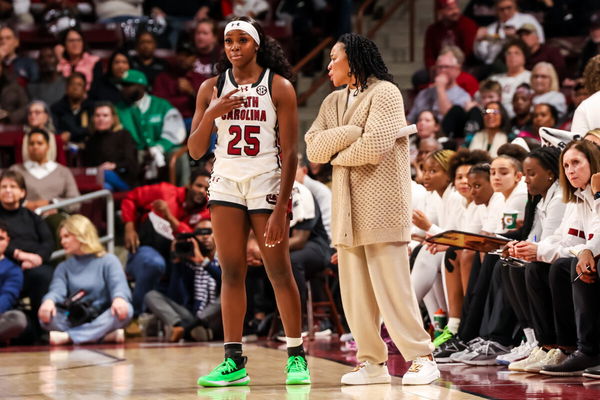
Jan 9, 2025; Columbia, South Carolina, USA; South Carolina Gamecocks head coach Dawn Staley speaks with guard Raven Johnson (25) in the first half at Colonial Life Arena. Mandatory Credit: Jeff Blake-Imagn Images
“You can’t tell me that when we have a sell-out crowd that the concession stands aren’t making money, right?” Staley told the audience. “You can’t tell me that businesses, restaurants, hotels, aren’t making money off of women’s basketball. So when you say women’s basketball isn’t a revenue-producing sport, you got to take an account for all of it.”
But that broader ecosystem—merchandise, tourism, local economies—isn’t reflected in the broadcast negotiations. And therein lies Staley’s concern. She isn’t just demanding more money—she’s demanding a redefinition of value. One that sees women’s college basketball not as a supporting act in a 40-sport bundle, but as a headliner that deserves its own stage.
Which it does to be fair.
Desser and Kosner had recommended exactly that back in 2021: split the women’s tournament into its own media package, sell it independently, and let the market determine its true worth. The NCAA didn’t follow through.
That reluctance, Kosner argues, cements second-class status. It forces fans, media, and sponsors to choose between events, often to the women’s detriment. “It locks in second-class citizenship,” he said. Under current contracts, even sponsorships for the women’s tournament require brands to first buy into the men’s.
So now, with her book freshly released and her voice louder than ever, Dawn Staley isn’t just telling her story—she’s reshaping the story of the sport itself. Her memoir may be called Uncommon Favor, but her demand is entirely common-sense. “Let’s negotiate in good faith,” she said. It’s not just a plea—it’s a pivot. And for women’s basketball, it could be the next defining move in a game that’s finally getting its due.