
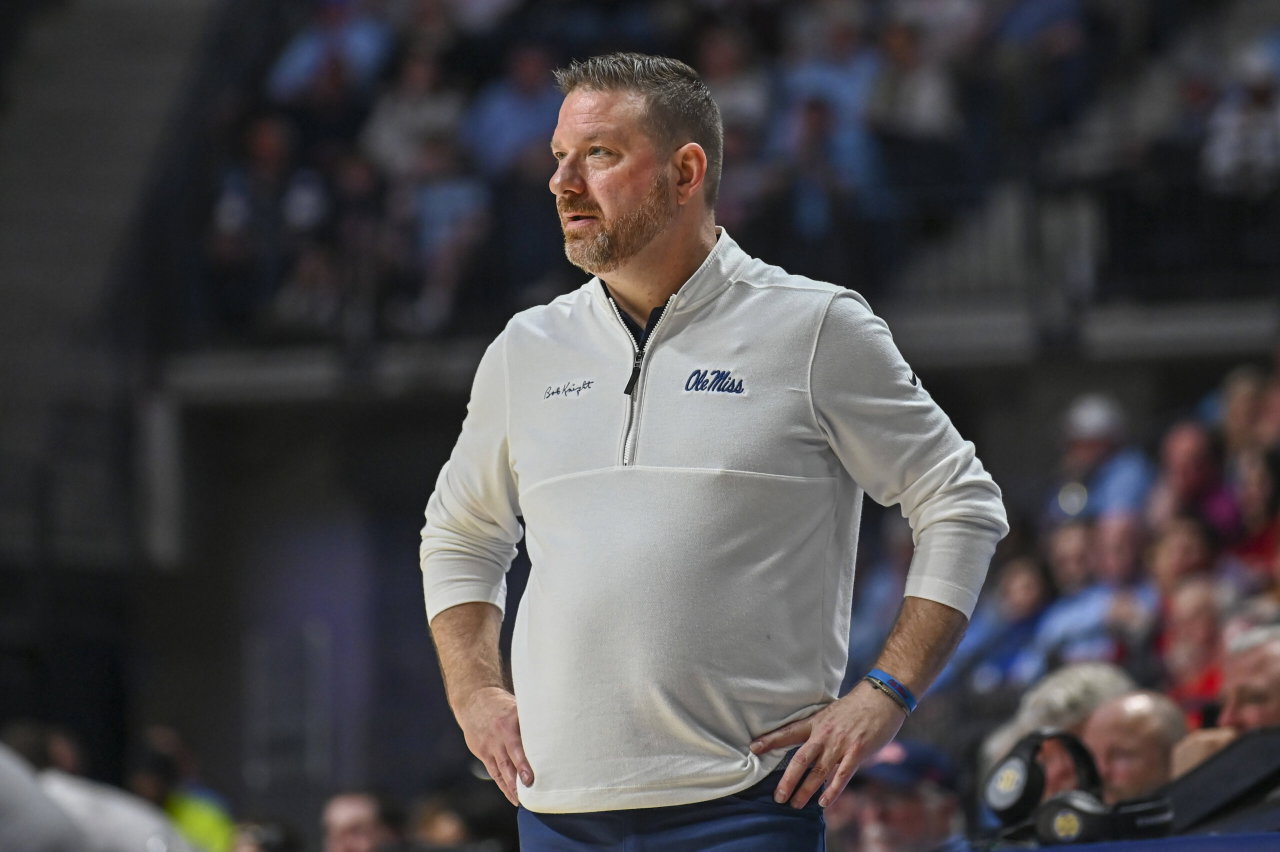
Ole Miss is facing significant consequences for tampering violations in its men’s basketball program, but head coach Chris Beard has walked away without individual punishment. The NCAA held Beard responsible for the violations, yet its findings reveal why the coach was spared while former assistant Wes Flanigan and the program faced sanctions.
Watch What’s Trending Now!
“Tampering violations occurred in the Ole Miss men’s basketball program when former men’s basketball assistant coach Wes Flanigan had impermissible recruiting conversations with the advisor of a student-athlete from another school who had not entered the Transfer Portal, according to an agreement released by a Division I Committee on Infractions panel,” a statement from the NCAA read.
“Men’s basketball head coach Chris Beard is responsible for the violations but did not receive any penalties because he demonstrated that he was not aware of the violations and that he promoted compliance.”
The case centers on former assistant coach Wes Flanigan. According to the NCAA, he communicated with an advisor to a player who was still enrolled at another school and hadn’t entered the transfer portal. Flanigan reportedly spoke to the advisor 16 times by phone and exchanged 10 text messages, all discussing the student.
The NCAA’s rules prohibit any direct or indirect communication with players at other schools before they enter the transfer portal.
Eventually, the player entered the portal but didn’t visit Ole Miss or receive a scholarship from the program and ultimately transferred to another program. The case was resolved through a negotiated agreement involving Ole Miss, Beard, Flanigan, and the NCAA’s enforcement staff.
Beard was ultimately held responsible under the NCAA’s head coach responsibility legislation, but the governing body recognized that all parties involved agreed that he was unaware of the contact between Flanigan and his advisor. As a result, he did not receive any penalties, and the sanctions were directed at Flanigan and the program.
Apart from the massive fine, Ole Miss is also under probation for two years. Several penalties, however, were imposed during the 2024-25 and 2025-26 academic years, including a one-week ban on all recruiting communications, a one-week prohibition on unofficial and official visits, and a reduction of five recruiting person-days for Ole Miss.
Flanigan had to serve penalties including a one-week prohibition on all recruiting communications, a one-year show-cause order including suspension and recruiting communication restrictions, and a two-game suspension.
Flanigan, who spent three seasons under Beard, has since left Ole Miss to join Georgia Tech as an associate head coach for Scott Cross.
Apart from this, the NCAA also found that the team failed to dissociate an unnamed booster who was involved in the program’s 2017 infractions case. At the time, Ole Miss had been told to dissociate the booster for three years, which meant that the school couldn’t accept “any financial assistance from the booster or his business interests, including those that could result in the booster receiving benefits or privileges not afforded to the general public.”
However, according to the NCAA, the booster contributed to the school’s athletic foundation 18 times, totaling $109,240. The report claimed they didn’t determine that the condition was knowingly broken, but agreed that the school “did not monitor its athletics department as a result of the violations.”
According to the NCAA, the booster must be dissociated for 2 years, and the athletics director and one senior member of the Ole Miss Athletic Foundation were required to attend the 2026 NCAA Regional Rules Seminar.
Regardless, the $455,000 fine and two years of probation will continue to hang over Ole Miss as part of the NCAA’s approved sanctions. While Beard may not face individual punishment, the final report distinguishes his responsibility as head coach from the violations committed by his assistants.