
Imago
Credit: IMAGO
Imago
Credit: IMAGO
When John Calipari walked away from Kentucky after 15 seasons, it sent shockwaves across college basketball as the blue-blood program and the coach who helped define it parted ways. At that time, it raised more questions than answers about what really went wrong.


But two years later, those answers are starting to show up.
Watch What’s Trending Now!
With the Arkansas Razorbacks charging into the Sweet 16 and the Kentucky Wildcats already out of the 2025–26 NCAA Tournament, coach Calipari’s decision doesn’t feel sudden anymore.
Why Did John Calipari Leave the Kentucky Wildcats After 15 Years?
Before we get into the ‘why’, let’s make one thing clear: Coach Calipari didn’t get pushed out of Kentucky; he walked away. However, that decision had been in the works for years.
On the surface, it made little sense for the fans and for obvious reasons:
- He was leading one of the most powerful programs in college basketball.
- Had a lifetime deal worth $86 million.
- And remained one of the sport’s biggest names.
Yet by the end, the gap between expectation and reality had grown impossible to ignore for the coach and the program.
Imago
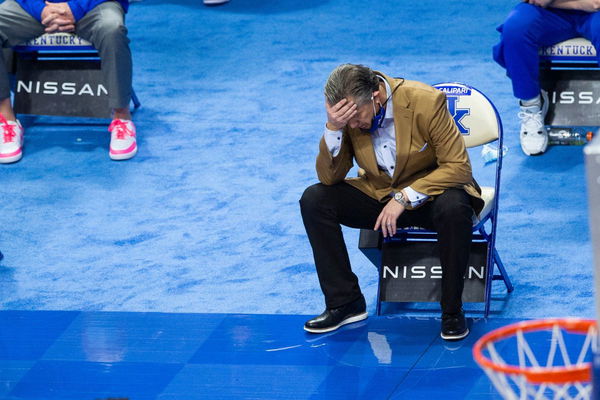
Feb 6, 2021; Lexington, Kentucky, USA; Kentucky Wildcats head coach John Calipari reacts after guard Brandon Boston Jr. (not pictured) misses a dunk during the second half against the Tennessee Volunteers at Rupp Arena at Central Bank Center. Mandatory Credit: Arden Barnes-Imagn Images
Kentucky hadn’t reached a Final Four since 2015. And if that wasn’t enough, they had just one NCAA Tournament win since 2019 under Calipari. So, for a program where March defines everything, that stretch wasn’t just disappointing; it was damaging the image they built for years.
But it was behind the scenes where things were even more fractured.
John Calipari’s relationship with athletic director Mitch Barnhart reportedly turned cold, with disagreements over resources, facilities, and, most importantly, the evolving NIL landscape. According to a report by The Athletic, the two sides were essentially in a “cold war,” with Calipari’s camp pushing for more support and the administration’s desire to see better results before committing further.
That tension collided with a rapidly changing sport.
The rise of NIL deals and the transfer portal reshaped how teams were built. And because of that, veteran-heavy rosters started winning championships, while Calipari’s long-trusted model of stacking elite freshmen began to lose its edge. Even he acknowledged the shift, pushing back against what he called a “transactional” system.
“I want to help 25 to 30 more families,” the coach said as per CBS Sports. “The only way you do that is you’re transformational as a coach. You’re not transactional. If I become transactional -I’m going to pay you this to do this and that – then I won’t do this anymore. I don’t need to.”
In Kentucky, adapting to that new reality wasn’t just difficult for John Calipari; it was complicated by internal misalignment.
However, what was surprising is at Arkansas, it was the opposite.
With billionaire boosters like Jerry Jones and John H. Tyson, plus support tied to Tyson Foods and the Walton family, Arkansas brought something Kentucky couldn’t guarantee at that stage: aggressive NIL investment and a unified vision.
The Razorbacks offered an NIL pool that could reach $5–6 million annually, which changed everything for the coach.
So Calipari just chose a situation that made more sense for where college basketball and his career were heading.
Did Kentucky make a mistake parting ways with John Calipari?
To understand if Kentucky made a mistake or not, you have to start with what that program was and what it has become.
While under Calipari, the Wildcats weren’t always perfect, the program still operated at a high level historically. He guided Kentucky to its eighth national championship, multiple Final Four runs, and consistently sent NBA-level talent to the league.
But then came the reset.
When Mark Pope took over Kentucky, the hire itself raised many eyebrows. Why? Because even though he is a former Kentucky national champion, he wasn’t the headline name many expected.
Still in his first year, coach Pope led the Wildcats to a 21–10 regular season and a Sweet 16 appearance (the program’s first in six years) to briefly calm concerns about the transition. But the 2025-26 season has flipped the narrative.
Despite assembling one of the most expensive rosters in college basketball history, which is worth around $22 million, the Wildcats failed to meet expectations. They finished the season with inconsistent form while struggling defensively.
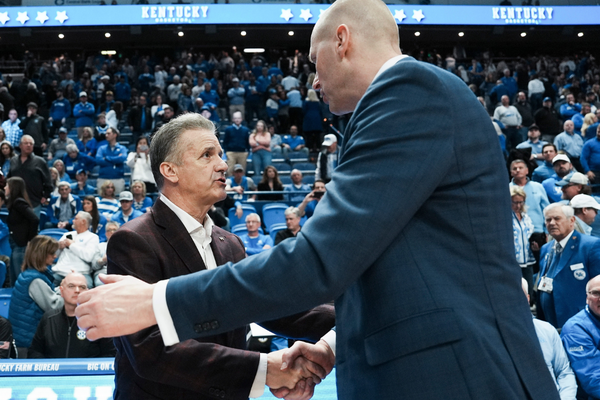
The Wildcats ended the year with 22-14 after barely escaping the Round of 64 in the NCAA tournament, only to collapse in the next round in a lopsided loss to Iowa State. For a roster built with that level of investment, it wasn’t just disappointing; it raised serious questions.
USA Today via Reuters
Credits : USA Today Network via Imagn
Even Matt Jones, a prominent Kentucky voice and investor, openly questioned the roster construction.
“It is clear that Mark Pope excels with a team that can shoot threes, and he brought in a bunch of guys who couldn’t shoot. That was the problem,” he said on The Field of 68: After Dark, pointing to a fundamental flaw in the coach’s approach. “I think he went too far in the other direction. And then he got guys who could defend… and they couldn’t shoot.”
Throughout the season, frustration grew louder among the fans as the Big Blue Nation openly called for changes.
However, Pope, for his part, pushed back on the narrative.
“We just have had some misfortune. With that said, this is what’s going to shock you. If you take the four years (of John Calipari’s tenure) before we got here and compare them to the two years since we’ve been here, we actually have a higher winning percentage in the last two than we did in the four preceding, barely, but a higher winning percentage,” he said. “I’m not talking about meeting the standard of where we’re trying to get. Clearly, we did not do that, but we’re making progress.”
But at Kentucky, progress isn’t the standard; winning is. And while Pope points to growth, Calipari’s results at Arkansas are starting to tell a very different story.
Arkansas’ rise under coach Calipari
In just two seasons with the Razorbacks, Calipari has already reshaped the program’s trajectory.
His first year with the program wasn’t smooth, as Arkansas stumbled to a 0–5 start in SEC play and battled injuries throughout the season. But he turned that adversity into momentum quickly, when the Razorbacks closed their season strong by powering their way to the Sweet 16 with statement wins over top programs.
However, in his second season, Arkansas surged to a 28–8 record and captured the SEC Tournament title to secure a No. 4 seed in the NCAA Tournament. More importantly, while Pope struggled to blend older portal transfers, Calipari went back to his roots and proved he can still win with elite freshmen by blending players like Darius Acuff Jr. and Meleek Thomas into a system.
And that’s where the question gets complicated.
Kentucky didn’t just move on from a coach; they moved on from a system, an identity, and a proven winner. While the reset may have been necessary at the time, the early returns suggest one thing: Calipari didn’t lose his touch, he just needed a different stage.
How Did Kentucky Wildcats Fans React to John Calipari’s Exit?
If there’s one thing that never changes about Kentucky basketball, it’s the intensity of the Big Blue Nation, and Calipari’s exit brought every bit of that emotion to the surface.
The immediate reaction during his exit was split between frustration and gratitude.
On one hand, many fans felt the program had reached a breaking point after years of disappointing March exits. So social media was filled with calls for a reset, with some believing “it is a good outcome for everyone,” pointing to the need for a fresh start for both Calipari and the program.
But despite the rough ending, many fans acknowledged that John Calipari restored Kentucky to national dominance and delivered one of the most successful eras in program history. For some, he even became the person who helped them “fall in love with Kentucky Basketball.”
Written by

Edited by

Snigdhaa Jaiswal