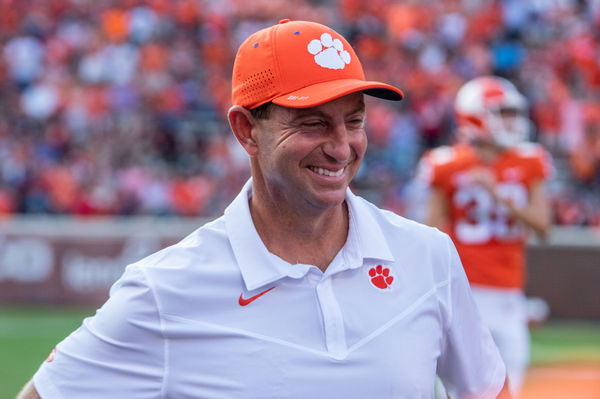
Dabo Swinney’s plea to fight against the “broken system” has finally gotten the backing he was looking for. After losing elite linebacker Luke Ferrelli to Ole Miss because of a tampering controversy, Swinney urged for a tighter system. Yet the Big Ten conference and the Clemson head coach weren’t on the same page and opposed the idea strongly. But Swinney isn’t alone in the fight.


The Clemson HC’s frustration stems from Ole Miss allegedly flashing a $1 million contract to Ferrelli just days after the linebacker enrolled in his program. For Dabo Swinney, this blatant disregard for boundaries isn’t just poaching; it exposes a completely unregulated market where signed contracts appear to hold no value with the NCAA’s immediate enforcement.
Watch What’s Trending Now!
While the Big Ten pushes to pause tampering investigations, the Big 12 and ACC are advocating for continued enforcement and penalties for rule-breakers, according to reports. The SEC has not officially made a decision yet. However, SEC commissioner Greg Sankey said earlier that the NCAA should keep going after schools that break tampering rules.
Big 12 commissioner Brett Yormark has clearly drawn a hard line. He has declared that he’s “adamantly opposed” to the conference’s request to pause all current investigations. ACC Commissioner Jim Phillips echoed a similar sentiment, who believes maintaining active enforcement remains “critically important” to protect the integrity of the sport while regulations are under debate.
It all started on March 11, when the Big Ten Conference sent a letter to NCAA president Charles Baker. In a March 11 letter to the NCAA, the Big Ten requested a pause on all tampering punishments, arguing that the current bylaw prohibiting contact with enrolled players is “unworkable” in the modern college sports landscape.
Well, the Big Ten’s pushback makes sense, as the reason their teams have been winning championship games since 2023 is because of their heavy investment in NIL and the transfer portal. Ohio State invested $20 million in its roster back in 2024. The result? Championship win. Even Indiana invested heavily in its roster and won last year’s championship game.
Recently, the NCAA decided to take tampering more seriously. Leaders from the Division I Board of Directors told the NCAA to start focusing again on enforcing the rules about tampering. They also sent a message to colleges warning them that teams caught tampering could face “significant penalties.”
These punishments can be serious. Coaches could be suspended from games, teams could lose scholarships that they give to players, and schools could even have wins taken away if they used a player who was involved in tampering. Even NCAA spokesperson Meghan Durham-Wright doubled down on it.
“The NCAA is committed to enforcing the rules as agreed to by NCAA member schools and will always work with members to ensure fair competition and to protect student-athlete well-being in this new era of college sports,” Durham Wright said.
Other coaches have also faced the same issues as Dabo Swinney. Duke lost its quarterback, Darian Mensah, who transferred to Miami after signing a $4 million deal with the team. The program also filed a case against him, claiming Miami already knew the amount they were offering him, as Mensah posted the transfer message hours after his deal, but even then, he made his move. That’s the kind of broken system Swinney was talking about.
“We have a broken system, and if there are no consequences for tampering, then we have no rules, and we have no governance,” Swinney said.
To see why Dabo Swinney calls it a “broken system,” let’s start with how tampering works currently behind the scenes.
How tampering works in the modern college football era
In college football today, tampering usually means coaches or staff talking to players before they enter the transfer portal, which is against the rules. This contact can happen through texts, social media messages, or other people, like high school coaches, trainers, or family members. Agents have made this much more common because they often talk to schools for players and connect them with teams that might want them.
There is also something people call “pre-portaling.” This means schools and agents start discussing deals before the player officially enters the transfer portal. Because the portal is only open for two weeks, everyone tries to move fast and set things up early. Sometimes agents even make three-way phone calls with the coach and the player to talk about possible contracts while the agent appears as the main contact.
But most people in college football agree there is a clear line that should not be crossed. If a coach contacts a player after the player has already enrolled and signed with another school, that is considered a serious rule violation. In this situation, people said that if Ole Miss coach Pete Golding really contacted Luke Ferrelli after he arrived at Clemson, it would be a major case of tampering. So, let’s wait and see if the NCAA is able to actually fix this concern or not.
Related Newsletters