Getty
NASHVILLE, TENNESSEE – OCTOBER 29: Head Coach Arthur Smith of the Atlanta Falcons looks on before the game against the Tennessee Titans at Nissan Stadium on October 29, 2023 in Nashville, Tennessee. (Photo by Justin Ford/Getty Images)
Getty
NASHVILLE, TENNESSEE – OCTOBER 29: Head Coach Arthur Smith of the Atlanta Falcons looks on before the game against the Tennessee Titans at Nissan Stadium on October 29, 2023 in Nashville, Tennessee. (Photo by Justin Ford/Getty Images)
The reaction came faster than Ohio State expected. Within hours, recruits from different classes, regions, and position groups were responding in near lockstep, even before the full implications of the move were clear. That response followed Ohio State’s January 24 decision to hire former NFL head coach Arthur Smith as its new offensive coordinator.
Watch What’s Trending Now!
However, this was not a normal coordinator hire, and recruits recognized that instantly. Smith arrives in Columbus with one of the most NFL-heavy resumes of any coordinator in college football. He spent the bulk of his coaching career in the league, including stints with Washington, Tennessee, Atlanta, and Pittsburgh. Most recently, Smith served as the Pittsburgh Steelers’ offensive coordinator after a three-year run as head coach of the Atlanta Falcons.
Unlike most college hires, Smith brings almost no traditional collegiate coaching background. His only prior college stop came in 2010 as a defensive intern at Ole Miss. That detail stood out to fans. Recruits, however, focused on something else entirely.
What do Ohio State commits and top targets think about the hire of Arthur Smith? ⭕️@LettermenRow spoke with several of them about the move including a five-star offensive lineman 👀
MORE: https://t.co/L94iEcyNqy pic.twitter.com/93LTItDGDR
— Mick Walker (@mickdwalker) January 25, 2026
When Lettermen Row spoke to Ohio State commits and top offensive targets following the hire, a clear pattern emerged. The reactions came from different positions, regions, and recruiting timelines. Yet the message was the same.
The praise was widespread. Four-star quarterback Brady Edmunds and offensive lineman Brody McNeel both pointed to Smith’s NFL background as a natural fit for Ohio State, while running back targets Asa Barnes and Wayne Shanks Jr. framed the hire as a boost to the program’s professional pipeline.
Tight end Grant Haviland focused on Smith’s offensive identity, noting excitement about how tight ends are featured in his schemes. Even five-star offensive lineman Maxwell Hiller, despite admitting unfamiliarity with Smith’s resume, described the hire in positive terms. Meanwhile, in-state offensive lineman Davis Seaman labeled it a “smart move.”
Despite different phrasing, every recruit’s reaction landed on the same point without exception: Smith’s NFL background was the draw. Not a single commit or target expressed hesitation, skepticism, or concern in the immediate aftermath of the hire.
Instead, the responses clustered around trust in development and preparation. That uniformity matters, especially when no recruit expressed hesitation or concern following the hire.
Timing amplified the reaction. Smith’s hiring came just days after the NCAA’s winter transfer portal window closed, removing immediate roster instability from the equation. With spring ball still weeks away, Ohio State now has a clean runway to install a new offensive identity without competing distractions.
That window matters because the Buckeyes entered the offseason with clear offensive pressure points. Quarterback development needed stabilization. Tight end usage had drawn internal and external questions. Red-zone efficiency lagged behind the talent level on the roster.
Smith’s history directly intersects with each of those areas, making the hire feel less theoretical and more corrective. As a result, recruits are not reacting to an abstract resume. They are reacting to a perceived solution.
Why Ryan Day Keeps Turning to NFL Coaches
At the same time, the move fits a clear trend under Ryan Day. Over the last several seasons, Day has increasingly leaned on coaches with NFL head coaching and coordinating experience. The goal has been to delegate responsibilities and build a more mature, professional coaching structure.
Arthur Smith becomes the latest example of that philosophy. With veteran coordinators running both sides of the ball, Day has steadily transitioned into a CEO-style role. He is no longer the focal point of play design or unit-level management. Instead, he oversees a professionalized operation built around specialists who have already done the job at the highest level.
For recruits, that matters more than play-call tendencies because it signals seriousness. Smith’s offensive reputation is often reduced to “run-heavy,” but his actual identity is more layered. His offenses rely heavily on play-action, zone concepts, and personnel versatility. Tight ends are not accessories. They are central pieces. Running backs are used to dictate defensive structure rather than simply accumulate carries.
Imago
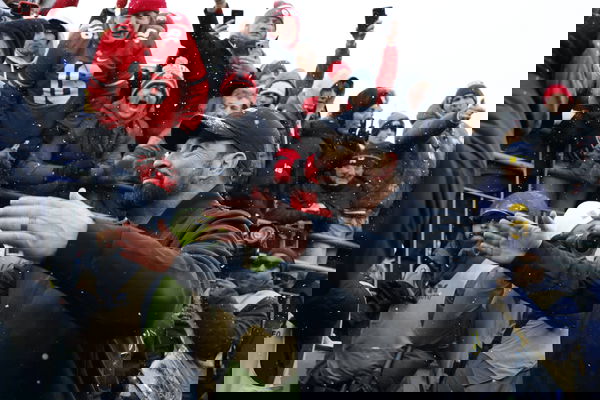
NCAA, College League, USA Football: Ohio State at Michigan Nov 29, 2025 Ann Arbor, Michigan, USA Ohio State Buckeyes head coach Ryan Day celebrates after the game against the Michigan Wolverines at Michigan Stadium. Ann Arbor Michigan Stadium Michigan USA, EDITORIAL USE ONLY PUBLICATIONxINxGERxSUIxAUTxONLY Copyright: xRickxOsentoskix 20251129_szo_aa1_0073
At Ohio State, that philosophy enters a talent environment far deeper than anything Smith coached at the NFL level, one that includes elite receivers, high-level quarterback prospects, and a tight end room ready for expansion. For recruits watching from the outside, the projection is obvious. If Smith could maximize efficiency with limited NFL rosters, the ceiling rises significantly in a college setting with consistent talent advantages.
In modern recruiting, optics often matter as much as schemes. NFL pedigree carries immediate credibility. That effect has already shown up in Ohio State’s 2027 class, which sits among the nation’s best with a strong offensive lean. The positions most closely tied to Arthur Smith’s resume are also the ones responding most positively. Offensive linemen see technical development. Tight ends see featured roles. Running backs see structure and volume.
The hire reinforces Ohio State’s pitch as a program built to prepare players for Sundays, not just Saturdays. The next phase is installation. Spring practices will provide the first on-field look at how Smith’s system integrates with Ohio State’s existing personnel. Early attention will center on tight end usage, red-zone efficiency, and quarterback command.
Public evaluation will follow quickly through spring showcases, media availability, and eventual fall camp adjustments. If the transition is smooth, the narrative strengthens. If it stumbles, questions will surface just as quickly. For now, however, the reaction is unified.
Ohio State did not hire Arthur Smith to win a press conference. It hired him to professionalize its offense. The evaluation now shifts to spring practice, where tight end usage, red-zone efficiency, and quarterback command will determine whether this confidence holds. If it works, Ryan Day’s NFL-heavy model gains momentum. If it stalls, the pressure returns immediately to the architect of the hire.
Related Newsletters