The guest list for President Donald Trump’s upcoming “Saving College Sports Roundtable” is loaded. Yet, one of the loudest voices in the sport won’t be sitting at the table. Paul Finebaum isn’t convinced the room will accomplish much anyway. It’s going to be a room of roughly 45 people sitting around a table for maybe an hour or two with a host who likes to command the room.
Watch What’s Trending Now!
Paul Finebaum made it clear that the problem isn’t just Washington. In fact, he thinks the real divide starts inside college sports itself. During an appearance on the Another Dooley Noted Podcast with Pat Dooley, he exposed the weakness.
“It’s not just Congress,” he said. “The fissures are bigger than they’ve ever been. It’s not just Congress,” he said. “I mean, how many times have you heard the commissioner or the president of the NCAA? Right now, you have several different divisions within the college sports rank. And the newest one is this private equity formula that a lot of people are interested in that will mean a lot more money. And they had a meeting in Dallas this week, including presidents at various schools in the Big Ten and one from the SEC. And they can’t even get along.
“They can’t even find any happy ground. So if the people within the bubble can’t get along, then how do you expect the most contentious body in this country to come to an agreement?”
By that body, of course, he means the United States Congress. College athletics has spent the last five years lobbying Congress for help. Leaders from the NCAA, conference commissioners, and university presidents have all pushed for federal legislation that would standardize NIL rules. But those efforts haven’t gone anywhere.
Imago
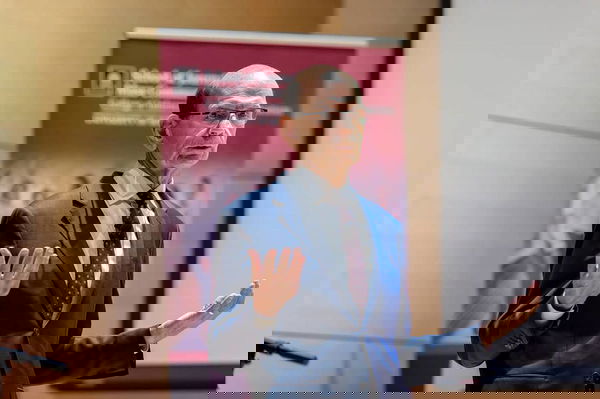
April 25, 2025: SEC Network and ESPN Radio Host Paul Finebaum speaks at the University of South Carolina on April 23, 2025, in Columbia, South Carolina. The program was part of the Buchheit Family Lecture Series through The University of South Carolina College of Information and Communications. – ZUMAm67_ 20250425_zaf_m67_032 Copyright: xTracyxGlantzx
Take the SCORE Act, for instance. The bill was supposed to regulate NIL deals while giving the NCAA limited antitrust protection. That bill stalled in the House last year after bipartisan resistance and has yet to regain traction. That failure alone exposes the bigger issue that the sport can’t even agree internally on what it wants. Now the White House is stepping into the middle of that mess.
According to reports from On3, Donald Trump’s college sports roundtable remains scheduled despite concerns earlier in the week that it might be canceled due to shifting White House priorities. The President will chair the session, with Ron DeSantis and Randy Levine serving as vice chairs. It features a high-profile guest list that includes Nick Saban, Urban Meyer, Tiger Woods, and Adam Silver. Power conference commissioners like Tony Petitti, Greg Sankey, Brett Yormark, and Jim Phillips are also expected to attend.
The agenda reportedly includes NIL regulations, transfer portal rules, and revenue sharing. The meeting is supposed to tackle the chaos surrounding NIL money, the transfer portal, and the broader power struggle reshaping college athletics. But Paul Finebaum isn’t convinced a room full of big names automatically leads to solutions.
Paul Finebaum drops a warning on CFB’s future
“Can anything get done,” Paul Finebaum said on the McElroy and Cubelic in the Morning show. “Or will it be a circus? Will it be just another show?”
That’s the question hanging over Friday’s gathering at the White House. From meetings to hearings, college football has had plenty of those, but what it needs is a unified solution. And unless something changes soon, Paul Finebaum thinks the situation could reach a breaking point.
“We don’t need any more shows in college football,” he said. “We need action… If something doesn’t happen very quickly,” he said. “And I mean in the next short period of time, and we’re talking about weeks, not years, then this thing could blow up.”
And if Friday’s roundtable turns into another talking session without real change, Paul Finebaum believes the sport could be heading toward a breaking point.
Related Newsletters