Imago
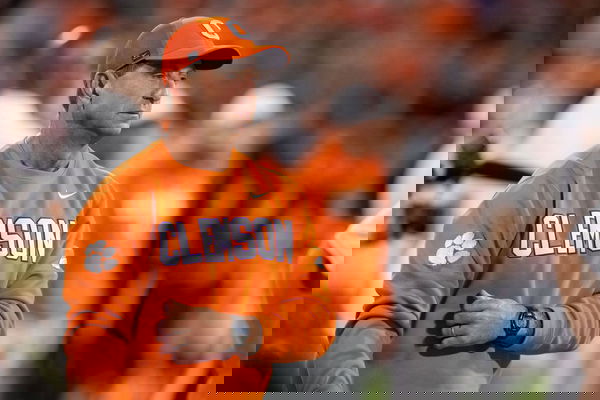
NCAA, College League, USA Football 2025: Florida State At Clemson Nov 08 November 8, 2025: Clemson Tigers head coach Dabo Swinney watches his team during warm ups before the NCAA Football matchup against the Florida State Seminoles at Memorial Stadium in Clemson, SC. Scott Kinser/CSM Credit Image: Â Scott Kinser/Cal Media Clemson Sc United States EDITORIAL USE ONLY Copyright: xx ZUMA-20251108_zma_c04_160.jpg ScottxKinserx csmphotothree440152
Imago
NCAA, College League, USA Football 2025: Florida State At Clemson Nov 08 November 8, 2025: Clemson Tigers head coach Dabo Swinney watches his team during warm ups before the NCAA Football matchup against the Florida State Seminoles at Memorial Stadium in Clemson, SC. Scott Kinser/CSM Credit Image: Â Scott Kinser/Cal Media Clemson Sc United States EDITORIAL USE ONLY Copyright: xx ZUMA-20251108_zma_c04_160.jpg ScottxKinserx csmphotothree440152
NIL and revenue sharing have made revenue generation all the more important. And Rutgers has finally decided to take some concrete steps to address that $78 million deficit eating away at the athletic department. The Big Ten program is reshaping its entire business structure with a model that looks almost identical to the Clemson Tigers’ setup under Dabo Swinney. College sports reporter Jon Blau from The Post and Courier put it plainly on X on Tuesday.
Watch What’s Trending Now!
“Rutgers is basically copying Clemson and its Clemson Ventures model, tasking Oliver Luck (Andrew’s dad), who was chairman of Clemson’s multimedia rights arm CAPCO (which became Ventures),” the X post read.
That detail is worth sitting with for a moment. Oliver Luck was the architect of Clemson’s framework that Rutgers is now replicating. When Clemson launched Clemson Ventures in August 2024, Luck was serving as chairman of CAPCO. CAPCO is the multimedia rights entity that Ventures absorbed and expanded.
At the time, he called it “the smartest, most strategic, ambitious move” any athletic department could make. He publicly praised the decision to centralize licensing, ticketing, sponsorship, and media operations under one roof. Now, less than 18 months later, Rutgers has pulled Luck from that Clemson orbit and handed him the same assignment in Piscataway. The man who helped build the blueprint is now being paid to run the copy. Ben Portnoy of Sports Business Journal confirmed the specifics.
Rutgers is basically copying Clemson and its Clemson Ventures model, tasking Oliver Luck (Andrew’s dad), who was chairman of Clemson’s multimedia rights arm CAPCO (which became Ventures). https://t.co/XK9fyXO7Ho
— Jon Blau (@Jon_Blau) March 3, 2026
“Rutgers is set to unveil Scarlet Knights Enterprises, Inc., a new third-party, commercial arm centered on revenue generation, AD Keli Zinn tells @SBJ,” Portnoy wrote. “Longtime sports exec Oliver Luck is slated to be the organization’s first board chair.”


The entity itself, Scarlet Knights Enterprises, Inc., will function as a fully independent nonprofit, separate from the university’s operating structure. It will have a board composed of four external members and three with direct ties to Rutgers. Rutgers AD Keli Zinn will also hold a seat on the board, keeping the athletic department directly connected to the new commercial arm. A CEO is still to be hired through an internal search, with no outside firm involved.
The key functions are expansive. It will oversee multimedia rights and naming rights across digital, broadcast, and physical platforms. It will drive corporate sponsorships, serving as a full-service media agency for athlete branding through original content and storytelling. It will also develop new premium offerings and fan engagement initiatives.
Luck brought that same framing from his Clemson experience to his vision for what Rutgers is building.
“It’s more in line with what these departments are becoming — which is professional sports teams,” he said. “It’s absolutely the right move to look at professional teams. How are they structured? Let’s figure out how we can mimic that given that you still have these big entities, the universities.”
Moreover, it’s not just Luck who brings his Clemson experience on the table. Keli Zinn has also been at the center of Rutgers’ NIL overhaul since she was appointed director of athletics in August 2025. Luck and Zinn go way back. They’ve been working together since Luck was at West Virginia.
Rutgers, with its high deficit, could use any hope that the initiatives like these provide because its financial situation in football, and overall, the athletic department, is dire.
The $78 million problem behind Scarlet Knights Enterprises
The urgency behind Scarlet Knights Enterprises makes a lot more sense when you look at the numbers Keli Zinn inherited the moment she walked through the door in Piscataway. Rutgers’ latest athletics financial report shows a deficit that topped $70 million for the third time in five years during the 2024-25 academic year. The total spending hit a record $193.8 million against $146.6 million in operating revenues.
The gap landed at a record $78 million. It brings Rutgers’ cumulative athletics deficit to $516.9 million since joining the Big Ten in 2014-15. This number sits in the background of every business decision the department makes.
“You could make the argument that we do not have an expense problem. But we do in fact have a revenue problem and a pretty significant one,” Zinn said.
What made the situation more pressing was a category that didn’t just stagnate but actually declined. The royalties, licensing, advertisement, and sponsorship sales fell by nearly $6 million in the most recent fiscal year. This is the area that Scarlet Knights Enterprises is now designed to fix.
“I think what you’ll see a year from now is that’s going to be our worst year looking at a profit and loss scenario,” she said. “But you’ll see some level of improvement that’s expected in that ’26-’27 year and then by ’27-’28, based upon the current projections we have, I’m hopeful you’ll actually see the deficit start to decline.”
The creation of Scarlet Knights Enterprises is Rutgers’ most direct answer yet to that timeline. It is a structural fix designed to generate the revenue that eleven years of Big Ten membership have not.
Related Newsletters