
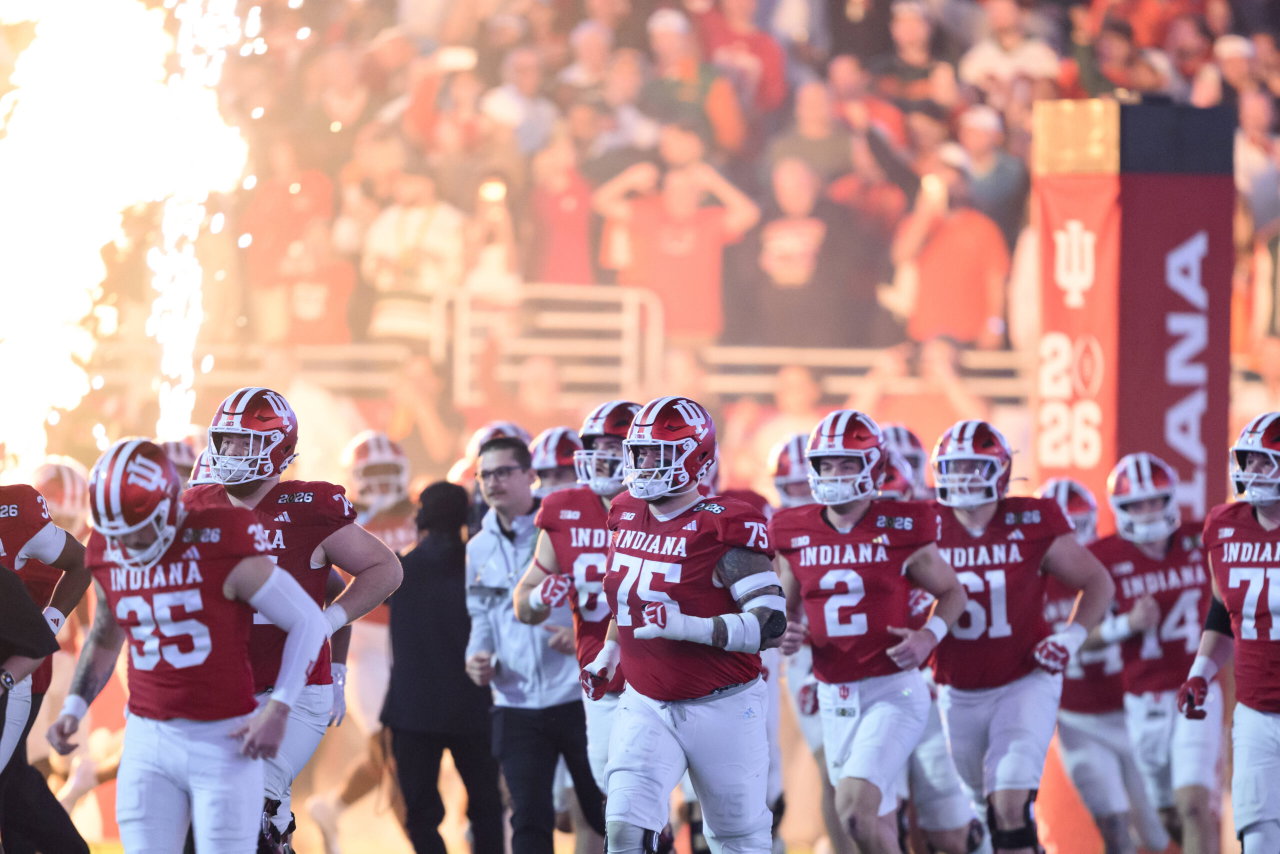
The celebration at Lucas Oil Stadium was still going when Daniel Ndukwe heard that something had gone wrong. Indiana had just beaten Ohio State 13-10 to win the Big Ten championship, and Ndukwe was celebrating with his teammates when strength coach Derek Owings pulled him aside, saying, “Man, Stephen just hurt his knee.” Stephen Daley, who had spent the night helping Indiana hold the Buckeyes to 10 points, had injured his knee while reaching over the front row to high-five fans. He would leave the stadium on a cart as confetti continued to fall around him. It was a particularly cruel ending to a season that had already changed for Daley once.
Watch What’s Trending Now!
Kellan Wyatt, Indiana’s starting edge rusher, had gone down with a knee injury against Michigan State in October after his leg was extended awkwardly while he was engaged with an offensive tackle. Wyatt had 27 tackles, eight tackles for loss and 2.5 sacks through seven games. Daley stepped into the vacancy and turned into one of the Hoosiers’ biggest defensive threats, finishing the regular season and Big Ten Championship with 19 tackles for loss and 5.5 sacks. Then, just as Indiana was heading into the College Football Playoff, Daley was the one watching his own season disappear.
Nearly nine months later, the two defensive linemen have another chance to finish what those injuries interrupted. Monroe County Circuit Judge Kara E. Krothe granted Daley, Wyatt and 95 other athletes a preliminary injunction Wednesday, allowing them to compete during the 2026-27 season while their legal challenge to the NCAA’s eligibility restrictions continues. But along with that, she also questioned the timing of the NCAA’s rule change.
She noted that discussions surrounding the new eligibility model had begun publicly in September 2024, while the legislation was not approved until this summer. Krothe also pointed to an October 2025 NCAA memo that told athletes the five-for-five model would not be adopted “anytime soon” and that eligibility rules would not change during the 2025-26 or 2026-27 academic years. The judge found that the plaintiffs relied on those representations when making decisions about their futures.
“It appears that the exclusion of the Class of 2022 was not based on a principled position to benefit student athletes, but to protect NCAA institutions from having to raise additional funds to pay players and … because ‘it would create a lot of administrative burdens,’” the judge wrote.
“Under the plain terms of the 2026-27 NCAA Manual, they are eligible to compete, and the NCAA is breaching its contractual obligations by denying them that opportunity.”
Krothe’s order also said the NCAA and its conferences could not prevent the plaintiffs from competing in Division I during the 2026-27 season simply because they had already played four seasons or had not entered the transfer portal. The ruling applies to 97 athletes across multiple sports, and the NCAA is expected to appeal.
Along with Daley and Wyatt, the ruling will restore eligibility to several notable players across college athletics, including Tamin Lipsey, Tre White, Malik Reneau, Andrew Rohde, and Santa Clara standout Elijah Mahi.
Stephen Daley and Kellan Wyatt Set to Give Hoosiers’ Defense a Major Boost
The timing is particularly significant for Indiana. Daley and Wyatt had already returned to the Hoosiers in August after the eligibility dispute threatened to end their college careers. A ruling from the U.S. Court of Appeals for the 10th Circuit on Aug. 21, however, put the broader path that had allowed Class of 2022 athletes to seek a fifth season on hold. Indiana’s players then received a temporary restraining order that allowed them to play the first two games of 2026.
Daley appeared in both of those games and has six tackles, including a tackle for loss. Wyatt also made his 2026 debut against Howard, but did not record a statistic. When the temporary restraining order expired on Sept. 14, both were forced to sit out Indiana’s 38-0 win over Western Kentucky while waiting for Krothe’s decision.
That created an unusually narrow window for the ruling. Indiana opens Big Ten play against Northwestern on Friday, meaning the injunction arrived just two days before the Hoosiers’ conference opener.
Krothe emphasized that timing in her 37-page opinion. She wrote that college seasons are “time-limited opportunities” and that once an athlete loses the opportunity to compete, it cannot simply be restored later even if that athlete eventually wins the underlying case. She also noted that the plaintiffs had secured roster spots but would not receive scholarship aid or NIL payments unless their eligibility was continued by court order.
For Indiana, the ruling brings back two players who were already expected to be part of the defensive rotation before the eligibility fight complicated their season. Cignetti had supported their attempts to secure another year throughout the dispute.
“We’d have to make no roster cuts if they’re eligible to play,” Cignetti said.
That matters because Indiana has not been waiting around for its defense to find its footing. The Hoosiers are 3-0, have allowed only 16 points through three games and are averaging just 203.3 yards allowed per game. They also shut out Howard and Western Kentucky in consecutive weeks, the program’s first back-to-back shutouts since 1993.
Cignetti had already acknowledged in August that bringing the two veterans back would change the options available to defensive coordinator Bryant Haines. Wyatt can play both defensive end and linebacker in Indiana’s three-man front, giving the Hoosiers another layer of versatility rather than simply another body on the line.
Before injuries derailed their seasons last year, Wyatt and Daley emerged as major defensive weapons for the Hoosiers. Wyatt started seven games on the edge, recording 27 total tackles, 8.0 tackles for loss, and 2.5 sacks. Meanwhile, Daley became a full-time starter, finishing with 38 tackles, 19.0 tackles for loss, 5.5 sacks, and two forced fumbles.
Those numbers came after Wyatt’s injury had already changed Daley’s role. Indiana’s official records credit Daley with 38 tackles, 19 tackles for loss, 5.5 sacks and two forced fumbles across 13 games in 2025. He also earned second-team All-America recognition from CBS Sports and On3. Wyatt, meanwhile, had started seven games before his Week 8 injury and finished with 27 tackles, eight tackles for loss and 2.5 sacks.
Neither player got to finish that championship season on the field. Wyatt missed the final nine games after his knee injury against Michigan State, while Daley missed Indiana’s three College Football Playoff games after injuring his knee during the celebration following the Big Ten Championship. Indiana ultimately went 16-0 and won the national championship without either player on the field for its postseason run.
Now the two veterans have a path back to the field because Krothe’s preliminary injunction prevents the NCAA and its conferences from enforcing the disputed restrictions against the plaintiffs while the case proceeds.
For Daley and Wyatt, that could mean a return against Northwestern on Friday night. For the larger group of 97 athletes, it is another step in a legal fight over who gets to benefit from college sports’ new five-for-five era.