
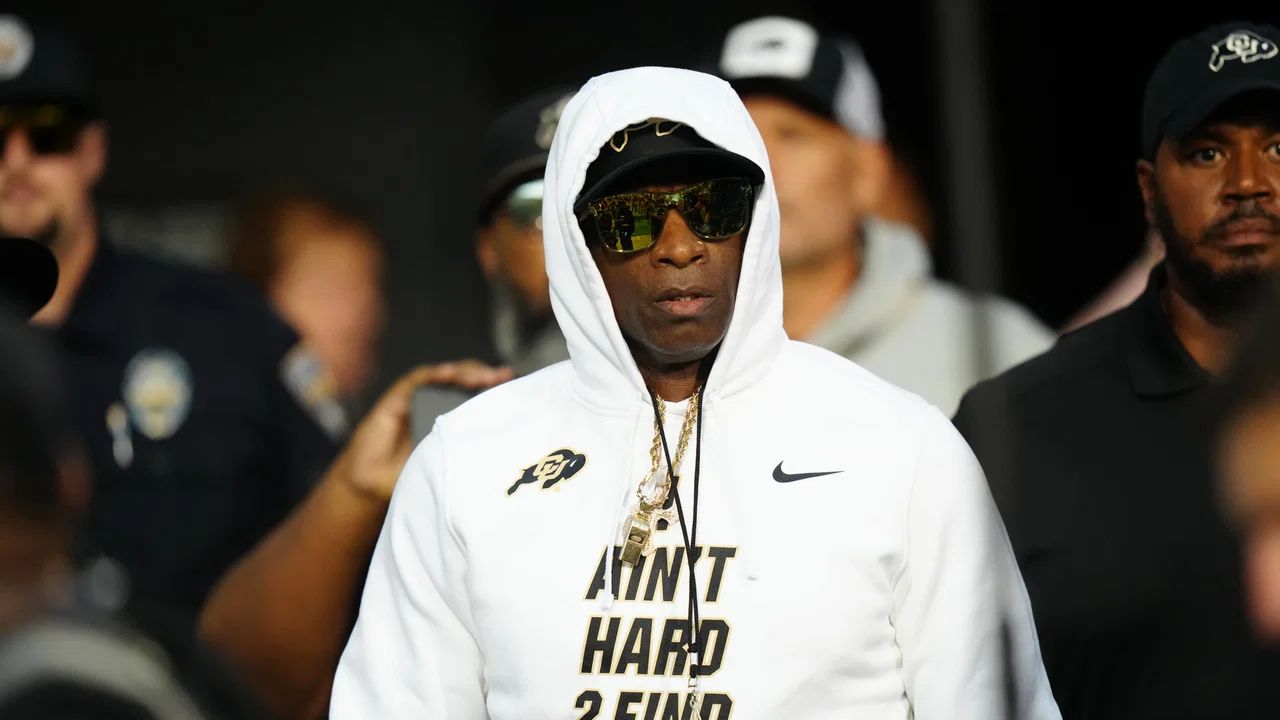
Travis Hunter went from looking almost unplayable at Colorado to looking strangely ordinary in Jacksonville. Under Deion Sanders, he was dominating games at receiver and cornerback, finishing his Heisman season with 1,258 receiving yards, 15 touchdowns and four interceptions. Now, the NFL version barely resembles that player, with his workload slashed and his two-way impact almost completely muted. For a No. 2 overall pick built on being different, that drop-off is impossible to ignore.
Watch What’s Trending Now!
And now, Deion Sanders has stepped into the conversation.
“I don’t ask questions because I’m not there,” Deion Sanders said during his interview with Romi Bean. “I don’t know what transpires when we’re not looking. I have no idea what’s going on. I know who he was and who he is right now. I know what he’s capable. Yeah. I do know that.”
Colorado did not treat Hunter like a luxury piece. They built around the fact that he could stay on the field, absorb a ridiculous workload and change games without needing a special package drawn up for him. Deion even managed his week around that reality, including giving him Tuesdays off so he could survive the volume. That is exactly why Jacksonville’s current handling of Hunter has become such a talking point.
While Sanders kept his response measured, Hunter’s painfully slow start gave longtime media nemesis Jason Whitlock the perfect opening to come after the former Colorado coach again, arguing that Sanders deserves some of the blame for how Hunter’s NFL situation has unfolded.
“Say it with me. Travis Hunter is a bust. He’s a good kid. Deion sold him as a 2-way player and making history…. instead of selling him as ‘go be a shutdown corner’ and maybe play a handful of offensive snaps,” Whitlock wrote.
It is a harsh assessment, but it points directly at the tension surrounding Hunter now.
That version of him has not carried over to Jacksonville.
Through the first two games of the 2026 season, Hunter is averaging just 38.5 total snaps per game, down sharply from roughly 70 per game as a rookie before a torn LCL ended his season after seven appearances.
The biggest change has come on offense. Jacksonville gave Hunter a legitimate receiving role in 2025, when he caught 28 passes for 298 yards and a touchdown while playing 67% of the team’s offensive snaps. This year, that involvement has almost vanished. Through two games, he has played just 10 offensive snaps, roughly 9% of Jacksonville’s total, including only six against Denver, where he was not targeted once. Through those two games, Hunter has just one catch for eight yards.
His defensive usage has also been inconsistent. Jacksonville has rotated Hunter with Jarrian Jones and Montaric Brown, keeping him around 58% to 60% of the defensive snaps. Against Denver, he logged 37 defensive snaps instead of staying on the field as an every-down corner.
That would be easier to understand if Hunter were getting consistently beaten, but that has not really been the case. Through two games, he has allowed four catches for 36 yards on five targets. Still, there have been costly mistakes, most notably a 22-yard defensive pass interference penalty against Denver that helped set up the Broncos’ go-ahead touchdown in the fourth quarter.
Jacksonville’s caution appears tied to the knee injury that ended Hunter’s rookie season, and there is an obvious reason to protect a player coming back from a torn LCL. But that is also where the criticism begins.
Hunter was not drafted No. 2 overall to fit neatly into one traditional role. His appeal was always tied to how many different ways he could affect a game. Right now, Jacksonville is getting only flashes of that instead of the full version it drafted.
Sanders has stayed out of the Jaguars’ decision-making and has not publicly challenged how they are handling Hunter. But the larger question is becoming harder to ignore: is this simply a temporary step in his return from injury, or is Jacksonville already redefining what Hunter is supposed to be in the NFL?