
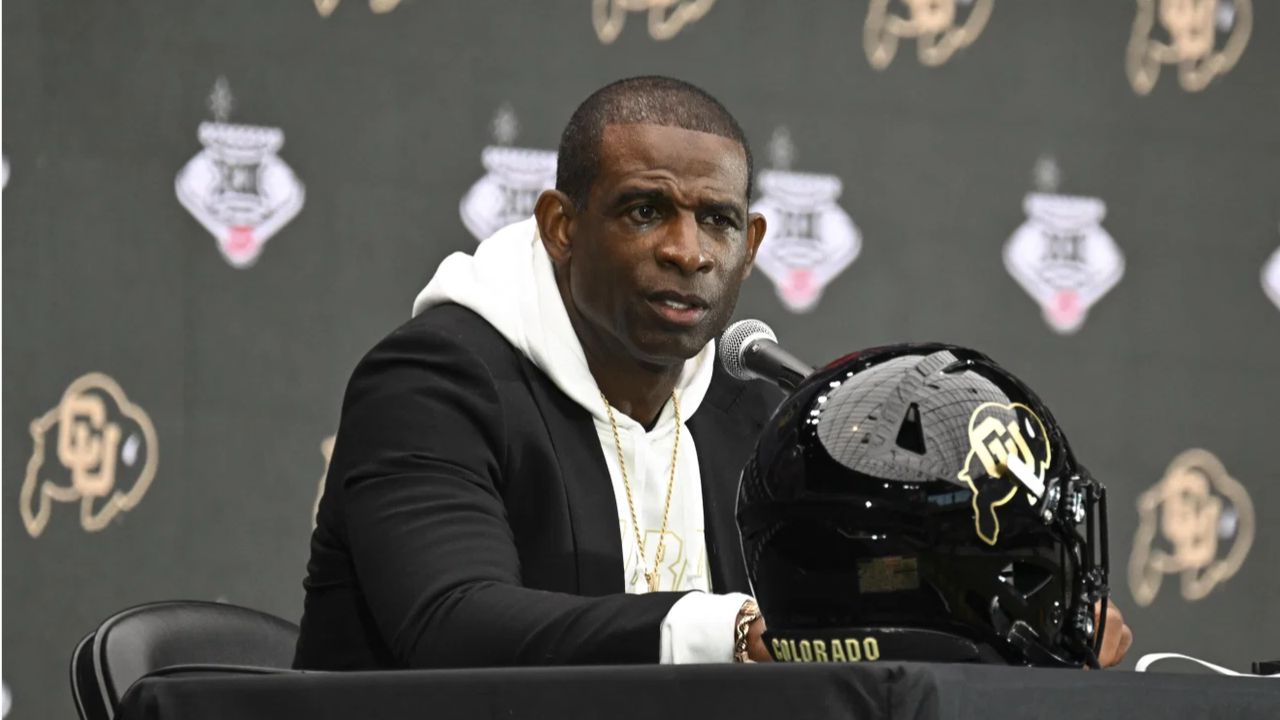
Deion Sanders can still walk into a recruit’s house and command attention. Cowboys legend Michael Irvin knows that better than most. The Pro Football Hall of Famer has known Sanders for years. He has watched the former Florida State star take that celebrity into college coaching at Jackson State and Colorado. But now, he has massive reservations about the Sanders name guiding Colorado out of its current rut.
Watch What’s Trending Now!
“I’m his true friend. I truly love him,” Irvin said on September 22 on the Dan Patrick Show. “But the reality of it is, and he’s talked about this, is this business now is not just a recruiting business. It’s a money business.
“You need money to recruit. I don’t care how good your mouthpiece is; you can sing all kinds of songs, you’re still going to need dollars to holler. Cuz when you walk into those young men’s homes, their parents are looking for that dollar.”
There is some hard evidence behind the broader problem. Colorado’s estimated 2026 roster budget was recently placed well below the spending levels of several major programs.
The Athletic’s estimates put Texas Tech between $38 million and $42 million. Alabama is in that same range, and Georgia is estimated at $31 million to $34 million. Colorado’s 2026 roster budget is just between $18 million and $20 million.
Colorado is also dealing with the added costs of the new revenue-sharing system. The school projected that it would reach the $20.5 million revenue-sharing cap in fiscal 2026. At the same time, the athletic department is expecting a $27 million deficit.
This is about more than getting a five-star recruit to visit Boulder. Colorado also needs the money to keep good players once they get there, replace the ones who leave, and keep up with schools that can spend more on their rosters.
On top of it, Sanders relies heavily on the transfer portal; the rebuilding job gets tougher every year. Colorado went 3-9 in 2025, including only one Big 12 victory. Sanders responded by going back into the transfer portal.
So, veterans like former Texas receiver DeAndre Moore Jr. and former Tennessee defensive back Boo Carter came to Boulder. The Buffs added 43 players in all, including several experienced offensive linemen and defensive linemen. That much roster turnover costs a lot of money.
“The young man wants to be coached by Deion Sanders. I want to get that opportunity,” Michael Irvin said. “But mom is saying, ‘I want to see people older than Deion. Like Ben Franklin’s and George Washington in this house.”
Colorado still has some familiar names and NIL deals. Four Buffaloes players, for example, signed a Taco Bell NIL deal before the 2026 season. But a few individual deals are not the same as having enough money to build and keep a deep roster.
Sanders himself has acknowledged how much money has entered the sport. Earlier this year, he compared the new NIL environment to “pay-per-view.” Colorado does have one positive sign.
The Buff Club raised a record $37.7 million in 2025-26, a big jump from the year before. The next step is turning that support into steady football funding instead of asking donors to step up every time a recruiting battle comes around.
That is where Sanders needs to change his approach. He probably cannot win many bidding wars against the richest SEC and Big Ten programs. Trying to do that player by player would burn through the available money quickly.
Colorado needs to be smarter about where it spends its money. Some players will be worth paying to keep, while other spots can be filled through development or cheaper transfers. The Buffs have already shown they can find talent outside the usual Power Four programs, much like Indiana did during its national title run.
Colorado’s 2026 roster already has several transfers who came from Group of Five schools. Finding more of those players would allow Sanders to spend the bigger portion of the budget on the players who can actually change the roster.
Retention should be another priority. If Colorado spends heavily to bring in a player, loses him after one season like Jordan Seaton, and starts the process again, the program never gets much return from that investment.
Sanders originally laid out a roster plan built around 40% undergraduate transfers and 20% high school recruits. That made sense when he had to overhaul a 1-11 team in his first season.
But building a roster that way is harder to sustain if the goal is to compete for a championship. For now, Sanders has responded with a disciplinary approach after he dismissed several CU athletes following his Northwestern loss.