
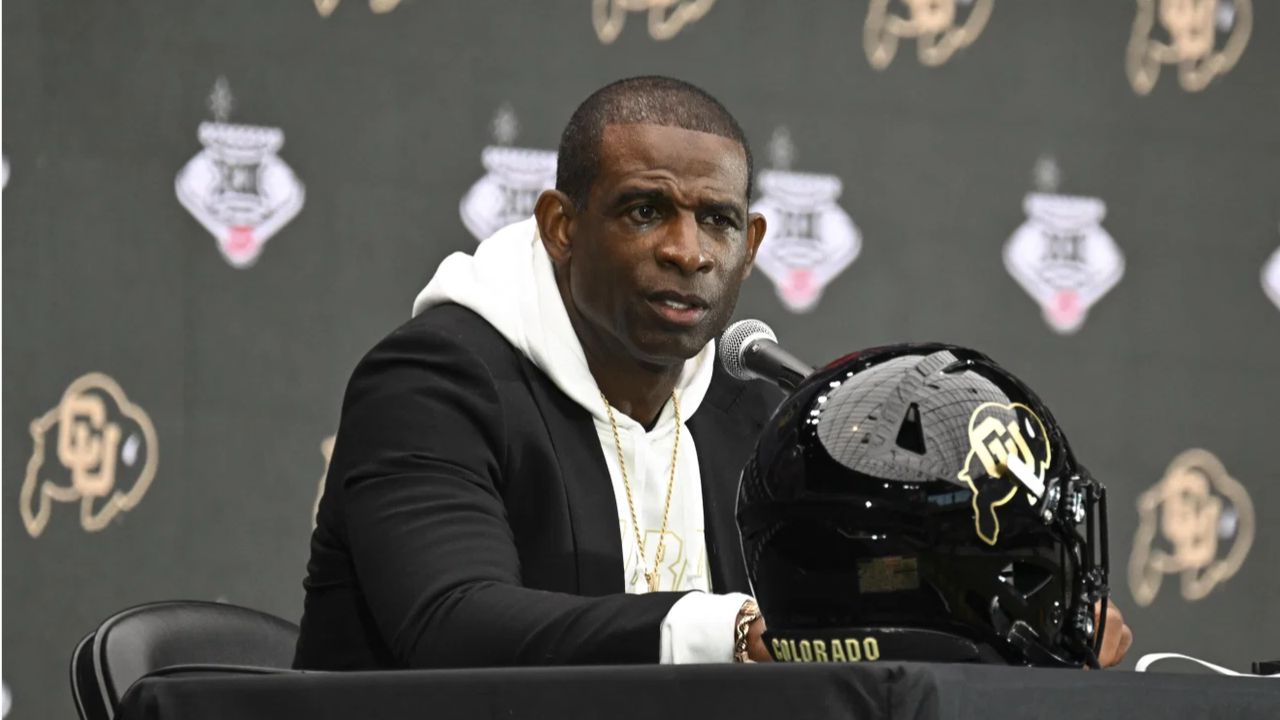
At the start of the 2026 season, Nick Saban delivered a traditionalist plea to Congress. Sitting in his home office, he argued that college sports tradition is worth defending. Now he has one more supporter who is joining the cause. Colorado head coach Deion Sanders also believes Congress needs to step in to stop the legal chaos.
Watch What’s Trending Now!
“The biggest crowds. The brightest lights. Now that’s prime-time,” said Sanders, donned in Buffs gear and his signature sunglasses, according to a Front Office Sports report on September 12. “And as a coach and father, I’m helping the next generation find their spotlight. That’s why I support the Protect College Sports Act.”
Sanders’ ad leans into ensuring that future generations have the platform to succeed while protecting vulnerable institutions. Coach Prime argues that the bill is a must right now. In his eyes, it is the only way to give an athlete a chance to shine on and off the field. Not to forget, it will protect women’s and Olympic sports and strengthen historically Black colleges and universities.
The initiative is part of an ad campaign valued at up to $10 million. Deion Sanders and Nick Saban are the lead faces of the national ad campaign urging Congress to pass the bill immediately. Texas Tech booster Cody Campbell is funding it. Notably, neither Sanders nor Saban was financially compensated for appearing in the commercials. They are doing them for free.
“College sports are built on tradition,” said Saban in an ad shown during Week 1 games, sitting in what appeared to be a home office, “The pride in our schools. The rivalries we pass down. And the way they develop the character of tomorrow’s leaders. That tradition is worth defending.”
Saban has complained that colleges are no longer running educational programs. The former Alabama head coach has testified before Congress that the current environment is too reactive. He wants to protect the sport from becoming a purely professional, rule-free league, advocating for a federal framework that allows leagues to enforce fair regulations.
On his part, Saban has always focused on the holistic development of his players. During the offseason and summer months, he brought in high-profile CEOs and financial advisors for his squad. These used to be mandatory sessions, so they had some backup to fall back on if they suffered a major injury.
At the same time, he has been criticized for advocating a system that benefited him and his ties to Alabama. And just when the sports moved towards NIL and the portal, Saban retired from the game.
But beyond an individual’s apparent hypocrisy, there is another issue with the entire campaign to advocate for the Protect College Sports Act. It doesn’t feature a key stakeholder in college sports: the players.
Everything advocated in the new legislation will directly impact the lives of student-athletes. In that context, their voices must be included in this discussion. College GameDay didn’t do it when the show had a long discussion on the legislation in Week 1.
Even before that, the testimony before the Senate committee and the White House meeting didn’t include any student-athletes.
Why is the Protect College Sports Act important?
Ever since college athletes won the right to make money from NIL in 2021, the rules have lost their essence, as argued by the advocated of PCSA. Different states passed different laws to give their local universities a recruiting advantage. This created an uneven playing field in which coaches and schools literally don’t know which rules apply from one state line to the next.
The NCAA, in its golden age, enforced strict rules on caps and transfers. However, over the last few years, courts have systematically ruled against the governing body in massive antitrust lawsuits. The organization is now legally powerless to stop absolute free agency, tampering, and unrestricted booster bidding wars.
This bill is widely considered the last stand for traditional college athletics. Senators Ted Cruz and Maria Cantwell introduced it. The legislation aims to replace the current “Wild West” environment of college sports with a single rulebook.
If passed, Congress will grant the NCAA and athletic conferences limited antitrust immunity. This means they can finally write firm rules on spending caps, agent fees, and transfer limits without being dragged back into court and sued immediately.