
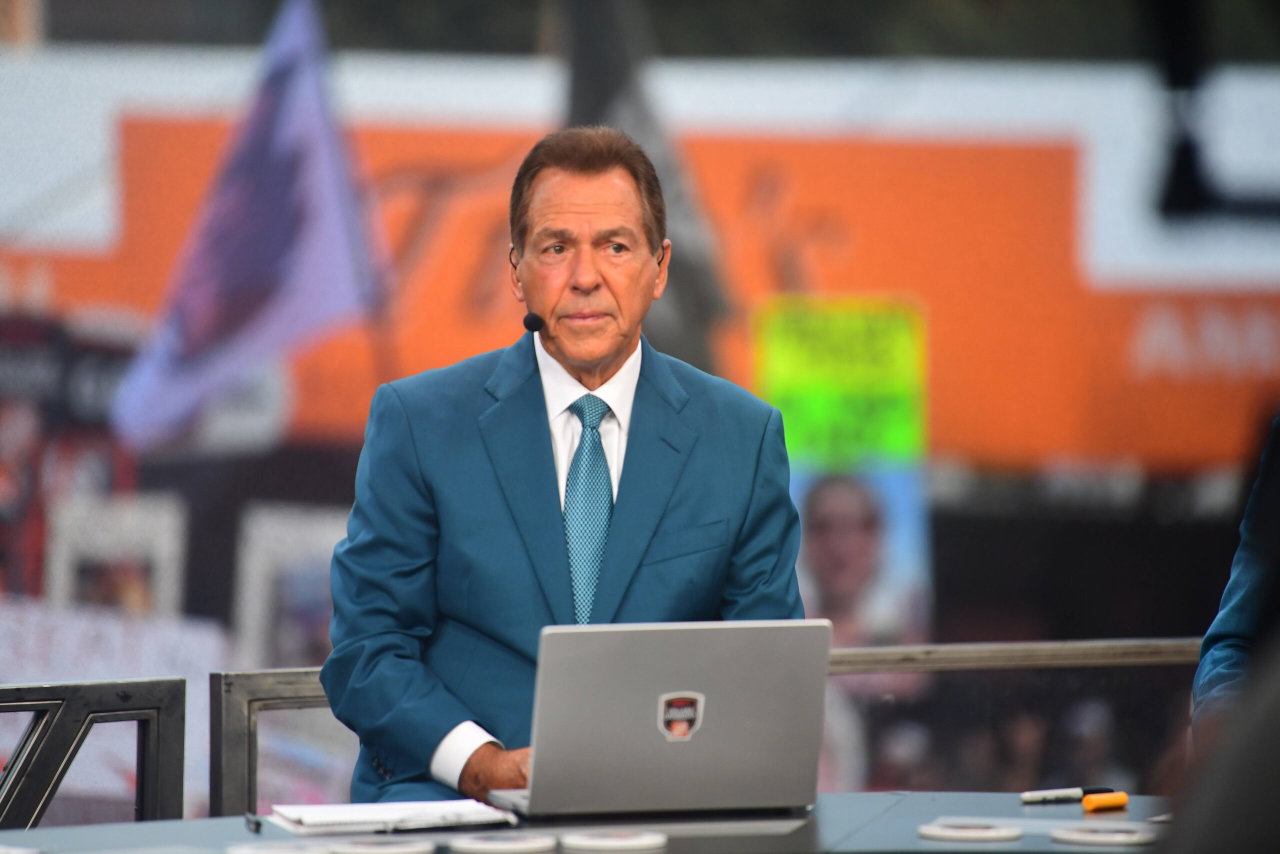
Nick Saban won seven national titles and 292 college games, building a resume nobody in football can match. Still, Paul Finebaum recently shared an unexpected twist about Saban’s early years in Tuscaloosa. As Saban became a powerhouse at Alabama, bad investments and a tempting Big 12 offer nearly changed his legacy.
Watch What’s Trending Now!
Speaking on the Dynastic Podcast, with Chuck Todd and J. A. Adande, Finebaum said that Saban was still carrying losses from bad energy investments in Louisiana when the Crimson Tide came calling. Saban had moved from Toledo to the Browns to Michigan State to LSU to the Dolphins before he got to Tuscaloosa.
“Saban got in trouble in Louisiana,” Finebaum said, according to an Instagram Reel post by DynasticPod. “You don’t see this reported very often. He got involved in some oil and gas deals that went bust. He didn’t have money. And when you’re the Alabama coach, and you start winning quickly, you start finding deals. Today, he owns a couple of Mercedes dealerships, which aren’t easy to get.”
During the early 2000s, private oil and gas drilling partnerships were common pitches for wealthy buyers in Louisiana. While successful wells paid big, volatile energy prices and dry holes often wiped out investors completely. High-profile coaches frequently trusted local boosters with these deals, leaving Saban in a financial hole right before he left Baton Rouge.
“He kept getting offers, but I think he realized, I’m in Alabama. I think his heart was still a little bit at LSU. He almost went to Texas in 2013 when Mack Brown departed, but he told me afterwards that he would have probably taken the job, but he did not want to have to answer to 15 different oil tycoon billionaires. He hadn’t made it to Alabama. He didn’t have to answer to anyone.”
Texas was still a powerhouse in the Big 12 back in 2013, and although they were experiencing an on-field slump, it was one of the few jobs capable of luring Saban away from Alabama. At the time, Saban was looking for financial security and support to keep his program on top, making the Longhorns’ massive budget a serious threat to Tuscaloosa.
However, Texas was notorious for powerful boosters meddling in football decisions, forcing coaches to manage competing agendas from wealthy donors. At Alabama, former athletic director Mal Moore had established a culture giving Saban complete control over the football program without interference, a setup successor Bill Battle maintained. Giving up that total authority to answer to a room full of Texas oil tycoons was a dealbreaker.
Former Texas regent Tom Hicks wrote in an email that Saban’s agent, Jimmy Sexton, signaled in a January 2013 call that Saban would consider Austin. Finebaum has said Texas was prepared to offer $100M, but Saban has denied it. In November 2013, Saban denied that anyone had approached him about the Texas job. He reiterated in 2022 that he had never spoken with anyone at the school and had no interest in the position.
Saban was making $700,000 at Michigan State when LSU called. LSU gave him a five-year deal worth $1.2M a year, nearly double his earnings from Michigan State. The Dolphins paid about $5M a year. Alabama’s first offer was eight years and $32M, with only $3.5M in 2007, which was a pay cut from Miami. By 2023, he had made more than $108M at Alabama.
Money was a factor in Saban’s departure from Michigan State, but he has maintained that it was not the reason behind his decision. “It wasn’t about the money, but it was about, if I tell somebody I’m gonna do something, I do it. And they didn’t do it,” Saban said in the ESPN docuseries “Saban.” He mentioned Michigan State had promised him a contract and then came up $100,000 short.
Saban’s financial success has extended well beyond his coaching salary since arriving at Alabama. Celebrity Net Worth puts his fortune at $200M, while Forbes has reported his dealerships are nearing $2B in annual revenue.
At 75, Saban works as a College GameDay analyst and still earns $500,000 annually as an Alabama advisor. His rise from reported financial losses in Louisiana to a multimillion-dollar fortune has made him one of college football’s wealthiest figures, with his financial success continuing long after his retirement.