
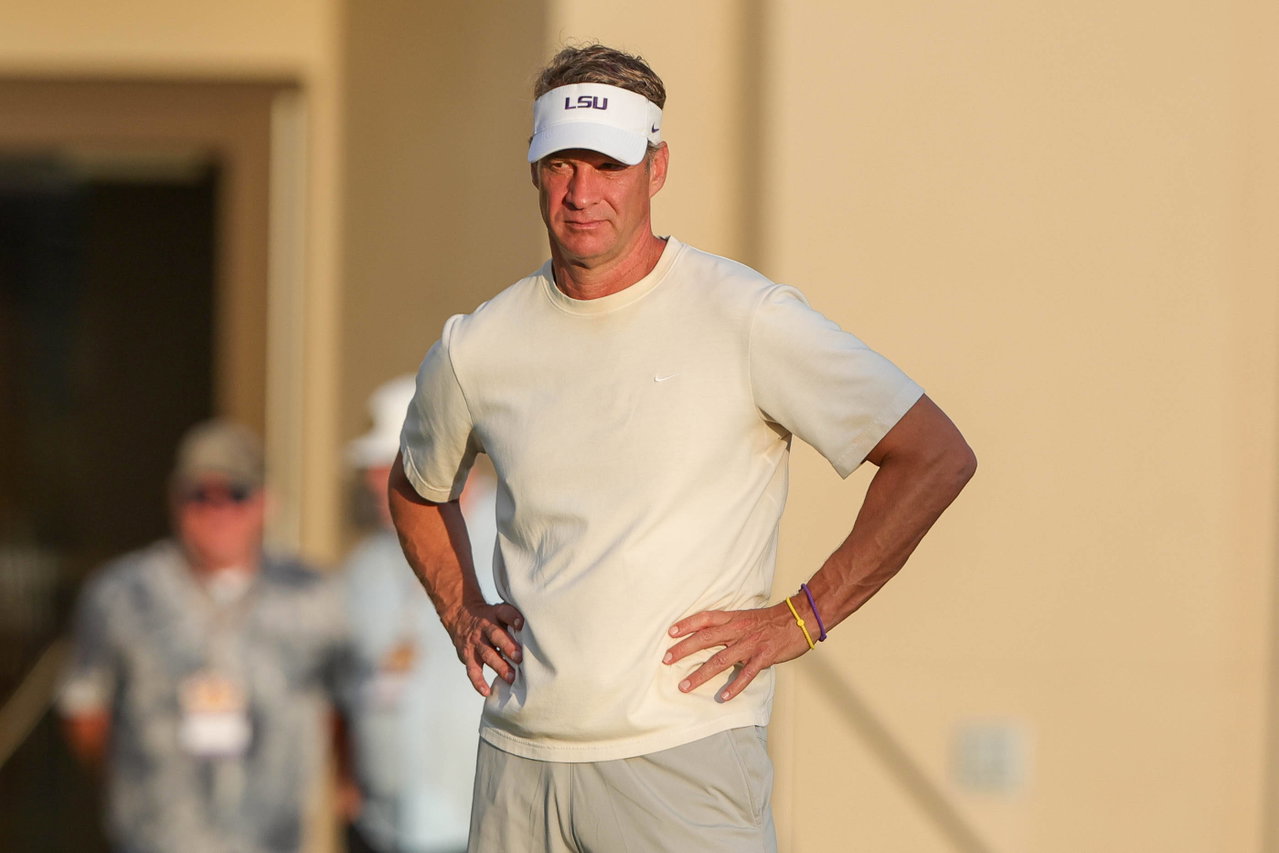
Lane Kiffin’s LSU debut was always destined to be one for the books, but few could have predicted just how chaotic the buildup would become. The SEC has filed a federal lawsuit against LSU over the program’s move to sign former NFL players, turning an already explosive situation into a full-blown legal battle. Louisiana Attorney General Liz Murrill has fired back in defense of LSU and the players.
Watch What’s Trending Now!
“It seems very disingenuous to me for the commissioner of the SEC to act like he has never seen this rule until today,” Liz Murrill told the media after the court hearing on Thursday. “Or the entire NCAA manual that’s in effect right now until today. If that’s true, then I really wonder why he’s making $4.8 million a year and has a private jet.”
In direct retaliation, while the courtroom hearing in Louisiana was underway, the SEC filed a separate federal lawsuit against LSU, its university president, and football head coach Lane Kiffin.
Louisiana Attorney General Liz Murrill directly blasted SEC Commissioner Greg Sankey’s legal strategy. She even called it “legal garbage” and “frivolous” during a high-stakes, nine-hour courtroom battle in Baton Rouge.
This explosive clash centers on the massive dispute over a fifth year of college athletic eligibility after the NCAA came up with a new five-for-five rule. While several student-athletes from the class of 2022 have secured temporary injunction, the LSU fiasco is another layer in the battle.
Kiffin wants to include two former Ole Miss players on his roster. The only issue is that both players had signed contracts with NFL teams. The SEC argues that LSU is violating the conference’s expressive association rights under the First Amendment. They are doing so by forcing the league to roster professional players against its explicitly voted bylaws. The SEC claims this conduct directly erodes public confidence in the integrity of college sports.
On Thursday, SEC Commissioner Greg Sankey traveled to Baton Rouge via a private plane to personally sit on the witness stand for over three hours. He aggressively defended the SEC’s authority to establish its own rules. He asserted that “the NFL is not a recruiting ground for college football.”
Sankey revealed that conference university presidents had voted 15-0 to bar former pros from returning to member rosters. LSU was the lone abstention.
While the hearing was underway in the Baton Rouge courtroom, the SEC blindsided LSU by filing a separate federal lawsuit against the university and Lane Kiffin in Alabama. The lawsuit accused LSU of creating a competitive imbalance and threatened severe punishments. It includes sweeping fines and half-season suspensions for coaches if they use ineligible players.
Attorney General Liz Murrill, who filed an athlete-friendly brief supporting the players, did not hold back her frustration regarding the SEC’s tactical federal filing. Murrill slammed the SEC’s separate lawsuit as a transparent “collateral attack” intended to threaten the Louisiana judge. She noted, “I don’t think this judge was impressed by that threat.”
In her official brief, Murrill argued that the NCAA and SEC had subjected these athletes to a classic “bait-and-switch”. They are altering eligibility parameters mid-career.
During a court recess, Murrill bluntly summarized the SEC’s motivation to reporters. “I think this is about power and the fact that their power and their rules have been challenged, and they don’t like it. It’s that simple,” she said.
Despite the SEC’s aggressive pushback, Baton Rouge District Judge William Jorden ultimately ruled completely in favor of the athletes. He granted them a preliminary injunction. The ruling bars the NCAA and SEC from enforcing their prohibitive rules.
This effectively clears a path for several key incoming players, including former Ole Miss standouts Dae’Quan Wright and Zxavian Harris. They finally got the green flag to suit up just days before LSU’s high-profile season opener against Clemson.
The legal war is far from over, as the SEC has vowed to appeal the decision immediately while their federal lawsuit in Alabama hangs over the program.