
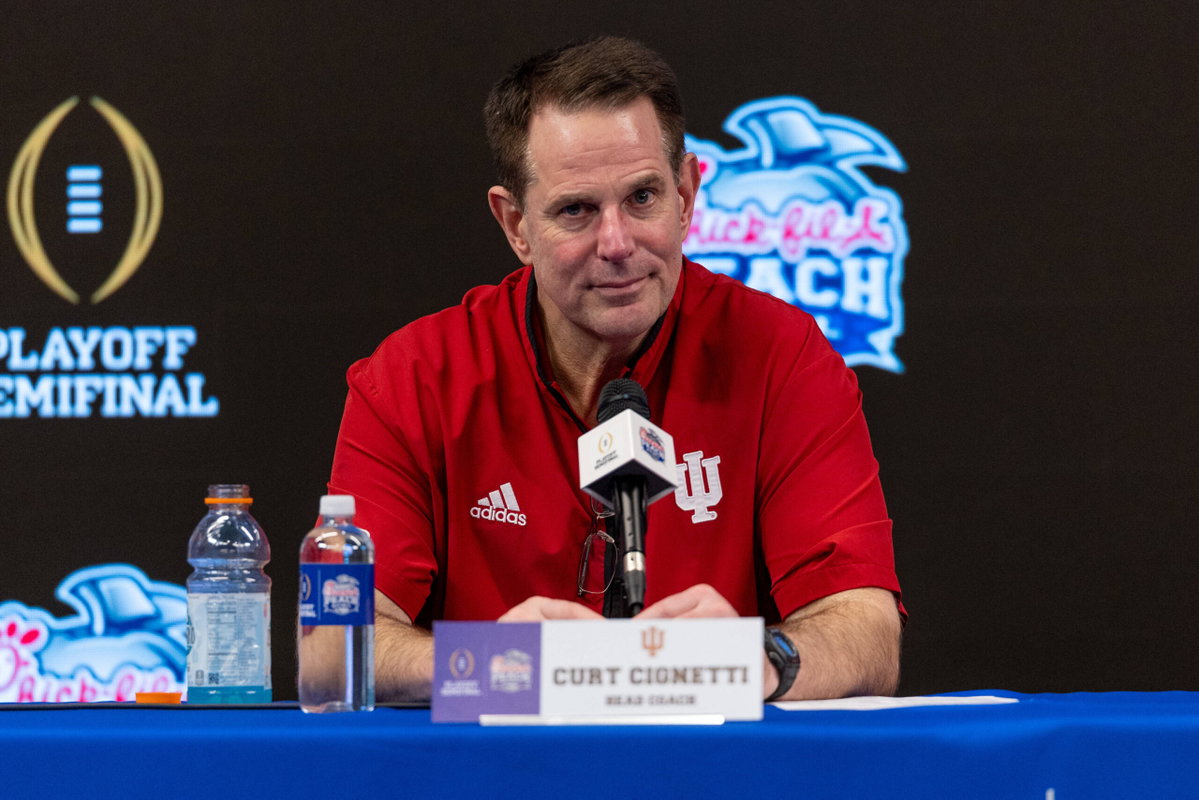
Curt Cignetti once said, “Google me, I win,” and he has certainly backed those words up, taking Indiana from playoff contenders to national champions. But while his results speak for themselves, his scheduling decisions are telling a different story. After their latest moves, they are getting called out for running away from tougher competition.
Watch What’s Trending Now!
Barstool Sports analyst Brandon Walker is urging Indiana to schedule like a program at the top of college football rather than shy away from major nonconference opponents.
“Curt Cignetti loves to be boisterous… and he loves to say ‘Google me I win,’ but then when it comes time to act like they’re the big dog in college football, they run from competition,” Walker said on October 7 in a podcast on Barstool Sports.
The issue centers on who Indiana plays before the Big Ten season starts. The Hoosiers will not face a Power Four non-conference opponent over the next five years, and Walker sees the same pattern as far out as schedules go. This season’s non-conference slate was Howard, North Texas, and Western Kentucky.
“They are the defending national champs. They’ve won 21 games in a row. They have put themselves at the top of college football,” Walker continued. “I feel if you’re going to do that, you should act like it… You shouldn’t run away like cowards from the Power Four teams of the world.”
Walker pointed to games elsewhere as a contrast and cited Texas playing Ohio State and Michigan playing Oklahoma, noting that neither Michigan nor Oklahoma is strong this year, but they are still facing each other.
The latest scheduling change has given those concerns fresh momentum. Indiana and UMass mutually canceled their game set for September 18, 2027, which had originally been scheduled for 2023 before being moved.
The contract reportedly had a $1.25 million guarantee clause, but neither school paid a penalty. Indiana then added Jacksonville State, so its 2027 non-conference opponents are Kennesaw State, FCS member Indiana State, and Jacksonville State.
Analyst T-Bob Hebert called the strategy “pathetic” after the Jacksonville State announcement. Urban Meyer, the former Ohio State coach, discounted the wins over North Texas, Howard, and Western Kentucky, saying he views Indiana as “2-0” rather than 5-0.
This criticism isn’t new. The Hoosiers have also faced criticism for canceling future series against programs such as Notre Dame and Virginia and replacing them with less prominent opponents. Cignetti, however, has previously defended the broader scheduling approach, saying it began before he arrived at Indiana.
“That was a scheduling philosophy that began before I was hired,” Cignetti said last year. “But I did sign off on it upon being hired.”
Now, there is a reason Indiana’s scheduling strategy remains a debate rather than a straightforward criticism. Cignetti has delivered results that few could have predicted when he took over the program.
Indiana went 11-2 in 2024, then 16-0 in 2025, and beat Miami for its first national championship. That is 27-2 over two seasons, with a Big Ten title and a national title.
This season, Indiana is 5-0 overall and ranked No. 7 in the AP Poll. The Hoosiers beat North Texas 52-16, Howard 55-0, and Western Kentucky 38-0, along with Northwestern 29-23 and Rutgers 47-15. Indiana has outscored opponents 221-54 through five games.
Meanwhile, Indiana’s Big Ten slate still offers real tests. Nebraska is next in an undefeated matchup, with Ohio State, Michigan, and USC later. Those games are included in the conference schedule. The non-conference slate is the part Indiana picks, and that is where Walker wants to see a Power Four opponent.
However, Indiana is not the only program following this model. Penn State also had weaker non-conference opponents. Even many SEC teams do not schedule as Texas did. The reasoning is simple. In the current 12-team CFP, you can’t afford a non-conference loss.
Texas lost to Ohio State last year and finished 9-3. That extra loss ultimately cost them a postseason spot. On the other hand, while non-conference wins do not add anything in terms of strength of schedule for Indiana, they are still good practice games for the new roster before the Hoosiers get to the Big Ten schedule.
That being said, the debate actually goes beyond Indiana’s scheduling choices. Journalist Matt Hayes argues that the bigger problem is the playoff system itself. As he puts it, “What’s allowed is what’s taken.”
Under the current 12-team format, Indiana has little reason to risk a nonconference loss if its Big Ten results can secure a playoff spot. Hayes argues that unless the selection committee puts more weight on strength of schedule, Cignetti has little incentive to change a strategy that has already delivered a national championship.
That could change if playoff expansion brings new requirements for Power Four matchups. Until then, Indiana has little reason to schedule differently.