
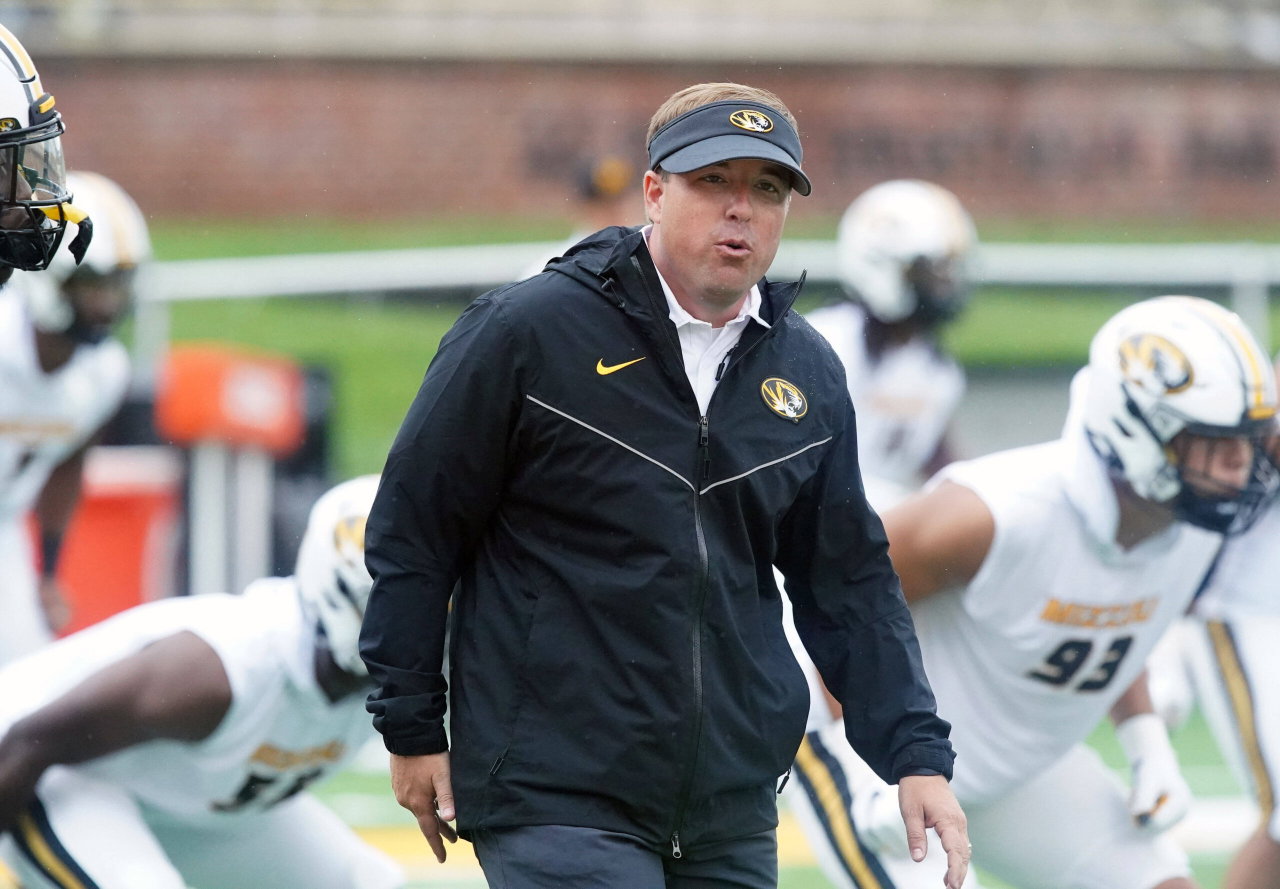
College football is no stranger to drama, but this time, the biggest hit happened behind a microphone. National college football analyst Josh Pate and Missouri head coach Eli Drinkwitz are now at the center of a public controversy, turning a disagreement over rankings into a personal clash over credibility and respect.
Watch What’s Trending Now!
The controversy erupted during Drinkwitz’s recent appearance on the Brandon Walker Show. While discussing college football media, the Missouri coach took a direct shot at Pate’s credibility.
rati“You do need to ignore Josh Pate’s opinion because you know his opinions about being commissioner and stuff. If you go back to the first of the year and you look at his quarterback list and you look at his rankings, not quite sure he’s as smart as he thinks he is,” Drinkwitz said with a chuckle.
Drinkwitz capped off his remarks by laughing, chanting Missouri’s famous “M-I-Z” slogan, and walking away.
Interestingly, Pate had challenged Drinkwitz’s position before. During a May episode of Josh Pate’s College Football Show, he addressed the Missouri coach’s complaints about the SEC moving to nine conference games without securing an expanded College Football Playoff. Although Pate acknowledged that SEC coaches had reasons to feel misled, his response was blunt: “Get over it.” He also urged frustrated coaches to “go win your games.” It wasn’t a personal attack, but it established an earlier public disagreement over college football policy.
Drinkwitz’s latest criticism also comes against the backdrop of controversy surrounding Pate’s JP Poll, a predictive rating system that evaluates teams based on projected strength rather than simply rewarding their records. While the AP Poll placed Missouri at No. 25 entering the season, Pate’s system has evaluated the Tigers differently.
The controversy surrounding Pate’s rankings intensified after Missouri demolished Florida 45-17 on October 3. Yet his October 6 JP Poll still ranked the Gators No. 11 and the Tigers No. 14. Two days later, Pate defended his assessment, explaining that FanDuel traders projected Florida as a four-point favorite in a hypothetical neutral-site rematch.
Pate also acknowledged that Missouri deserved to rank ahead of Florida in his separate merit-based Commissioner’s Poll. That’s where the disagreement gets interesting. Missouri had beaten Florida by 28 points, but Pate’s predictive approach still suggested the Gators would be favored if the teams met again.
And Drinkwitz isn’t the first coach to challenge the analyst’s numbers. In January 2025, Illinois head coach Bret Bielema mocked Pate after his 10-3 Fighting Illini were excluded from the JP Poll’s top 25.
“Thought today was January 22nd. April 1st must’ve came early this year,” Bielema wrote on social media.
Pate responded with a simple clarification: “Sir, this is not a ranking.”
The exchange exposed the same fundamental disagreement over predictive ratings. Coaches want their victories recognized, while Pate maintains that his system measures projected strength rather than rewarding results alone.
Still, Drinkwitz has results to defend his program. Missouri won 11 games in 2023 and 10 in 2024, demonstrating that its success wasn’t limited to a single breakout season. Those achievements give the Tigers’ head coach legitimate grounds to question analysts who remain skeptical of Missouri’s ability to compete consistently in the SEC.
And the tension between coaches and predictive models extends beyond Pate. In August 2025, SMU head coach Rhett Lashlee accused ESPN’s Football Power Index of being “rigged” after its updated rankings placed every top-15 team in either the SEC, Big Ten or Notre Dame.
Despite finishing 11-3 and reaching the College Football Playoff the previous season, SMU sat at No. 19.
“Because the whole thing is rigged,” Lashlee wrote on X.
Unlike Drinkwitz’s personal criticism of Pate, Lashlee’s complaint targeted what he perceived as institutional bias toward the SEC and Big Ten. But both controversies highlight the growing willingness of head coaches to publicly challenge the systems used to evaluate their programs.
Now, Drinkwitz has made the disagreement personal. Pate can defend his predictive model with hypothetical matchups and betting projections, but the Missouri coach has actual victories to support his argument. And with Pate previously facing criticism from Bret Bielema over the same system, the latest confrontation raises a familiar question: Is the JP Poll exposing uncomfortable truths about college football teams, or is its creator placing too much faith in projections that don’t always match what happens on the field?