
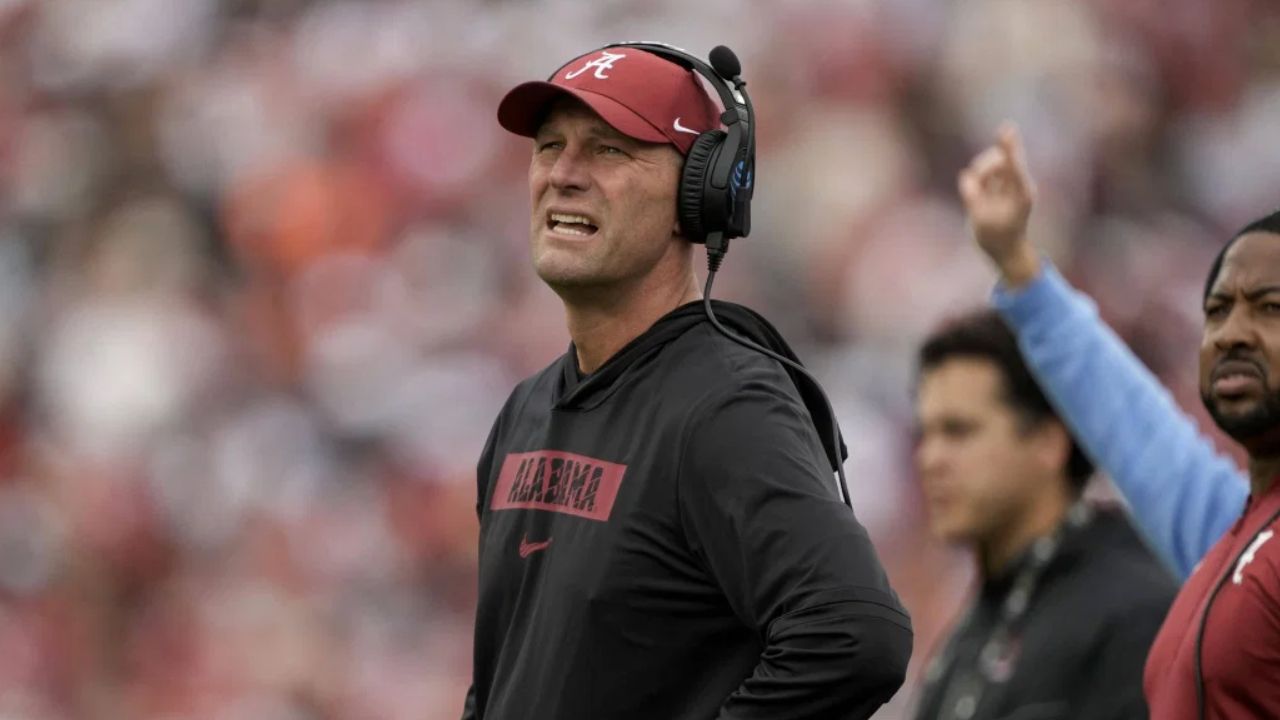
The latest playoff rankings have offered yet another twist: Alabama stayed third, ahead of Texas, despite both teams carrying two losses. And the reason has to do with the CFP Committee’s perception of the SEC and Alabama’s consistency.
Watch What’s Trending Now!
“Not if they’re talking about strength of schedule,” Prominent CFP reporter Heather Dinich said, if Alabama is ranked too high. “It is clear that the selection committee holds the SEC schedule and the entire conference in higher regard.”
Dinich acknowledged on ESPN’s Get Up on November 18 that she had not seen the actual figures, but believed the SEC would sit at No. 1. In her view, that assessment was helping Alabama remain above Texas.
“There is a new metric this year that they are using that measures conference strength,” Dinich explained.
She said each team receives a number for its league schedule, with the conference then assigned an overall strength figure based on those schedules. She also stressed that schedule strength was not the only consideration.
The committee had looked at Alabama’s consistency, too.
“Texas offense, even though it has more CFP top 25 wins, is part of that separation,” Dinich said. “So winning SEC games by a 23-point scoring margin, winning all of their games by a 25-point scoring margin.”
“That consistency combined with the schedule strength of Alabama is what’s keeping them at three right.”
Alabama entered the November 17 rankings at 8-2, with both losses coming against conference opponents. Georgia beat the Crimson Tide 20-17 in Tuscaloosa on October 10.
A week later, Tennessee handed them a 26-10 defeat in Knoxville. Those results left Kalen DeBoer’s team with little room for another slip. The response, though, has been convincing.
Alabama beat Texas A&M 31-20 on October 24, defeated LSU 31-13 in Baton Rouge on November 7, and followed that with a 21-6 road win over Vanderbilt. The Tide have now won three straight and sit at 6-2 in SEC play.
Moreover, Alabama has not simply scraped through every conference game. Its wins over Kentucky, South Carolina and Mississippi State came by 28, 31 and 33 points, respectively.
The team has also beaten Texas A&M, LSU and Vanderbilt by double digits. Furthermore, the schedule has given DeBoer little room to ease his players into conference football.
Alabama faced Georgia and Tennessee in consecutive weeks, then had to travel to LSU and Vanderbilt. Its two losses hurt, but the committee appears to have placed considerable value on the opponents it faced and the way it handled most of the remaining schedule.
Consider Indiana: Curt Cignetti defeated USC comfortably with his backup QB and yet moved just a single spot ahead after being pulled down to 9th for no particular reason.
According to CFP Committee Chair Hunter Yurachek, Alabama faced similar circumstances to Indiana, where “five of their SEC opponents” lost their games in Week 10. However, it didn’t have the same impact as it did with Indiana.
“It’s very minimal for Alabama because of the quality of the strength of schedule those five teams had lost,” Yuracheck said to ESPN about Alabama.
The Longhorns have a strong argument of their own. They are also 8-2, and their résumé includes five wins against teams that were ranked in the CFP Top 25 when Texas played them.
The most notable came in the season opener, when Steve Sarkisian’s team beat defending national power Ohio State 24-23. Texas also won at Tennessee, beat Ole Miss, defeated Missouri on the road, and escaped LSU 22-21 on November 14.
Those results explain why the Longhorns moved from No. 6 to No. 5 in the November 17 rankings. But two defeats have complicated their position. Texas lost 27-24 to Oklahoma on October 10 and suffered another 27-24 defeat against Florida a week later. And both games came at home.
Dinich pointed to the inconsistency of the Texas offense as another reason the committee has separated the two SEC teams.
The Longhorns have shown they can beat quality opponents, but they have also struggled to put games away. Their 22-21 win at LSU was another example of a game that went down to the final moments.
“Essentially, the committee just said Alabama didn’t drop because it’s Alabama,” USA Today’s Matt Hayes wrote about Alabama’s ranking. “Frankly, I’d have been a lot happier if they just said that and got it out in the open.”
The argument over conference strength and the Committee’s alleged Alabama and SEC bias has not gone unnoticed outside. Curt Cignetti spent part of his November 16 press conference pushing back against the suggestion that Indiana’s schedule was soft.
“We don’t play anybody. We have a soft schedule, right?” he said, repeating the criticism he has heard for three years.
His frustration was not difficult to understand. Indiana had just beaten USC 27-13, improving to 9-1, and its only defeat had come against Ohio State. There is evidence that the Big Ten has put together a demanding schedule, too.
Six conference teams appeared in the November 17 CFP Top 25: UCLA at No. 4, Indiana at No. 8, Oregon at No. 13, Ohio State at No. 14, Iowa at No. 15, and USC at No. 18.
That is a substantial group, with an undefeated UCLA team and several programs that have spent the season in the playoff discussion. Indiana’s own conference slate has not been empty of strong opponents.
Seven of its Big Ten opponents entered their games against the Hoosiers with a combined 29-10 record. That is why Dinich’s explanation is likely to keep the current ‘Bama bias’ debate alive.