

Female reporters like Laura Rutledge, Holly Rowe, Alyssa Lang, Nicole Auerbach, and others face a different level of pressure in sports media. One of the most recent examples is the fake AI video showing Rowe being slapped. That is what Chris Childers was getting at when he admitted online abuse got to him enough that he finally fired back.
Watch What’s Trending Now!
ESPN’s Ryan McGee joined SiriusXM’s Chris Childers as they talked about the abuse their female colleagues deal with.
“What you and I deal with is a grain on the sand on the beach that Alyssa Lang and Laura Rutledge and all our female colleagues… have to deal with. I understand the perspective of it, but it ain’t a lot of fun.”
Childers didn’t soften his response as he agreed and pointed to their resilience.
“I’ve told them you’re tougher than me,” he said. “You are because I would have wilted. There’s no way in hell I could read some of that weird a– stuff and deal with it.”
That’s a blunt admission from someone who works in sports media himself. And once you look at what these women have dealt with, it isn’t hard to understand why.
Imago
Credits: IMAGO
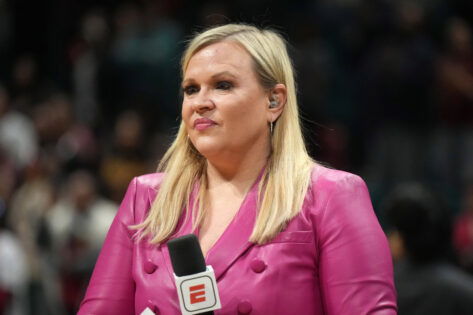
Holly Rowe got caught in one of the uglier examples. After Texas’ comeback over Ohio State, the ESPN reporter tried to get a quick word with Steve Sarkisian. He celebrated and moved on. That should have been the end of it. Instead, an AI video falsely showed the Longhorns’ head coach hitting her and knocking her down. It spread online.
Arch Manning later laughed at the clip and called it “hilarious,” sparking backlash. He eventually apologized, saying there was “nothing funny about it.” Holly Rowe said they spoke and moved on.
Still, a fake assault video becoming entertainment says plenty about the internet. And this wasn’t the first time a female sports reporter had been pulled into something like this. Back in December, Laura Rutledge got her own taste of it after an awkward NFL postgame interview with Justin Herbert.
The Chargers QB wanted to celebrate with his teammates and initially tried to avoid the camera. She kept after him and eventually got the interview. Again, that should have been the end of it. Instead, an AI-generated video circulated showing a fake version of Justin Herbert hitting and knocking her to the ground.
Laura Rutledge chose to laugh it off publicly rather than spend days fighting the internet over it. That’s part of the problem Ryan McGee and Chris Childers were discussing. Women working in sports are constantly expected to absorb bizarre behavior, shrug it off, and keep moving. And if they react, the reaction itself becomes the next story.
This isn’t just about a few bad online comments. Studies on sports media show that while male reporters mostly get heat over hot takes or team bias, female journalists face deeply personal attacks targeting their appearance, gender, and credibility. Industry data reveals that women make up barely ten percent of sports newsrooms, making them easy targets in a heavily male-dominated space.
Nicole Auerbach and Alyssa Lang have seen it too. Sometimes it’s not one big viral attack, just a steady stream of cheap shots. Lang got one at SEC Media Days in July when a fan told her to lose weight if she wanted to keep her job. So she fired back.
“Those are actually called abs, in case you haven’t seen your own recently,” she commented.
Ryan McGee said he has spent months trying to figure out where his own guardrails should be with social media because constantly consuming that negativity can eventually mess with your head. Childers agreed.
“We see what you say, and I’m not crying here, but we are people, and it’s crazy,” he said.
And when they bite back, the internet gets another excuse to pile on. Childers admitted that is how the cycle works.
“Sometimes we succumb to your bait, and then we look like the idiots,” he said. “So you win.”
If this cycle continues unchecked, the damage goes way beyond temporary social media noise. Media experts warn that constant exposure to gender-based hate creates severe mental burnout, driving talented female voices out of sports journalism entirely.
When young women see top broadcasters getting targeted with deepfake videos and constant harassment, it discourages the next generation from even entering the industry.