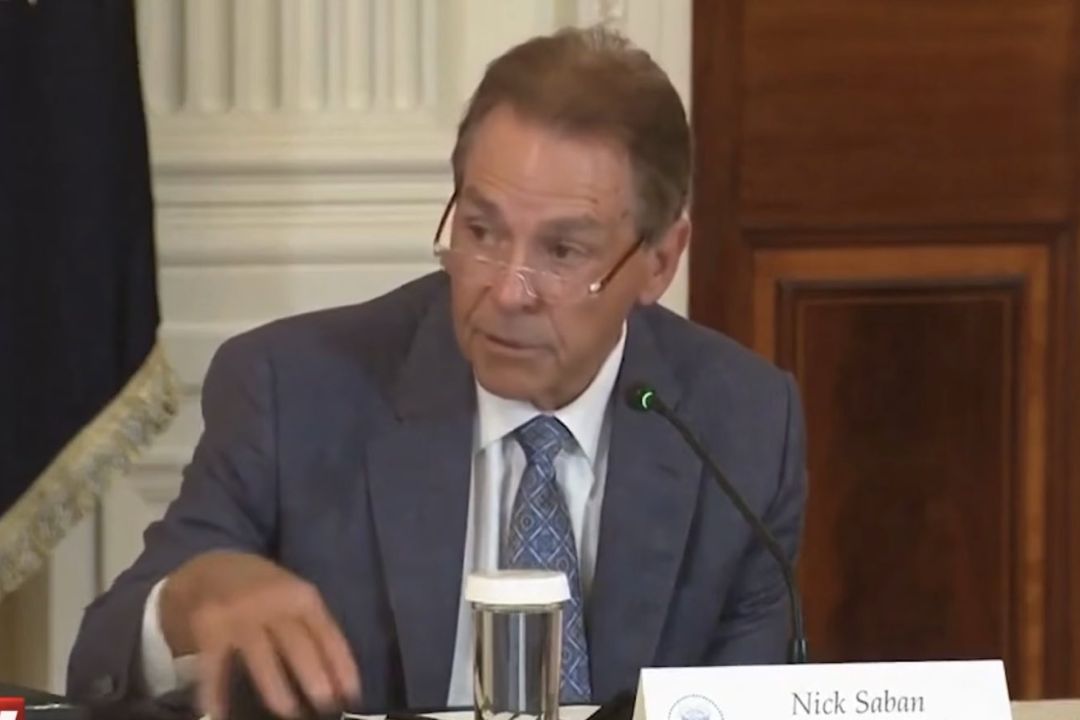
With some athletes now playing seven or more years of college sports and some of them refusing to turn pro, things in college sports have changed dramatically over the years. On Friday, when President Donald Trump hosted a college sports roundtable at the White House in an attempt to save it from getting worse, the meeting focused on the chaos surrounding NIL money, eligibility, and the transfer portal. The guest list included roughly 50 influential figures across athletics and media, including Nick Saban, who shared an unfiltered view of the current landscape of the sport.
Watch What’s Trending Now!
Nick Saban, who was joined by NCAA President Charlie Baker, among others, at the roundtable, claimed on March 6 that the current system has changed how players make decisions. Instead of focusing on long-term development, he said many athletes are now chasing the biggest immediate payday.
“People, instead of making decisions about creating value for their future, they were making decisions about how much money could they make at whichever school they can go to or transfer to,” he said.
This development has made it hard for coaches to guide players the way they once did before the NIL era. Nick Saban said the traditional model, which helps athletes develop academically, personally, and professionally, has been pushed aside in favor of a marketplace driven by NIL collectives and transfer opportunities. He made it clear that the current setup has distorted the original purpose of college athletics.
Nick Saban: “We need to come up with a system… to allow student athletes in all sports, including women’s and olympic sports, to enhance their quality of life, while going to college — but still provide opportunity to advance themselves beyond their athletic career.” https://t.co/qUUOzKt842 pic.twitter.com/sxnKZXggWz
— Rapid Response 47 (@RapidResponse47) March 6, 2026
“So, we need to develop an effective system of revenue sharing, authentic name, image, and likeness,” he said. “Authentic being you have marketing value, which now we have collectives which just create opportunities which just become pay for play.”
The shift from genuine marketing to what Saban considers backdoor salaries is what drove him from coaching and, in his view, is now threatening the stability of programs nationwide. However, money isn’t the only problem, though, as eligibility rules are creating another strange reality. Nick Saban pointed out that some athletes are now playing six, seven, even eight years of college football, meaning 25-year-olds are sometimes lined up against 18-year-old freshmen. According to him, that’s not healthy for the sport.
Nick Saban did not just highlight the age gap; the 74-year-old veteran framed it as a fundamental fairness and safety issue. Pitting seasoned 25-year-olds against 18-year-old true freshmen alters the physical reality of the game. For Saban, prolonged eligibility is less of a perk and more of a loophole compromising the sport’s integrity. Beyond the on-field age disparity, Saban argued that the very structure of team-building is collapsing under the weight of the transfer portal.
Nick Saban expresses concern over transfer portal
Nick Saban also addressed the massive roster turnover created by the transfer portal. As he pointed out, there are currently more than 4,000 athletes in the portal.
“Fans don’t like it,” he said. “Support groups don’t like it. It’s not really healthy for players in graduation to transfer several times in your career. You really put yourself in a pickle in terms of your ability to graduate.”
The environment, Nick Saban argued, which includes tampering accusations, bidding wars, and constant roster turnover driven by NIL money, makes it harder than ever to build stable programs. And eventually, he warned, it could damage fan interest in the sport itself. All these bring us back to the bigger question discussed at the roundtable. Who fixes this mess? Nick Saban believes the solution likely requires federal involvement.
“I think we need to come up with a system, and we obviously have to do it with the president’s leadership and also with Congress,” he said. “Whether it’s [the] antitrust legislation or whatever it is to allow student athletes in all sports, including women’s and Olympic sports, to enhance their quality of life while going to college, but still provide opportunity to advance themselves beyond their athletic career, which is what the philosophy of college athletics and getting a college education has always been about.”
The veteran coach stressed that college football has outgrown the NCAA’s eligibility to govern itself. By directly appealing to President Trump and Congress for antitrust legislation, he made it clear that a federal mandate is the only viable safety net left to protect non-revenue sports and traditional student-athlete values.
Nick Saban ended by saying college athletics were always supposed to be about education. And lately, nobody seems to be talking about that anymore. With that reality hanging over the discussion, the roundtable shifted toward the political fight shaping the next phase of college sports.
Related Newsletters