
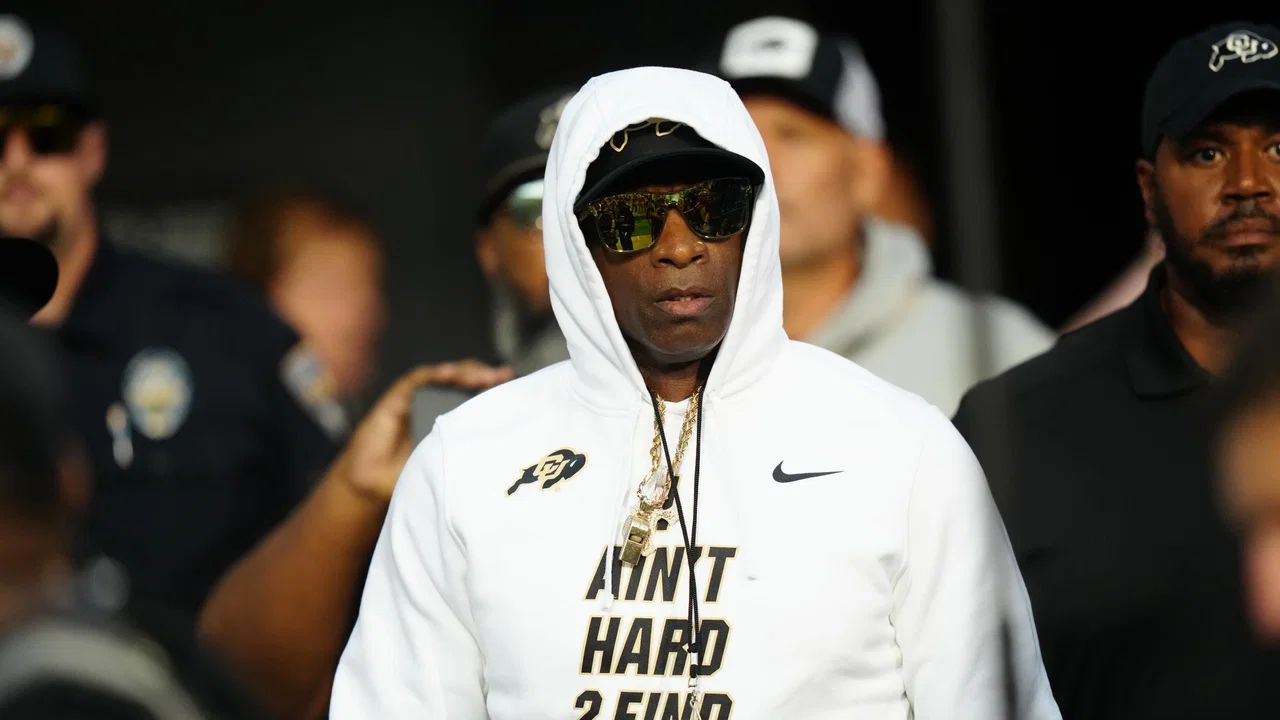
Deion Sanders and Colorado’s offense are back to square one after an embarrassing 20-10 loss to Arizona State. Just a week after beating Kansas State 27-24 in overtime, the Buffaloes’ running game completely collapsed, leaving quarterback Isaac Wilson exposed and the offense in shambles.
Watch What’s Trending Now!
Now, former Colorado quarterback Bobby Pesavento and ex-head coach Gary Barnett are calling out the glaring weaknesses that continue to haunt Sanders’ struggling program.
During the postgame broadcast, Pesavento was asked why Colorado’s offense continues to struggle with consistency through the air and on the ground. He explained that the lack of a running game forced Wilson into predictable passing situations, allowing Arizona State’s defense to attack him.
“Both defenses played pretty well. Our defense played really well, but we couldn’t establish a run game,” Pesavento said. He added that opposing defenders could “pin their ears back and get to Isaac Wilson,” putting Colorado in a difficult position.
The statistics from the Arizona State game tell the same story. According to Colorado’s official detailed box score, the Buffaloes managed just 64 net rushing yards on 34 carries, averaging 1.9 yards per attempt. Richard Young, who rushed for 120 yards against Kansas State, was held to just 47 yards on 15 carries. Wilson threw for 248 yards and a touchdown, but Arizona State recorded four sacks and an interception.
The bigger concern is that these struggles are not limited to one game. Through nine games, Colorado is averaging just 19.8 points and 387 total yards per game, according to the university’s official cumulative statistics. The Buffaloes have rushed for 1,184 yards, averaging 131.6 per game, while their passing attack has produced 2,299 yards. They have also scored only nine rushing touchdowns, compared to 14 through the air. The team has thrown 11 interceptions and lost seven fumbles, making its offensive struggles even harder to overcome.
Colorado also struggled to capitalize on its opportunities against Arizona State. The Buffaloes entered halftime trailing 17-0 and had a 74-yard touchdown pass from Wilson to Ernest Campbell wiped out by a penalty for an ineligible receiver downfield. They eventually found the end zone in the fourth quarter through a seven-yard touchdown connection with Joseph Williams, but the comeback never gained enough momentum. Colorado also went 0-for-3 on fourth-down attempts.
The contrast with the Kansas State game was particularly noticeable. Colorado rushed for 222 yards and three touchdowns in that victory, allowing Wilson to operate without carrying the entire offense. Against Arizona State, however, the running attack disappeared, making the Buffaloes much easier to defend.
Pesavento also pointed toward costly mistakes, admitting that Colorado “shot ourselves in the foot” despite making some good plays.
Gary Barnett, Colorado’s head coach from 1999 to 2005, offered a broader assessment of the problems facing Sanders’ program. The former Colorado head coach admitted that the team still struggles to do enough to win close games.
“Good enough to make it close, but you’re right, Mark. We can’t get over the hump,” Barnett said. He also pointed out that Colorado has “some holes offensively and defensively” that need to be filled.
His comments were particularly relevant considering how the defense performed after halftime. Colorado allowed just three more points after surrendering 17 in the first half. However, the offense could not provide enough support to turn that defensive effort into a comeback.
For Sanders, fixing the running game has to be a priority. The Kansas State victory showed what Colorado can accomplish when it runs the football effectively, but the Arizona State loss exposed how quickly things can fall apart without that balance. Wilson needs more help, and the offense cannot continue relying on its quarterback to overcome every difficult situation.
With the Buffaloes sitting at 3-6 overall and 1-5 in Big 12 play, there is plenty of work ahead. Pesavento identified the lack of a running game as a major concern, while Barnett highlighted the larger weaknesses that need to be addressed.