
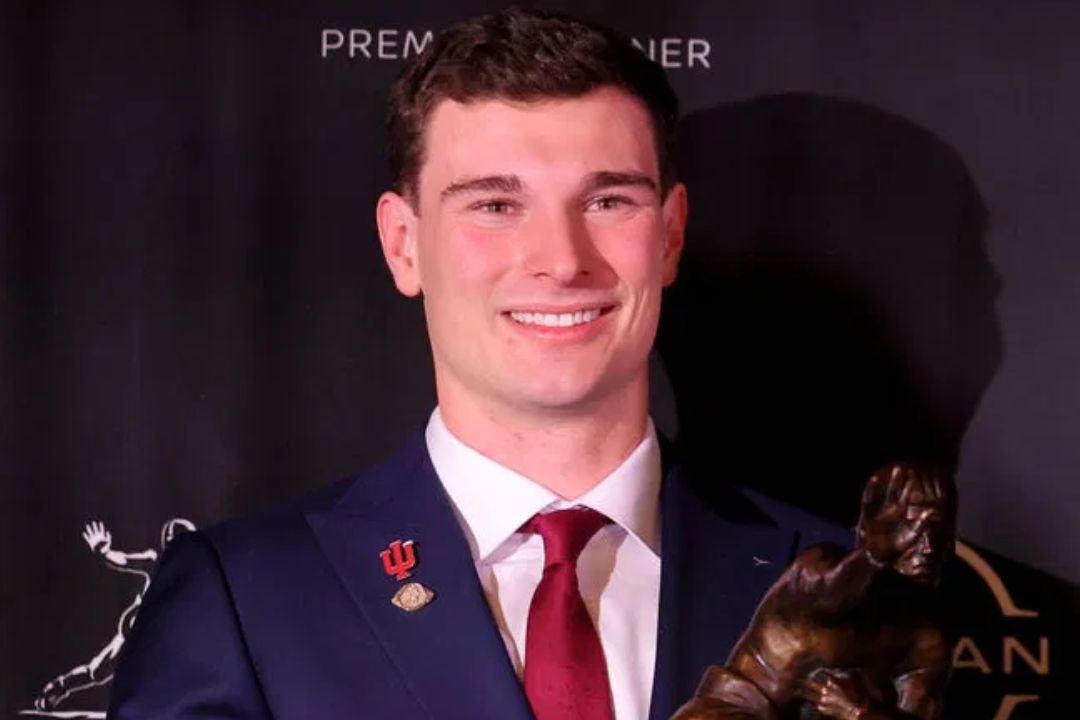
Former Indiana QB was always the No.1 overall pick in this year’s NFL draft. In fact, he was the only player whose draft fate was already sealed before his name was called in Philadelphia. That 1st overall pick did come with a whopping $54.5 million rookie contract. But Fernando would have raked in at least $5 million less if the Raiders hadn’t drafted him 1st overall. The same goes for Carnell Tate.
Watch What’s Trending Now!
NFL rookie contracts include significant signing bonuses and salaries, but a chunk of that money goes to state taxes, depending on where a player’s home stadium is. For Fernando, that happens to be the State of Nevada, at the Las Vegas Raiders, which doesn’t impose a tax on income. Similarly, since the state of Tennessee also doesn’t levy tax on income, Carnell Tate saves his state tax from his $48.7 million 4-year contract, after the Titans drafted him 4th overall. The same can’t be said about other top-5 NFL draft players.
The New York Jets drafted David Bailey from Texas Tech at 2nd overall, and he has a $54.6 million rookie contract. Unlike Fernando Mendoza, Bailey will have to pay a total of $5.7 million from his contract earnings. For Bailey, it will be one of the highest state taxes among rookies, since New Jersey imposes a 9% income tax. Likewise, for Arvell Reese, with a $46.6 million rookie contract with the Giants, he will owe the state of New Jersey $4.7 million in taxes. For Jeremiyah Love, the sum won’t be too high, even though the Cardinals drafted him higher than Reese and Carnell Tate.
The Arizona Cardinals drafted former Notre Dame RB, Jeremiyah Love, at 3rd overall. But since the state has just 2.5% income tax, the RB will likely pay $1.3 million in state tax. However, just paying off the state tax of the playing team isn’t how the framework works. Instead, players have to pay a tax for every state in which they play their NFL games. So, if Mendoza plays against the Giants or the Jets, he would have to pay 9% of the portion of his earnings as state tax. And that would be excluding the federal tax.

Fernando Mendoza won’t have to pay any state income taxes on his new deal with the Raiders 🔥 (Via: @fos)

Hence, choosing a team based on the state also becomes equally important for players.
“It was very close to happening, but it was just those state taxes, man,” Tyreek Hill said after ditching the Jets for the Dolphins. “I realized I had to make a grown-up decision, and here I am in a great city in Miami.” Despite choosing a team in a state with no income tax, all players still have to pay 37% of their income (if contracts exceed $626,350 annually) as federal tax. So, Fernando would still get 37% less than his $54.5 million contract.
The most tax beneficial teams by far are the AFC South teams, averaging a 0.26% tax rate. That happens because teams in the division play tax-free state teams more often, which reduces players’ state tax burden and arguably gives them the lowest tax hit in the NFL. So had Hill chosen to play for Houston, Jaguars, Titans, or Tampa Bay, he would have had significant savings on his state tax.
At Miami, though, he would still have to pay 2.67% of state tax on portions of his income, owing to facing teams from tax-heavy states. Fernando and Carnell Tate, though, would have benefited much more had they been drafted by an AFC South team. But since NFL draft fate is random, and in that randomness, this is still one of the best deals the duo has got.
California levies the highest tax among all US states, while states like Florida, Tennessee, Texas, and Nevada are exempt from that tax. Even then, if a rookie plays in California against the Chargers or, say, the Rams, he would have to pay California income tax on the portion of his salary earned while playing and working in the state. Nevertheless, Mendoza and Carnell Tate will benefit significantly, since they would play the majority of their games (8.5 games) in their tax-free home state
However, Sam Darnold faced the wrath of the California Jock Tax earlier this year after winning the Super Bowl. Would the same apply to these rookies as well?
Why Seahawks’ Sam Darnold lost money even after winning the Super Bowl this year?
The NFL playoffs are usually additional games, which are not usually included in players’ contracts. Even though some players have built-in bonuses to offset it, rookie players and Sam Darnold don’t have that advantage this year. To offset that financial loss, the NFL pays each player $53,500 for featuring in the wildcard rounds, and the payment goes up to $81,000 for conference games. For Super Bowl appearances, though, players get $178,000. But is it still a good deal for players like Darnold?
Darnold signed a whopping $100 million contract this offseason, averaging $33 million per year, or say, $1.9 million per game (for 17 games). That essentially means he earns a much smaller paycheck ($178,000) for winning the Super Bowl in Santa Clara, California, than what the Seattle Seahawks pay him for a single game.
Now, assuming Darnold had 180 duty days each year and has to pay tax on 4.4% of his income, due to 8 Super Bowl days, the state of California would then be taking a total of $1.5 million from the QB, levying a total of 13.3% state income tax on the total compensation. In simple words, Darnold will owe the state of California $197,771 while getting only $178,000 from the NFL to play the game. And that’s exactly how the tax system works for even NFL rookies.