
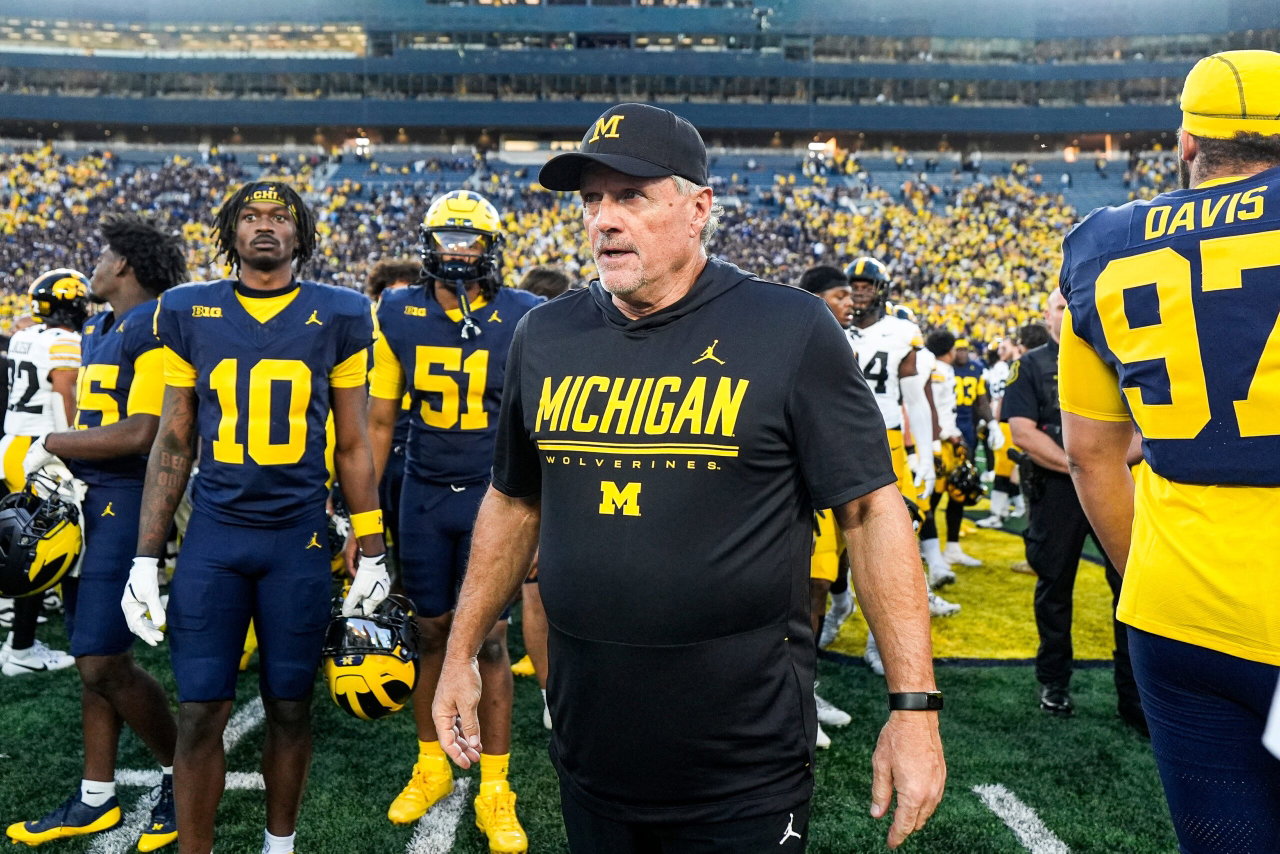
The transition from Utah to Michigan was supposed to give head coach Kyle Whittingham a program with the resources and talent to compete at the highest level. Instead, five games into his first season at Ann Arbor, Whittingham is dealing with problems that were rarely part of the equation during his long tenure in Salt Lake City.
Watch What’s Trending Now!
“I think what’s more surprising to Kyle is that the controllable things in a program, like effort and pre-snap penalties, are also an issue for Michigan,” said Joel Klatt on The Herd with Colin Cowherd. “That was never really an issue at Utah.”
Klatt covered the Wolverines’ 20-14 loss to Minnesota on October 3 as FOX’s analyst, and he explained why he thinks that gap exists.
“I would categorize it like this: he was at Utah for so long that the culture and discipline of that program was like a flywheel. It’s hard at first, but once it gets going, it perpetuates itself,” Klatt said. “So Kyle didn’t have to spend a ton of time at Utah talking about culture, effort, toughness, pre-snap penalties, and things like that, because it was baked into the cake after his lengthy tenure.”
Now, Whittingham is having to recreate that flywheel momentum while the offense struggles to run the ball. Michigan ranks No. 100 in the FBS in rushing at 135.0 yards per game through five games. At Utah in 2025, first-year Michigan offensive coordinator Jason Beck ran the No. 2 rushing attack in the country, averaging 266.3 yards per game.
Klatt also sees a scheme-to-personnel fit problem. In Utah, Beck had quarterback Devon Dampier, an explosive runner, along with athletic offensive linemen. His Michigan offense is more horizontal, while the roster, largely recruited by Jim Harbaugh and Sherrone Moore, was built for a more direct, downhill style. Klatt said the options are to adjust the scheme or change the players to fit it.
“They can’t go out there and run this exact same philosophy and scheme, because it has proven to be ineffective so far for Michigan,” Klatt said. “They have to adjust to the players they have.” He then offered a real estate analogy.
“If you’re a real estate developer, it’s much more difficult to take a house that has good bones but just isn’t right and try to make it perfect,” Klatt said. “What would you rather do as a developer? Tear it down and start from scratch. It’s your vision.”
Whittingham’s situation is different from what coaches like Curt Cignetti and Bob Chesney walked into at Indiana and UCLA, respectively. Cignetti had the opportunity to completely redo the program in his image at Bloomington. And when it came to the ‘culture’ issue, he brought in transfer players from his former program who understood how he operates. Chesney is doing a similar thing at the Bruins.
Michigan is a different case because, on offense, 10 of the 11 starters were recruited for the Michigan offense, not the one Beck is running now.
Some of the frustration has surfaced publicly. Michigan tight end Zack Marshall apologized on October 6 after messages criticizing Beck’s scheme leaked on social media. ESPN reported that the messages said Beck told the tight ends that “none of us are valuable to this offense.”
Whittingham said after the Minnesota loss that the situation is the biggest challenge of his 40-year coaching career. The defense, led by coordinator Jay Hill, ranks No. 6 in the country in total defense. The offense has failed to match that.
Michigan also has not decided between Bryce Underwood and true freshman Tommy Carr at quarterback for its Week 7 home game against Penn State on October 17, coming off a bye week. That game will be the first chance to see whether the bye week gives Michigan the adjustments Klatt says it needs to make.