
Lincoln Riley isn’t taking any more chances after a four-year playoff drought. In spring practice, USC is adopting a new approach under defensive coordinator Gary Patterson, who is installing the same methods he used at TCU. The program has reportedly been focusing on players’ physical movement during drills.
At USC, during spring practice, players wear a white stripe on their helmets. Coaches use this stripe to watch where the players are looking and how they move their bodies while doing drills. If a player looks in the wrong direction or moves the wrong way, the coaches can see it quickly, which is exactly what Gary Patterson is trying to apply to the Trojans’ roster.
It’s more of an eyes thing, you know; we really still have to keep getting better at it,” USC defensive coordinator Gary Patterson said on the USC Athletics podcast. “It’s all about where you snap your head; something happens in the secondary. Let’s just say the number two receiver runs an out of seeing you snap your eyes to the outside and make a call, telling the corner that he’s going to come off; I’m going to go look up the outside receiver.
When you play single high defense, you don’t have to talk as much. If you play just vision quarters, you know, could you stay in an area when you match, when you match up routes and do things? Then you have to talk to each other.”
Defensive coordinator Gary Patterson explains why he’s adapted the white stripe on the defenders helmets during practice. “It’s an eyes thing” when reviewing the practice film they’re able to see the players snap their eyes by seeing the stripe move.
When they get to the point… pic.twitter.com/V4QkyQcQUq
— Trojan Football ✌️ ᶠᵃⁿ (@TrojanFBx) March 10, 2026
This isn’t just a practice gimmick; it’s the foundation of a historic defensive standard. During his TCU tenure, Patterson’s strict eye-discipline rules birthed the nation’s most lethal units. His defenses led the NCAA in total defense five times, consistently forcing turnovers because his defensive backs rarely broke visual discipline to chase backfield ghosts.
USC doesn’t need a league-wide trend to justify this tweak. It needs a fix that translates on Saturdays. Patterson’s helmet-stripe emphasis is a small, repeatable ritual meant to eliminate the tiny eye errors that turn into explosive plays. And the urgency isn’t theoretical. The tape from the Trojans’ last season showed how quickly one wrong glance can unravel an entire call.
USC’s defensive struggles
Last season, USC’s defense consistently failed to get stops. The defensive woes were on full display against Illinois, where the unit completely unraveled. Quarterback Luke Altmyer carved them up for 328 yards, a symptom of a secondary that consistently busted coverages and a pass rush that generated no pressure. The 502 total yards surrendered in that game weren’t just a bad stat line, but the blueprint for why a fundamental change was necessary.
Losing so many yards made it clear that the defense needed big improvements, and that’s why hiring Gary Patterson could help the team get much stronger next season. USC’s secondary didn’t just lack raw talent last season. They also lacked spatial awareness. Blown coverages, like the defensive collapse against Illinois, frequently stemmed from defenders peeking at the quarterback instead of reading their immediate threats.
Imago
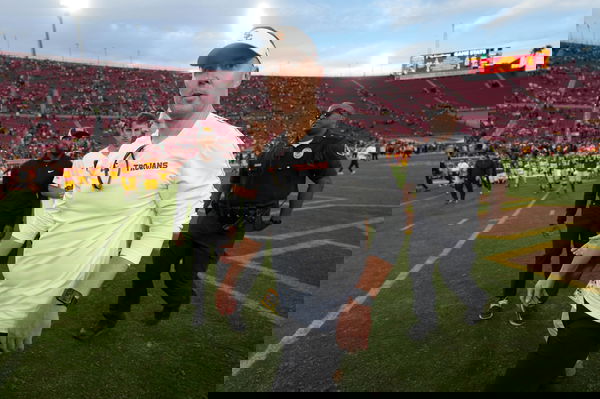
NCAA, College League, USA Football: Notre Dame at Southern California Nov 30, 2024 Los Angeles, California, USA Southern California Trojans head coach Lincoln Riley leaves the field after the game against the Notre Dame Fighting Irish at United Airlines Field at Los Angeles Memorial Coliseum. Los Angeles United Airlines Field at Los Angeles Memorial Coliseum California USA, EDITORIAL USE ONLY PUBLICATIONxINxGERxSUIxAUTxONLY Copyright: xKirbyxLeex 20241130_tbs_al2_082
Gary Patterson’s helmet-stripe tracking directly attacks this bad habit, retraining defenders to trust their positional keys. While a striped helmet is no magic bullet, it represents the kind of detail-obsessed, ground-up rebuild that Patterson is known for. For a USC defense desperate for an identity, instilling that discipline is the only path back to contention.