Imago
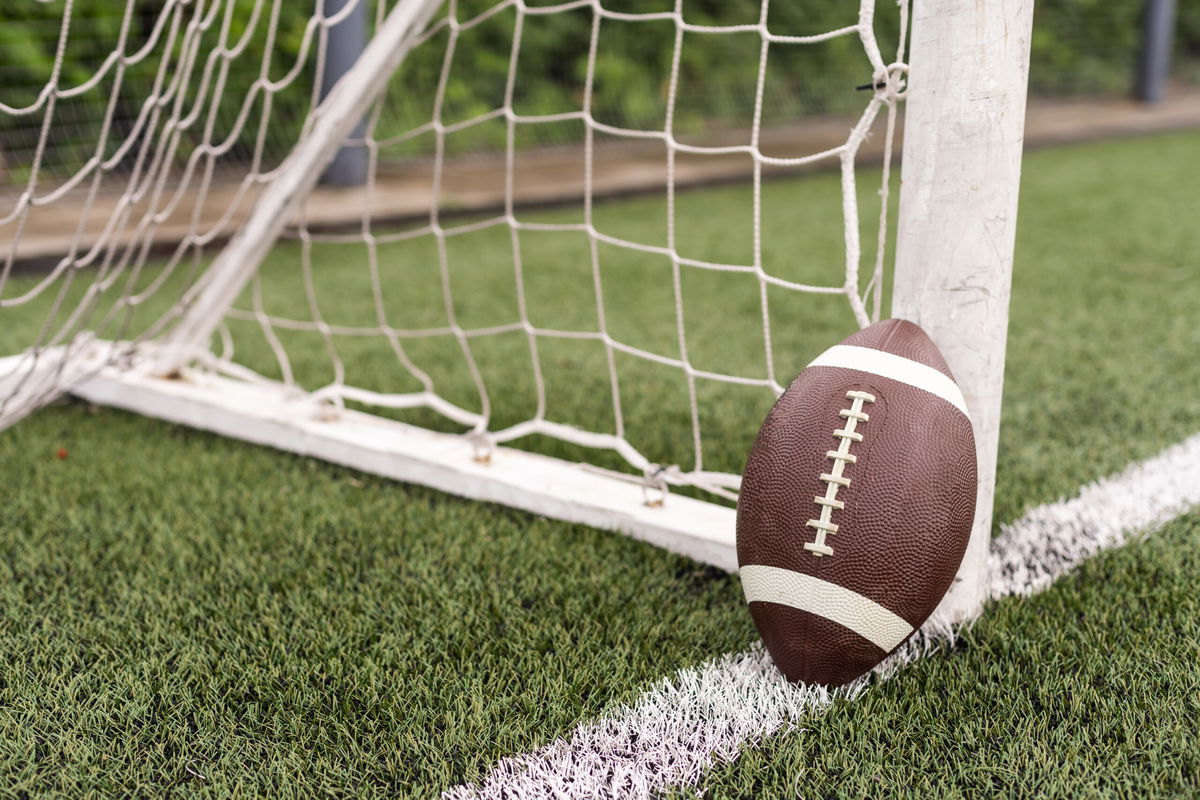
Close up view of an American Football sitting on a grass football field on the yard line. Generic Sports image . High quality photo xkwx athletics ball field football grass green horizontal american football background copy space culture game lines play recreation sport yard yard line american line pigskin sports white american football league american football player bet big game college competition environment final goal green yard helmet national sport outside sideline soccer sports background sports calendar sports club sports equipment sportswear stadium superbowl team touchdown tradition usa artificial
Imago
Close up view of an American Football sitting on a grass football field on the yard line. Generic Sports image . High quality photo xkwx athletics ball field football grass green horizontal american football background copy space culture game lines play recreation sport yard yard line american line pigskin sports white american football league american football player bet big game college competition environment final goal green yard helmet national sport outside sideline soccer sports background sports calendar sports club sports equipment sportswear stadium superbowl team touchdown tradition usa artificial
A bowl game in Detroit is quietly slipping into the night. For nearly three decades, right after Christmas, that game inside a dome up north kept showing up on the schedule. It changed the name from Motor City Bowl to Little Caesars Pizza Bowl to Quick Lane Bowl, and most recently to the GameAbove Sports Bowl. Now, after 29 years, it’s finished.
According to On3, the annual bowl in Detroit is being discontinued. The game debuted in 1997 as the Motor City Bowl, played first in the Pontiac Silverdome before moving to Ford Field once the Lions made the jump. It was always a dome affair because nobody was volunteering to sit outside in Detroit in late December.
Over the years, it became a dependable stage for MAC champs and runners-up to test themselves against the ACC or Big Ten. From 2014-19, the ACC filled the power slot, but the Big Ten stepped in from 2020 onward.
Every so often, the GameAbove Sports Bowl delivered something unforgettable. Just take the 2024 season, for instance, when Toledo and Pitt met inside Ford Field. Tucker Gleason led Toledo to a 48-46 victory with four passing TDs and one on the ground. The game ended in six overtimes, the longest bowl game in FBS history.
.png)
.png)
.png)
Two days ago, the Hawaii Bowl set a record with five overtimes. But such moments are rare, and attendance has been an issue for years. Ford Field seats 65,000, yet the last five games drew fewer than 29,000. The final 2025 game, with Northwestern beating Central Michigan 34-7, had just 27,857, a slight increase from the previous year’s six-overtime game. When a game can’t even fill half the lower bowl, its long-term viability is clearly in question.


The annual bowl in Detroit, known most recently as the GameAbove Sports Bowl, is being discontinued.
It was originally known as the Motor City Bowl back from 1997-2008, was the Little Caesars Pizza Bowl from 2009-2013, the QuickLane Bowl from 2014-2023, and the GameAbove Sports… pic.twitter.com/OfPAaD3IST
— CFB Kings (@CFBKings) February 11, 2026
When it’s gone, it will hurt some people who were watching at home. ESPN reported that its 33 non-playoff bowls averaged 3.1 million viewers, up 13% year over year. The final GameAbove Sports Bowl peaked at 2.7 million viewers. The eyeballs are on the broadcast, but the stadium seats remain empty. And this isn’t just about one bowl in Detroit.
The cancellation of the GameAbove Sports Bowl marks the third bowl to fold this offseason, joining the LA Bowl and the Bahamas Bowl. The LA Bowl lasted barely five years, while the Bahamas Bowl was scrapped before 2025 and replaced by the Xbox Bowl in Frisco. So how did we get here?
A shift around college football bowl games
It’s the expanded 12-team CFP format that brought these changes. This past postseason was proof that it’s becoming a matter of survival of the fittest. We saw 5-7 Appalachian State playing in the Birmingham Bowl in a regular-season rematch, no less, because there weren’t enough eligible or interested teams.
Rice and Mississippi State got in at 5-7 due to a shortage of 6-6 teams and high Academic Progress Rates (APR). Meanwhile, traditionally eligible programs such as Notre Dame, Kansas State, and Iowa State opted out of bowl games.
There are nearly 40 bowls on the calendar, so a little trimming was always inevitable. This offseason, three have already perished. But there are still plenty of 6-6 teams ready to cash the postseason check. Still, one thing recurs: some teams simply don’t see bowl games as worth pursuing anymore. So now, you might not even know who’s suiting up.
While the Detroit Bowl once delivered unforgettable moments like a six-overtime thriller, it ultimately became a casualty of college football’s unfamiliar landscape. The game left behind only memories of post-Christmas dome football.
Related Newsletters