
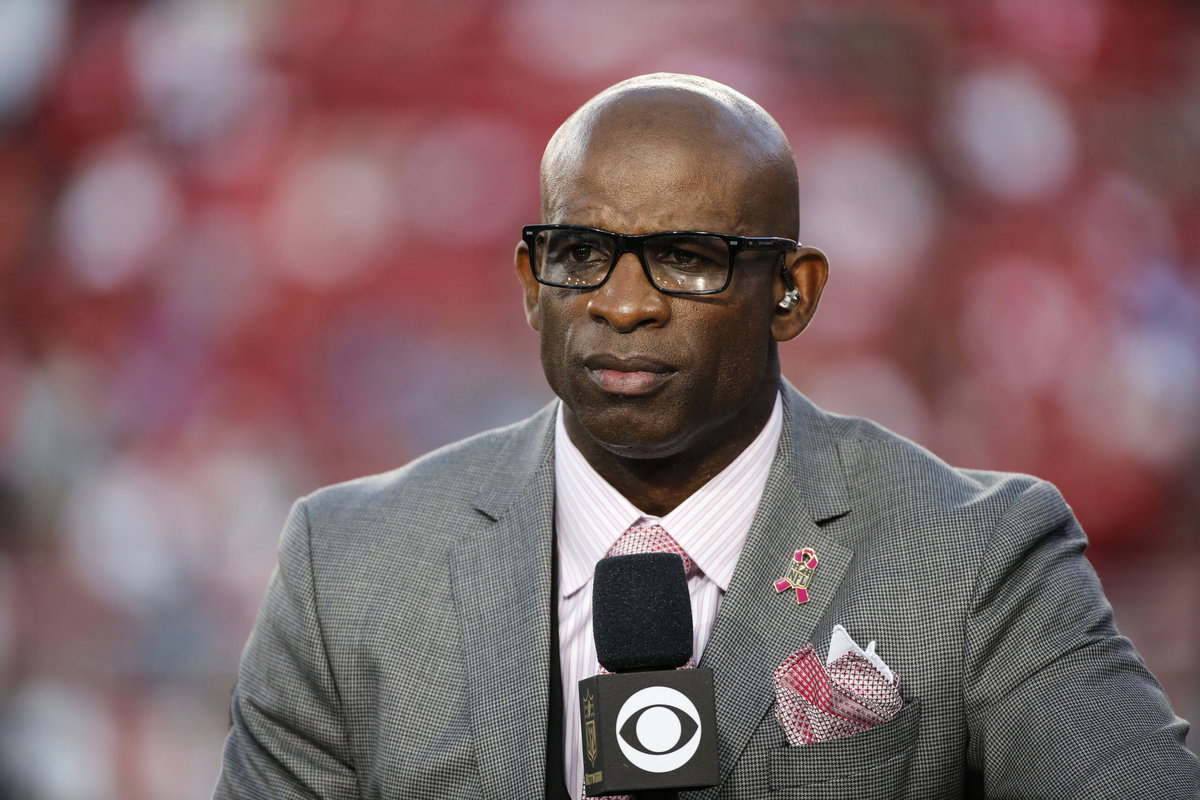
There aren’t many absolutes in recruiting, but Deion Sanders has one when it comes to outside cornerbacks. The Colorado head coach revealed this week that he rarely makes exceptions to a specific requirement at the position, citing an NFL trend that he admits he still doesn’t fully understand.
Watch What’s Trending Now!
“5’11” is that it. I can’t go lower [than that to recruit CBs],” Deion Sanders said on the Morning Run podcast. “Unless they walk on, and I want to give them a chance if they walk on. I know the NFL isn’t drafting someone on the island shorter to play outside. Maybe to play slots. And I wish they would draft more slot corners.
“They don’t do that until too late, and I don’t understand that because now in the NFL you have a $20 million receiver playing against a free agent, because they don’t value the slots.”
For Deion Sanders, it’s not that a 5-foot-9 player cannot play football; instead, the NFL still gives more value to bigger outside corners, while many offenses are putting their best weapons inside. The modern NFL has changed as slot receivers are no longer just secondary targets. Now, teams move elite players all over the formation to create favorable matchups, and defending those players requires special skill sets.

Coach Prime speaks recruiting corners less than 5'11 and the disadvantages of shorter corners.
For instance, a great slot corner should be quick to mirror receivers in small spaces. On top of it, he must tackle in the open field, understand route combinations, blitz when needed, and communicate with linebackers and safeties. In all, it’s one of the most demanding positions on defense. Yet the NFL draft still shows a preference for length and size at cornerback.
For starters, in the 2024 NFL Draft, Michigan’s Mike Sainristil was one of the best defensive players in college football. In his final season, he recorded six interceptions and helped Michigan win a national championship. Former Alabama coach Nick Saban even called him “the best football player pound-for-pound in the draft.” However, Sainristil measured only 5-foot-9 and was mostly viewed as a nickel corner.
He slipped out of the first round and was selected by the Washington Commanders at No. 50 overall in the second round. NFL analyst Lance Zierlein praised his toughness, instincts, and ball skills, saying he could become a starting nickel defender. In no time, Sainristil proved how valuable a smaller defensive back could be. As a rookie, he played 1,158 defensive snaps, the most among rookie cornerbacks in the NFL during the 2024 season.
College football is quite different from the NFL, and it gives coaches room for experimentation, deploying creative packages and finding new philosophies. That was the reason offenses like Air Raid, RPO, and Spread Option transformed the NFL. And they were all born through college football coaches. However, for that to happen, Sanders must recruit favorable and quality players to play in the slot. But the prospect of the NFL pipeline limits it.
How NFL’s de-prioritizing slot corners affect Deion Sanders’ schemes?
Sanders might love a player’s talent. He might believe that the player can dominate college football, especially as a slot defender. However, he also promises recruits that he will prepare them for the NFL. If the league is reluctant to spend high draft picks on shorter outside corners, Sanders has to consider that reality when offering scholarships.
Take, for example, Boo Carter, who transferred from Tennessee to Colorado. Coach Prime brought him to play slot corner, but due to the undervalued nature of the position in the NFL, he had to offer other roles, too, playing Carter at safety and island corner. Even if Boo was the “best athlete on the team” according to Sanders, he just couldn’t utilize him at slot corner because players would be reluctant to play a low draft-stock position.
“I wanted to see him play there because in history, I don’t see them saying at slot (corner) chosen in the first round. I don’t see that,” Deion Sanders said in an April presser. “So I want him to have a chance to exhaust himself at the corner, slot, and safety. He can do many things.”
Because of the limitation, Deion Sanders’ best corners are usually island corners, and the slot corner position is usually reserved for players with low draft stock. Of course, every player can rotate occasionally, but no player would like to play in the slot willingly. It might be even more frustrating for Sanders since he was arguably the greatest cornerback himself, but he can’t do anything about the changing times.