
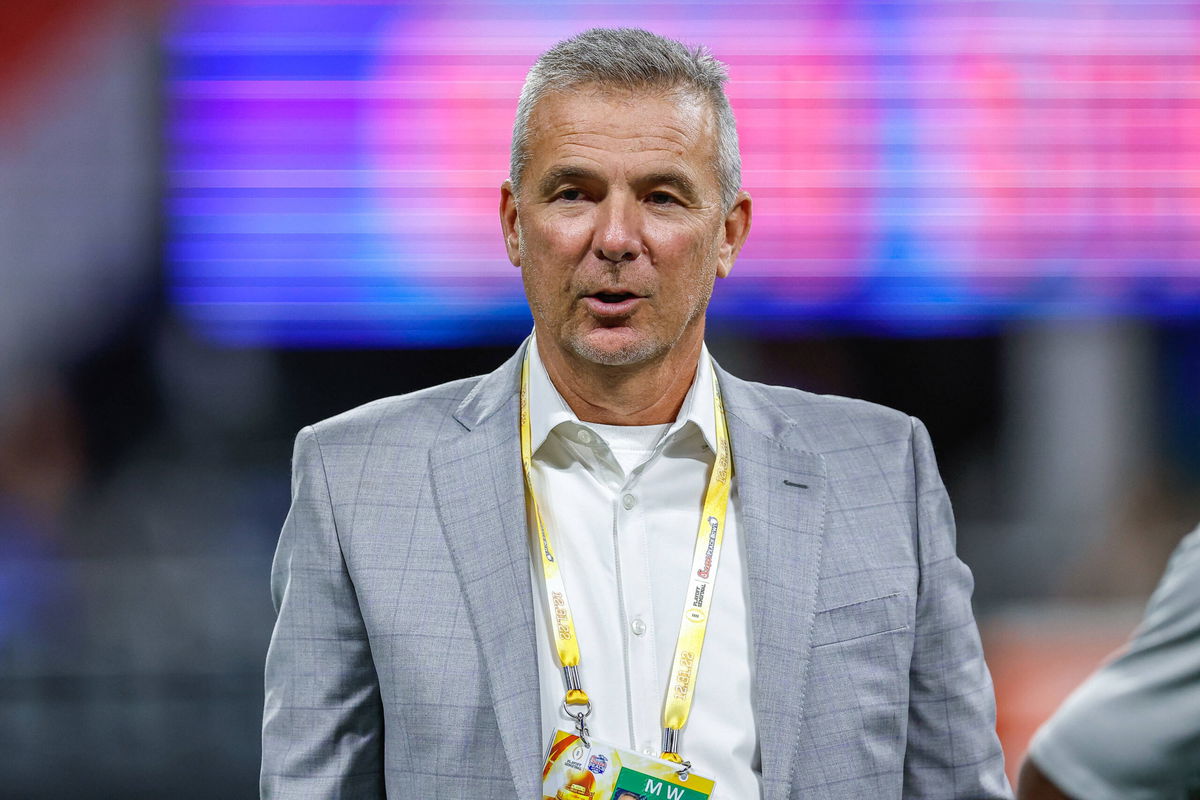
College athletics have seen some rapid transitions over the last few years. Programs are moving toward an NFL GM-style of functioning. The NIL has completely changed the financial landscape. However, for former Ohio State head coach Urban Meyer, the sport is drifting away from what made it special.
Watch What’s Trending Now!
“It certainly has in the last five years—how much further it goes, I kind of hope we tap the brakes and keep it about the university,” Urban Meyer told the WRUF show on June 27, when asked if he wants college football to turn fully into NFL style. “I’m that old guy in the room, I guess, and I’m just such a firm believer in education and a career after the sport.”
Meyer’s biggest concern is the misconception that NIL is purely about money. Millions of dollars are flowing into the college ranks, now going directly into the pockets of student-athletes. But this is not true for every player. Only a select few are getting those huge amounts that grab the headlines. For a majority, the reality stays the same, especially if you’re not part of a powerhouse program.
Yet portal activity surged: 10,965 entered the 2026 portal, with 6,700 from FBS schools. Despite the chase for NIL deals, 40% of FBS and 64% of FCS players were left unsigned, a reality Meyer believes most overlook. What ends up happening is that players don’t prioritize their education. The fact that they can transfer that easily means they often have no options if football doesn’t work out.
“The majority of people that put on a helmet, they’re going to have to go work for a living. I believe that if you get a degree from the University of Florida, make the right networking, you get good grades, you do everything right, there’s a strong… I know it. We’ve seen it. That’s the same with Ohio State and other great schools,” Meyer said.
Even during his time at Ohio State, Meyer went from the sidelines to college classrooms. He co-taught “Leadership and Character” at the Ohio State Business College. Alongside Lt. Col. Charles Buchanan, he developed a curriculum for the students. Years before NIL reshaped college football, Meyer launched his initiative to help student-athletes. He mandated a “Real Life Wednesdays” program after seeing that most of his athletes lacked basic corporate knowledge and career paths.
While education remains his top priority, NIL has also been heavily hurting the non-revenue women’s sports, according to Meyer. “I believe that if we lose women’s sports and if we lose team sports, which are the non-revenue sports, the fabric of our country will be hurt,” the former Ohio State head coach said.
Universities have long deprioritized non-revenue sports to fund major programs. Meyer argues that cutting women’s sports to fund NIL deals strips thousands of young women of educational and athletic opportunities.