
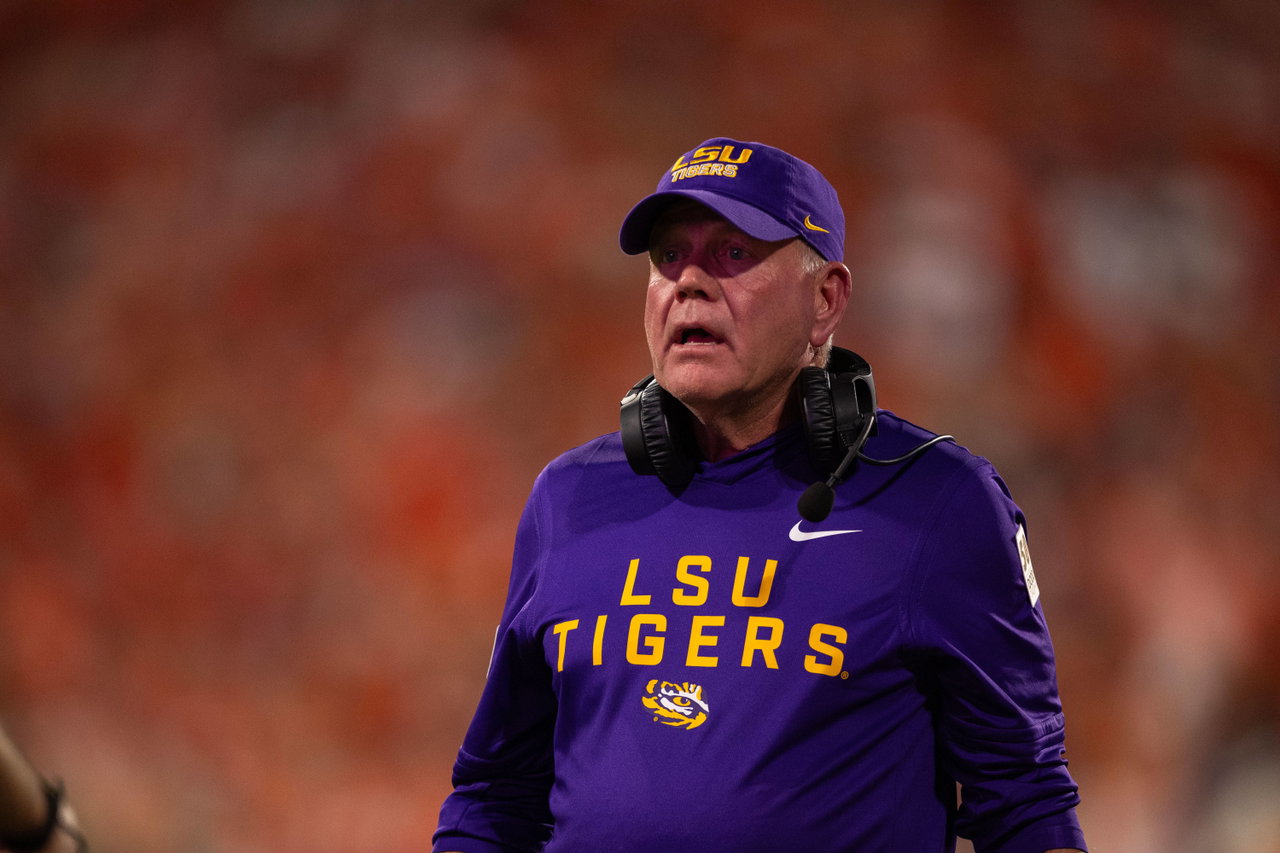
Brian Kelly didn’t get a clean exit from Notre Dame when he came to LSU. But one thing was still clear: being Notre Dame’s winningest head coach, he knew how to win. LSU handed him a 10-year, $95 million contract. However, midway through his fourth season at LSU, Kelly was shown the exit door. The fired former head coach is now opening up on what he could have done better during his time at Baton Rouge.
Watch What’s Trending Now!
“I think, certainly for me, when you’ve been fired, it’s the initial reaction to, all right, what are the things that I could have done better?” Kelly said on The Independent podcast on July 14. “There was a reason why they wanted to make a change. So, the first thing you have to do is look at the things that you didn’t do well enough. And look, at the end of the day, I didn’t win enough games.”
The most significant reason for Kelly’s firing was that LSU stopped winning the games that mattered most. He finished with a 34-14 record and reached one SEC championship game in 2022. But he never took the Tigers to the playoffs. The final straw was when the 2025 LSU team fell apart after entering the year with playoff hopes.
The Tigers lost to Ole Miss and Vanderbilt, then suffered a crushing 49-25 home defeat against Texas A&M where they gave up 35 unanswered second-half points. That loss dropped LSU to 5-3 and 2-3 in SEC play. Athletic director Scott Woodward decided the program was no longer moving toward championships. The problems also went beyond the win-loss record. During that loss to the Aggies, Kelly was caught on a live broadcast aggressively chewing out his offensive coordinator, Joe Sloan, on his headset. This highly public emotional outburst was heavily criticized as a bad look for the program.
LSU had also invested heavily in the transfer portal and surrounded QB Garrett Nussmeier with one of the country’s most expensive rosters. In return, the program got only disappointment. Tensions spiked further when the coaching staff failed to protect their recruiting borders, such as losing the nation’s top incoming freshman quarterback, Bryce Underwood, to Michigan
Unlike his predecessors (Nick Saban, Les Miles, and Ed Orgeron) who all won national titles within four years, Kelly never made the College Football Playoff, finishing with a 34-14 overall record.
“We could talk about 72 different other reasons why having a .700 winning percentage and being 22-and-3 at home is not winning. But that’s what it is,” Kelly expanded. “So, you can’t keep going back to that. You’ve got to go and look at what I needed to do better in my tenure at LSU. So that’s really what I think the most important element is, and whatever that’s called in this process. Maybe acceptance.”
Several off-field issues also damaged Brian Kelly’s standing inside the program. Former LSU defensive back Matthew Langlois publicly blasted his former coach, claiming Kelly explicitly forced him into a medical retirement before he could seek secondary or tertiary medical opinions. Langlois stated that Kelly completely ignored him the moment he was injured, stating on social media that Kelly was “genuinely one of the worst humans I’ve been around”
Reports after his firing also described concerns that he had delegated too much responsibility to assistants, rather than personally overseeing key parts of the program. Critics also questioned his involvement in recruiting and his connection with players. Anonymous people around the program told reporters they believed LSU lacked the culture and leadership expected from a championship contender.
Kelly himself later admitted he gave young coordinators too much freedom in some situations. His relationship with fans never fully recovered, either, after several public controversies during his tenure. Looking back, Kelly probably had several chances to change the story. Greater involvement in recruiting could have strengthened long-term roster building. LSU also needed better performance in marquee SEC games.
For now, Kelly has stayed active since leaving LSU. He recently accepted a role with CBS Sports as a college football analyst, calling Mountain West games while appearing on studio coverage. He has visited programs to study modern football operations and has spent time with Green Bay Packers coach Matt LaFleur. It is clear that Kelly wants another shot, and if last year’s coaching carousel was any indication, he will get that chance very soon.