
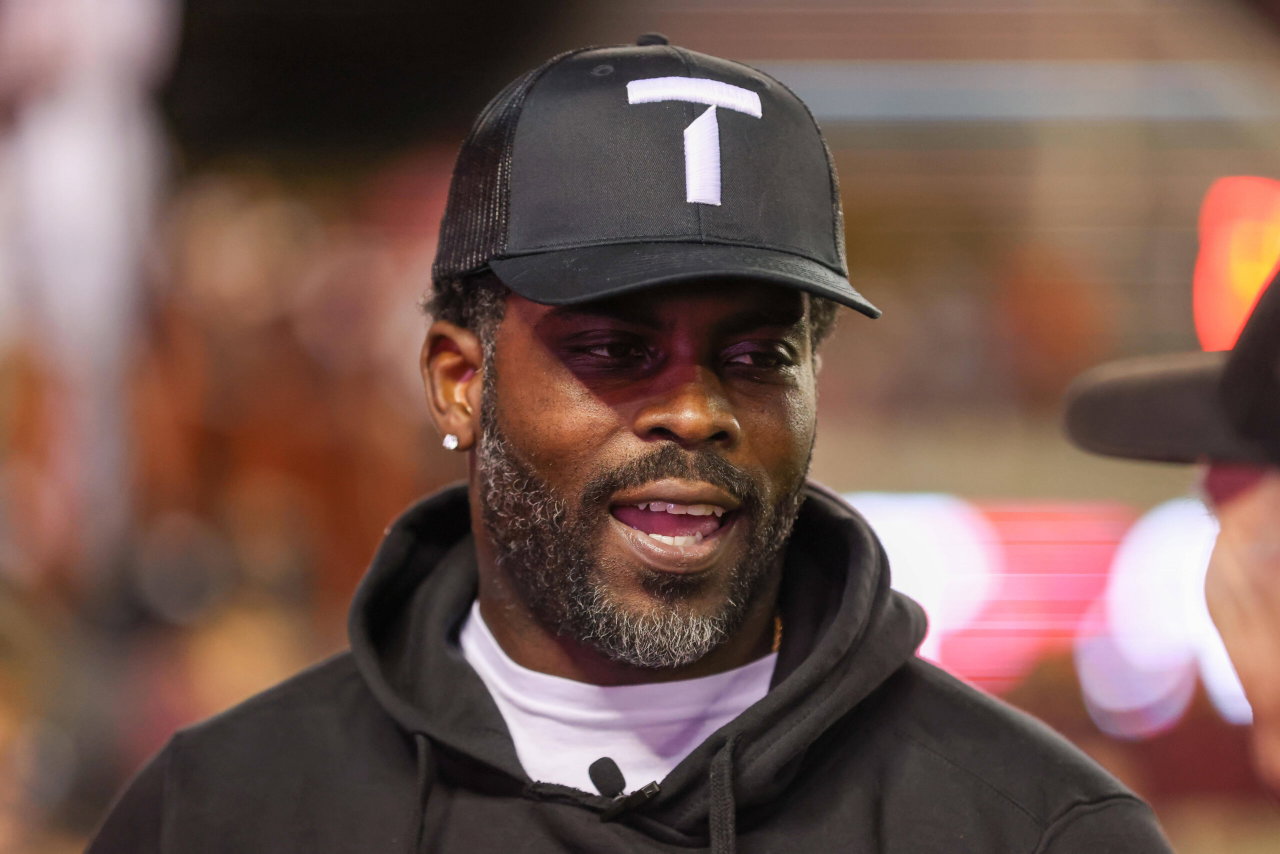
Virginia Tech retired Michael Vick’s No. 7 jersey years after he helped turn the Hokies into a national contender. The former quarterback left campus as the first overall pick in the 2001 NFL Draft. His path to the pros looked clean from the outside. Yet Vick shared that the final hours of his decision felt far less settled.
Watch What’s Trending Now!
Vick described how former Virginia Tech coach Frank Beamer played the decisive role in sending him to the NFL. Vick had wanted more time in Blacksburg, but Beamer’s call changed the direction.
“I never forget I was riding down Jefferson Avenue in Newport News. I had one hour left. Coach Beamer called me, and he said, ‘Michael, you got to do it. I’m sorry. You got to go. I know where your heart is. I know you want to be back,’” Michael Vick recalled on Beyond Ballin’ w/ Lala, describing the final moments before he decided to leave Virginia Tech for the NFL. “You know, I had everything I wanted on campus. Like… I didn’t want for anything. But he [was] kind of like… take the next step, and I was a little upset, but I did it,” he added.
The conversation aired on October 3, 2026, with the YouTube version posted around October 10. Vick liked the campus life and felt settled there, but also saw value in another year to sharpen his passing and learn how to read defenses better. The upset feeling came from leaving a place he preferred, not from any hard feelings toward Beamer.
That preference lined up with what he had said weeks earlier. On December 15, 2000, Vick stated he planned to return for another season. He had already finished his second year of playing time and two seasons of eligibility remained. He had redshirted in 1998 after arriving on campus, then played in 1999 and 2000.
Vick has said he felt peer pressure from people who kept pointing to the millions waiting in the draft. Coming from Newport News, Virginia, he saw a chance to help his family right away at age 20. Staying carried risks too because an injury or a down year could have hurt his draft spot and the money that came with it.
Those financial aspects were hard to ignore, yet Vick’s own doubts about readiness still mattered. He wanted more time to grow as a passer. His athletic skills were obvious, but he did not feel prepared for the pro level yet.
Another season could have meant one more shot at a Heisman run, a title chase, and perhaps a larger payday as the salary cap climbed.
Still, the work Vick had already done made the NFL talk impossible to set aside. His redshirt freshman year in 1999 changed how people saw him and the program. Virginia Tech went 11-0 in the regular season, claimed the Big East title, and reached the BCS National Championship Game against Florida State.
Individual honors matched the team success. Vick finished third in the 1999 Heisman voting, the highest finish by a freshman at the time. He earned Big East Offensive Player of the Year, became a first-team All-American, and took home the first Archie Griffin Award. His 180.4 passing efficiency set an NCAA freshman record. Those marks made it difficult for anyone around him to treat the draft as something he could just walk away from.
He followed that year with another solid season. Virginia Tech finished 11-1 in 2000. Vick completed 87 of 161 passes for 1,234 yards, eight touchdowns, and six interceptions. His last college game came on January 1, 2001, in the Gator Bowl win over Clemson, where he was named MVP.
Beamer and the staff had tried earlier to keep him. Conversations included input from NFL figures such as Donovan McNabb. The coach believed one or two more years would let Vick polish his game, chase bigger college prizes, and enter the league with an even stronger resume. According to Vick, that changed in the final hour when Beamer told him to go.
On January 11, 2001, Vick announced at the Boys & Girls Club in Newport News that he would skip his remaining two seasons of eligibility and enter the draft. Beamer stood nearby, visibly emotional, and told reporters the choice was right for Vick and his family.
The Atlanta Falcons selected Vick first overall in the 2001 NFL Draft, one of the youngest players ever to go that high. In May, he signed a six-year, $62 million contract that included $15.3 million guaranteed over the first three years and a $3 million signing bonus.