
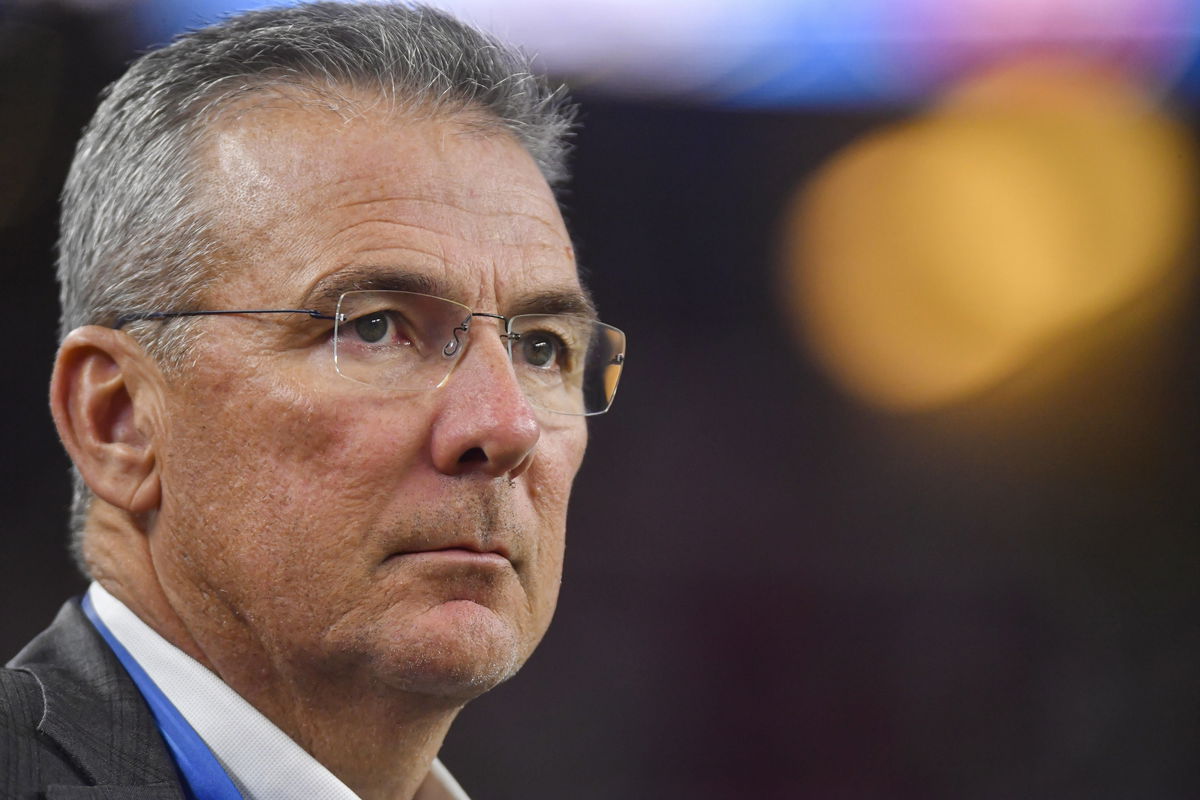
For Urban Meyer, to seal his Ohio State legacy, there were numerous happy coincidences, but none like his 3-star QB from Glenville High School. Coming into a stacked QB room at Ohio State, no 3-star recruit expects to start right away, and likewise, Cardale Jones redshirted in 2012. There was no game action, no starter snaps, just unlimited grind under OSU’s pressure cooker environment. But you see, he only wanted to play football.
Watch What’s Trending Now!
So much so that he even declared he didn’t come to Columbus to play “School” and classes were “pointless,” as he tweeted publicly, drawing widespread backlash. In practice, though, he always made it seem like he was there to play just football. The dedication, the relentless drive, and the hunger were waiting to be reaped. That’s when head coach Urban Meyer named him Ohio State’s QB1 just two games before the 2014 national title game.
“My heart warms up because I love those three guys. They are all major contributors to a historically strong program,” Urban Meyer said on his Triple Option podcast. “J. T. Barrett, I believe, still holds most of the records. Braxton Miller, I tell people, [is] the most underrated player that’s ever put on a Buckeye jersey.”
But there’s something special about Cardale Jones, Meyer’s 3-star, little-known recruit, something no QB showed Meyer.
“Cardale Jones, I’m gonna fight it. At some point, I’ll even donate to it. He deserves something in that stadium for what he did [for the team],” Meyer concluded.
Meyer had three standout QBs for his 2014 campaign. Braxton Miller was initially his starter, but he suffered a shoulder injury in the preseason. That elevated J.T. Barrett to QB1, and the team dominated throughout the season with him under center. The Buckeyes were 11-1 when Barrett broke his ankle late in the Michigan game. Enter third-string QB, Cardale Jones, who had just 19 pass attempts before Meyer gave him the responsibility.

Ohio State's QB room was STACKED in 2015 under Urban Meyer 😤
“J.T. Barrett goes down, and Mickey Moradi, our strength coach, gives me the signal, which means he broke his leg. I was like, “Oh God,” Meyer said on ‘The Script’ podcast while speaking to Jones last month. “Cardale is such a big dude. I grab him by the shirt, and I said, ‘Okay, here’s the play, you can do this, Cardale,’ and give him the play, and I kept yelling at him real loud, and I hit him on the bu-t. He kind of jogs out there. I’m thinking, ‘There’s no way in hell he can do this.’”
Initially, Urban Meyer was right, and nerves took over as Ohio State managed to scrape past Michigan. A week later, when the Buckeyes played Wisconsin in the Big 10 title game, it was a different story. Cardale Jones passed for 257 yards in the game, as OSU won 59-0. Then came Nick Saban’s Alabama in the CFP semifinals. It was a test, but nothing that Jones couldn’t pass.
He passed for 243 yards as OSU made it to the national championship game against Oregon. Where many third-string QBs would have faltered, Jones proved clutch in key moments. It didn’t look like OSU’s former #12 was playing his first real season under center. The passes flowed smoothly, the mobility was excellent, and Jones was efficient, scoring two touchdowns as OSU won its first national title since 2002.
“To me, they ought to build a statue of Cardale Jones,” Meyer revealed on ‘All Things Covered’ podcast in 2023. “Beat Wisconsin 59-0, beat Alabama, and then he goes on to beat Oregon. And that’s one of the greatest runs of certainly Ohio State history.”
Jones passed for 860 yards in the 2014 season, and every single one of those yards came under immense pressure. Although he won the starting QB role later in the 2015 season, he couldn’t keep it, and Meyer eventually opted to rotate him. Despite some turnover issues and rhythm problems in 2015, what matters is Jones’ role in leading the team to the national championship. For that, he deserves at least a plaque in the stadium. And Meyer is making sure it happens.
Urban Meyer wants Ohio State to mimic Alabama’s blueprint in honoring its legends
Unlike other programs like Alabama, Ohio State has a thin list of names immortalized around its stadium. There’s Archie Griffin’s bronze statue, in honor of his winning the Heisman Trophy twice. Legendary head coach Woody Hayes also has a statue near the stadium, and several other legends, like Eddie George and Les Hovarth, have their numbers retired and displayed on the stadium facade. For Urban Meyer, though, that isn’t enough.
“You know, if you ever made me an AD, I would have so many statues and so many plaques,” Meyer remarked in an episode of the Triple Option podcast. “Some places do it. I know Alabama’s got stuff all over the place. I love Ohio State; I’m a Buckeye. Where are the statues? The fans eat that up, and more importantly, there are players that are deserving of bringing your kid to a game someday and say, look, that’s your father right there.”
In a sense, Urban Meyer is right: Cardale Jones deserves a place on the stadium’s facade and his name immortalized in Buckeye history. Because for many, his feat may look ordinary. But the former OSU HC, having experienced his prowess first-hand, knows how hard all of it was.