Imago
Mandatory Credits: @r/TheResourceNetwork/Reddit
Imago
Mandatory Credits: @r/TheResourceNetwork/Reddit
Indiana football is sitting at the center of two competing realities in modern college athletics. On the field, it represents proof that the sport’s product is thriving, unpredictable, and capable of delivering stories no professional league can replicate. Off the field, it sits inside a financial ecosystem that is growing richer, more complex, and more strained by the month. That tension framed everything Indiana AD Scott Dolson said this week.
Watch What’s Trending Now!
The Big Ten is poised to generate more than $1 billion in revenue this fiscal year, yet the conference continues to explore new funding models. That’s the backdrop for a private equity discussion that has split opinion across the league. Front Office Sports brought that debate into sharp focus during National Championship media day on January 17. Reporter Amanda Christovich asked Scott Dolson directly whether Indiana had considered school-specific private equity and where he stood on the broader Big Ten proposal.
“We haven’t considered any school-specific private equity,” Scott Dolson said. “But I was really supportive of the vision that Commissioner Petitti has and was really looking at how we modernize our conference, our 18 schools together, to maximize the value. And there are lots of things on the table when you do that, including private equity.”
From Scott Dolson’s perspective, the Big Ten’s academic foundation and governance structure are non-negotiable. Any investment model, he said, must preserve institutional control over operations and student-athlete priorities.
Has Indiana considered any school specific private equity?
Indiana AD Scott Dolson shares his views on PE in the Big Ten with FOS reporter @achristovichh at National Championship media day. pic.twitter.com/JboHp9u3VB
— Front Office Sports (@FOS) January 17, 2026
“Any type of investment we would have, any type of futuristic model would keep those foundational values,” he added. “But then at the same time, maximize the opportunity so we can provide more resources for all our schools.”
As first reported by Sportico, the Big Ten has worked with market advisor Evercore to seek private equity offers that could provide upfront cash to member schools. Athlete revenue sharing is set to become a permanent budget item, forcing departments to find new money without sacrificing other priorities.
Tony Petitti has been open about why the conference is even considering this path. In July, he told The Athletic that the Big Ten is evaluating how professional leagues centralize operations and create efficiency. The question, as he framed it, is whether a strategic capital partner could accelerate that process. The answer, he said, is still uncertain, but the evaluation is ongoing.
For public universities, uncertainty comes with complications. Ohio State AD Ross Bjork pointed out that public institutions are state entities, making private equity deals legally and structurally difficult. He said there are more questions than answers at the institutional level, which helps explain why no school has moved forward independently.
Scott Dolson echoed that skepticism back then, suggesting Indiana would first look internally for solutions. His emphasis remained on leveraging the collective value of the Big Ten’s 18 brands rather than chasing standalone capital.
Outside voices see both upside and risk. Adam Breneman, a former Penn State and UMass TE turned media executive, noted that private equity offers immediate capital and professionalized operations. The cost, he said, is shared control. Those concerns have already cooled enthusiasm elsewhere.
Imago
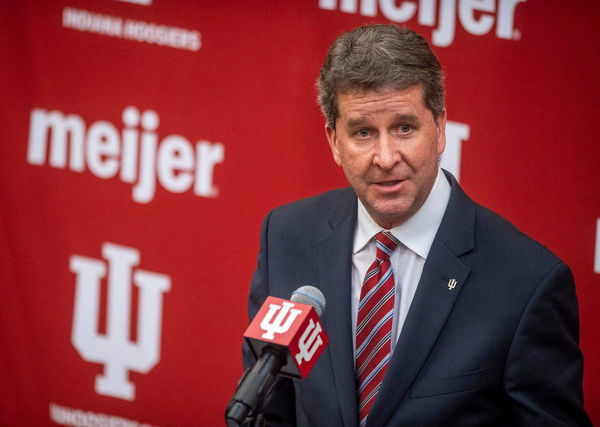
Syndication: The Herald-Times Vice President and Director of Intercollegiate Athletics Scott Dolson introduces Indiana s newly announced head coach of football Curt Cignetti on Friday, Dec. 1, 2023. , EDITORIAL USE ONLY PUBLICATIONxINxGERxSUIxAUTxONLY Copyright: xRichxJanzaruk/Herald-Timesx USATSI_22009000
The Big 12, ACC, and SEC have all backed away from serious private equity pursuits, and Florida State has slowed its own exploration after resolving its legal dispute with the ACC. That hesitation becomes far more consequential when it collides with resistance from one of the conference’s most powerful brands.
Michigan slams Big Ten private equity
Michigan football has made clear it views private equity as a red line. In November, a member of the university’s Board of Regents openly questioned the Wolverines’ long-term place in the Big Ten if the league proceeds without unanimous consent. The proposed deal, involving a reported $2.4 billion investment from UC Investments in exchange for a 10 percent stake in Big Ten media and sponsorship rights, has drawn sharp criticism in Ann Arbor.
Under the proposal, UC Investments would receive 10 percent of revenue for 15 years, after which it could sell its stake. The remaining 90 percent would be distributed among member schools, with payouts tied to earning potential. Michigan and USC have reportedly objected, while the other 16 schools appear aligned.
Regents Jordan Acker and Mark Bernstein have labeled the idea short-sighted and reckless. Acker went further, saying independence could be considered when the current media rights agreement expires in 2036 if the league moves forward over Michigan’s objection. Indiana, through Scott Dolson, has positioned itself carefully in the middle. Supportive of modernization but open to discussion.
Related Newsletters