
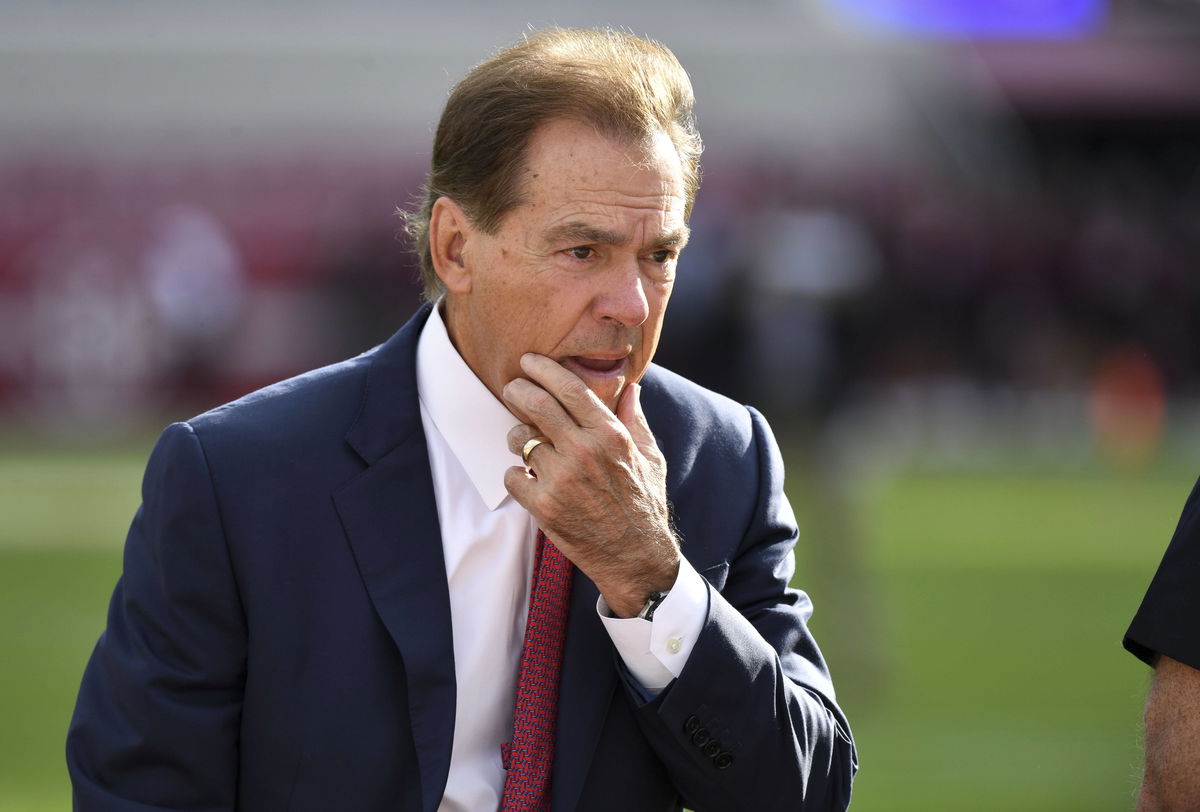
Imagine firing a guy who went on to win seven national championship rings and became the undisputed GOAT of college football. Hard to picture, right? But long before the trophies and the Alabama dynasty, a 30-year-old Nick Saban actually got handed his pink slip at Ohio State. He was working as the Buckeyes defensive backs coach back then, and when Pat McAfee asked him on air if he had ever been fired, Saban owned it without hesitation.
Watch What’s Trending Now!
“Yeah, I got fired when I was a defensive back coach at Ohio State,” Nick Saban said on The Pat McAfee Show. “I actually love Ohio State. I’ve always liked Ohio State. I loved it when I coached there. It’s a great institution, so it was my fault I got fired. I can’t blame anybody else for that.”
The Hire
Before coming to Columbus, Saban was a young, rising assistant who spent the 1978 and 1979 seasons coaching defensive backs at West Virginia University. Ahead of the 1980 season, Ohio State head coach Earle Bruce, the legendary head coach who had taken over for Woody Hayes, needed a replacement for Pete Carroll (yes, that Pete Carroll), who had left the Buckeyes to become the defensive coordinator at North Carolina State.
Saban was hired to fill Carroll’s shoes, taking over as the defensive backs coach for the 1980 and 1981 seasons.
In the span of those two years, the Buckeyes won 18 out of 24 games with 3 losses apiece in each year. 1980 saw losses to UCLA, Michigan and Penn State in the Fiesta Bowl. 1981 saw losses to Florida State, Wisconsin and Minnesota.
These are successful years no matter which metric you come at this from. But the number of points allowed had increased. That Buckeye defense had given up 15.1 points per game in 1980, which increased to 21.1 points per game in 1981. Saban didn’t know it at the time, but the writing was on the wall.
The Fire
The firing happened right after the 1981 season. Despite grabbing a share of the Big Ten title with Iowa, the defense came under scrutiny.
The breaking point came at the Liberty Bowl in Memphis on December 29, 1981. It was a cold, rainy day, and Ohio State barely scraped past Navy with a 31-28 win. Navy was a run-heavy team that rarely threw all year, yet they shredded Saban’s secondary for 240 passing yards and two touchdowns. The leaky pass defense, three turnovers, and blocked punt made the close win feel like an embarrassing loss to leadership.

Ohio State escaped, but Earle Bruce had apparently seen enough. After the game, he was already furious with the performance. A conversation involving DC Dennis Fryzel and reporters added more fuel. By the time the staff returned to Columbus, things had gone south. The coaches were called into an early-morning meeting. Then and there, Bruce fired Fryzel, DL coach Steve Szabo, and Nick Saban.
Saban was trying to teach high-level, complex defensive coverages to a group made up mostly of underclassmen. Years later, Saban realized he pushed too much too fast on young players, which created costly mistakes on the field.
“What it made me realize is that you have to work to please the person that you’re working for,” Saban was quoted years later. “I really look back at all of the things that I did, the mistakes that I made, and even sometimes if you’re right, it’s not worth it to be right.”
The Aftermath
For Nick Saban, it was the first and last time he would hear those words as a coach. He was understandably stunned. Speaking to the Citizen-Journal after the dismissal, he did not sound like someone who thought his defense had been perfect. He admitted that the unit had struggled against Purdue and Minnesota. But he also stood behind his players.
“Everybody said this year the only way to beat Ohio State was to throw the ball,” he said then. “Well, we had three sophomores and a freshman starting, and I wouldn’t trade those kids for anybody else in the world. They worked hard, they came to all the practices, they never got down on themselves, and they got better… We were all doing the best we knew how to do. I can walk tall. I’m not ashamed.”
In a strange twist of fate, Saban actually went to coach at Navy for the next year. His coaching path would take him to a lot more places such as Michigan State, Toledo, LSU, and even the NFL spots of Houston, Cleveland and Miami, before he would find his final home at Tuscaloosa.
But back then, it was Nick Saban at just 30 years old. The future wasn’t obvious yet. There was no Alabama dynasty, no seven national championships, no reputation as the sport’s ultimate program builder. Just a young defensive coach who was already showing he’s a players’ coach. The firing did not exactly hurt his career in the long run.
Nick Saban moved on, kept climbing, and eventually became the most successful coach college football had ever seen. More than four decades later, though, he still refuses to blame Earle Bruce for what happened in Columbus.