
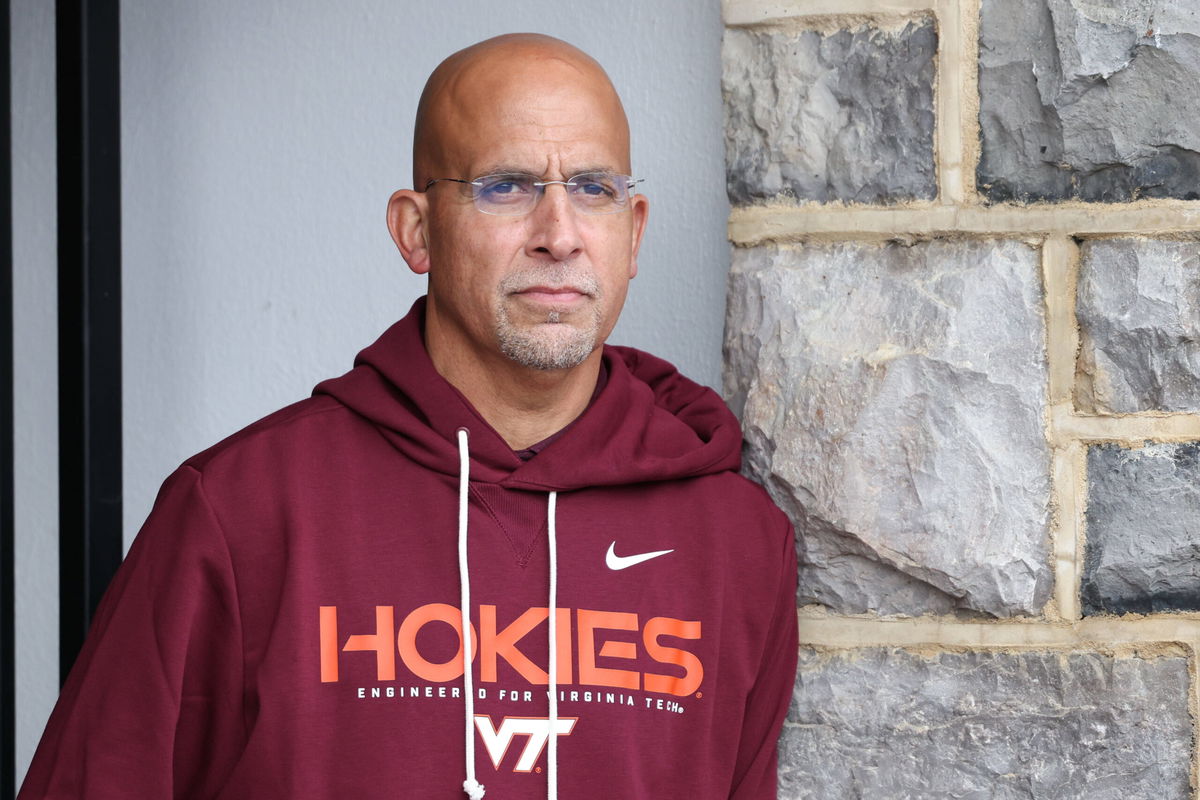
The coaching carousel waits for no one. Last year, we saw a record number of head coaches being fired and new faces stepping in. There was also some shuffling around, with the likes of LSU poaching Lane Kiffin away from Oxford. Among the noise, the James Franklin transition to Virginia Tech is considered one of the more smooth head coaching changes. But for the man himself, there is an element of fatigue involved that no one else is privy to.
Watch What’s Trending Now!
Penn State fired James Franklin in 2025 after three back-to-back losses, despite his dominant 2024 playoff season. Of course, Franklin had some issues, including his failure to win against ranked opponents. A few months later, he accepted the Virginia Tech job. In hindsight, the former Nittany Lions coach wishes that there had been some time between the switches.
“In some ways, I wish there was a little bit more time because you’re going through a process, right?” Franklin said on the August 7 Virginia Tech Athletics’ podcast. “It’s 12 years you’ve given yourself and your family. You’ve poured your heart and soul into something, and all of a sudden it changes like that, and you don’t have a whole lot of time to process it, right? You’re trying to process it.”
“You’re trying to learn. And you’re trying to grow. But we tell the players all the time that you need to be constantly growing and learning and evolving and getting better… But as you’re doing those things, you’re trying to take the time and you say like, you know, you wanted to get back in, but it took some time.”
Even though Franklin had an incredible 2024 season with Penn State, the program regressed a year later. Not only did his team lose games against top teams like Oregon, but it also failed to show up against struggling teams. So, when James Franklin couldn’t quite lead his team to a win against Northwestern on October 11, PSU decided to part ways with him despite a $49 million buyout.
After exiting Penn State, Franklin didn’t sit idle. He appeared on College GameDay with Nick Saban and Co., echoing his desire to continue coaching. Even Nick Saban felt his firing was “unfair” because the expectations he himself had created got him the axe.
When he was hired in 2014, PSU was heavily crippled by NCAA sanctions, and recruiting was abysmal. However, in just two years, he turned the program around and won the 2016 Big Ten championship. Then, 2024 was probably the peak. He reached the playoff semifinals; his team was just one good Drew Allar throw away from the national title game. Beyond that, he developed elite recruiting from scratch and consistently produced top-10 classes.
That record was also the reason several programs started chasing him immediately after the firing. He left Happy Valley with a stellar 104-45 record. But also because firing him for three-game losses over his 12 years of development seemed absolutely unfair. Programs including Arkansas, Florida, UCLA, and Maryland pursued him immediately. At last, though, he landed at Virginia Tech.
VT has now offered him every resource, including their $229 million ‘invest to win’ initiative. This financial restructuring immediately elevates the Hokies into one of the highest-funded athletic programs within the ACC.
The administration fully backed Franklin’s roster overhaul, helping him bring over critical impact players like former Penn State quarterback Ethan Grunkemeyer and elite tight end Luke Reynolds.
The school has also tried to remove all financial bottlenecks, granting Franklin the necessary salary pool to build a premium assistant coaching and recruiting staff. All in all, it is estimated to be a whopping $15.5 million per year coaches’ salary pool. Never mind Franklin’s own 5-year $41 million contract.
The athletic facilities are undergoing aggressive physical upgrades, with extensive construction projects such as a fully revamped its weight room.
The Blacksburg community has also fully embraced the transition, selling out spring events and meet-and-greets across Richmond to generate maximum offseason momentum.
The schedule also offers optimism with a healthy mix of strong opponents and some cupcake battles thrown in. Franklin’s squad should comfortably build early momentum through a soft non-conference opponents featuring home matchups against teams like VMI Keydets and Old Dominion, followed by winnable regional tests at Maryland and Boston College.
However, the difficulty spikes drastically in late October and November, forcing the Hokies to play an aggressive nine-game ACC slate that concludes with three of their final four games on the road. Surviving this back half will be the real test, as Franklin must navigate intimidating road environments against contenders like Clemson, a high-powered SMU team, and a formidable Miami Hurricanes squad, before closing out the year at home in the Commonwealth Cup against Virginia.