Imago
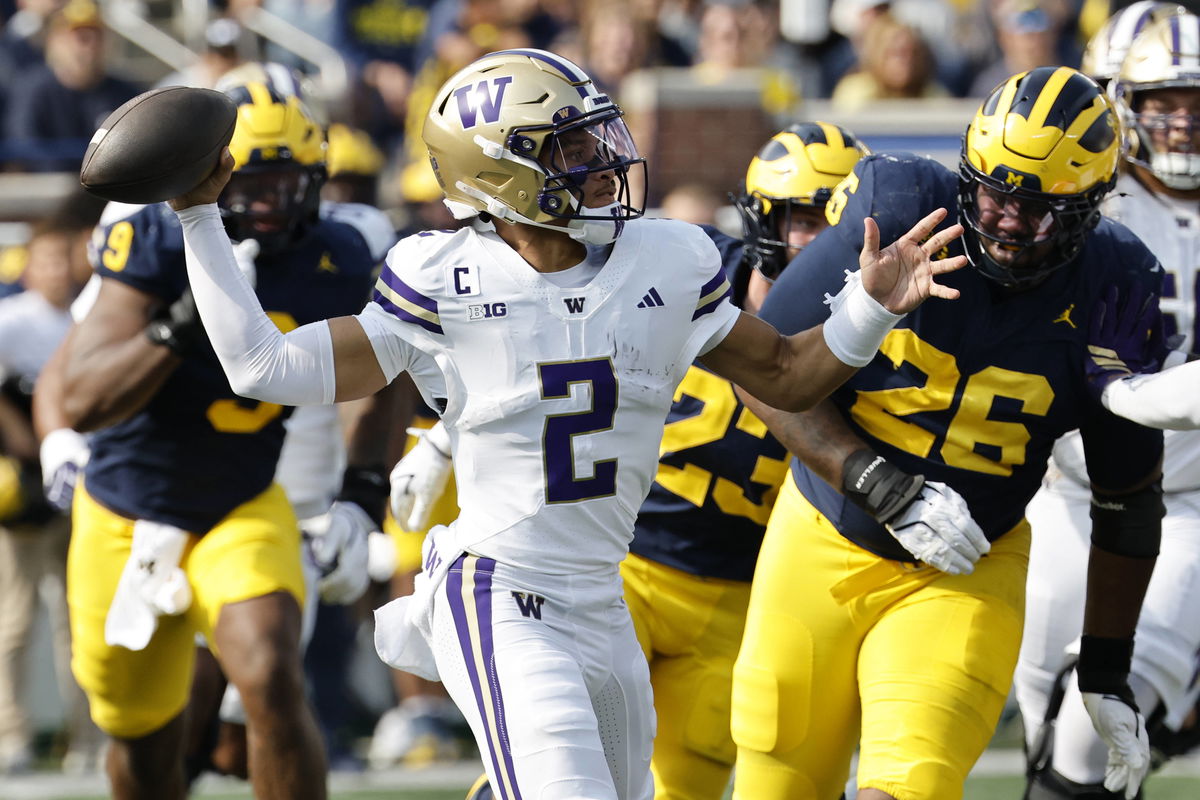
NCAA, College League, USA Football: Washington at Michigan Oct 18, 2025 Ann Arbor, Michigan, USA Washington Huskies quarterback Demond Williams Jr. 2 passes in the first half against the Michigan Wolverines at Michigan Stadium. Ann Arbor Michigan Stadium Michigan USA, EDITORIAL USE ONLY PUBLICATIONxINxGERxSUIxAUTxONLY Copyright: xRickxOsentoskix 20251018_jcd_aa1_0063
Imago
NCAA, College League, USA Football: Washington at Michigan Oct 18, 2025 Ann Arbor, Michigan, USA Washington Huskies quarterback Demond Williams Jr. 2 passes in the first half against the Michigan Wolverines at Michigan Stadium. Ann Arbor Michigan Stadium Michigan USA, EDITORIAL USE ONLY PUBLICATIONxINxGERxSUIxAUTxONLY Copyright: xRickxOsentoskix 20251018_jcd_aa1_0063
Imago
NCAA, College League, USA Football: Washington at Michigan Oct 18, 2025 Ann Arbor, Michigan, USA Washington Huskies quarterback Demond Williams Jr. 2 passes in the first half against the Michigan Wolverines at Michigan Stadium. Ann Arbor Michigan Stadium Michigan USA, EDITORIAL USE ONLY PUBLICATIONxINxGERxSUIxAUTxONLY Copyright: xRickxOsentoskix 20251018_jcd_aa1_0063
Imago
NCAA, College League, USA Football: Washington at Michigan Oct 18, 2025 Ann Arbor, Michigan, USA Washington Huskies quarterback Demond Williams Jr. 2 passes in the first half against the Michigan Wolverines at Michigan Stadium. Ann Arbor Michigan Stadium Michigan USA, EDITORIAL USE ONLY PUBLICATIONxINxGERxSUIxAUTxONLY Copyright: xRickxOsentoskix 20251018_jcd_aa1_0063
Demond Williams’ decision to enter the transfer portal, just days after he signed an undisclosed, top-of-the-market deal with the Washington Huskies, sent shockwaves through college football. What followed was public backlash, legal threats, and much more. But the sharpest criticism perhaps focused squarely on the timing of the announcement, prompting a public reaction from head coach Jedd Fisch’s wife.
Watch What’s Trending Now!
“Announces during a funeral of an athlete at University of Washington how disgusting! While all of his former teammates were at the funeral!”Amber Fisch wrote, responding to the Demond Williams situation in a public comment on Barstool Sports’ Instagram account.
Earlier this week, Washington soccer goalkeeper Mia Hamant passed away after a seven-month battle with Stage 4 SMARCB1-deficient kidney cancer, an ultra-rare form of the disease.
Hundreds of UW athletes, along with Mia Hamant’s friends and family, gathered inside Alaska Airlines Arena to mourn her life. Williams chose not to attend the funeral and instead used that day to announce his transfer decision, which intensified Amber Fisch’s frustration.
Demond Williams definitely isn’t coming back to Seattle if the head coach’s wife is calling his actions ‘disgusting’ on a public reply to Barstool Sports main IG account.
This shows that litigation against DW will just be punitive (a lot of people are probably OK with that) pic.twitter.com/SJYkPvxf0g
— Ralph Amsden (@ralphamsden) January 7, 2026
Williams explained that his U-Turn decision was driven by a desire to do what was best for his future. That reasoning did not sit well with Washington, which responded by threatening legal action and describing his contract as legally binding. The university has also accused other programs of tampering and has stated that it intends to present evidence to support those claims.

The core dispute centers on a one-year revenue-sharing agreement Williams signed with Washington, reportedly worth approximately $4 million. The deal follows a Big Ten–approved template and was designed to limit exactly this type of scenario. Under its terms, Washington is not required to enter Williams into the transfer portal or facilitate his move to another program.
Because of that language, Washington has declined to process his portal request, effectively blocking formal contact with other schools. The school has also raised concerns that Williams may have already engaged in discussions elsewhere and has indicated it intends to submit any evidence of tampering to both the Big Ten and the NCAA.
His decision to enter the transfer portal drew additional scrutiny because his profile carried a “no contact” tag. That designation suggested the quarterback already had a destination in mind, further complicating the situation and intensifying criticism. Taken together, everything points toward the possibility of an inevitable legal dispute.
Big Ten commissioner Tony Petitti has been involved in discussions surrounding the situation, with conference officials supporting Washington’s position. League leadership has framed the case as a test of whether revenue-sharing agreements can be enforced in the current college football landscape.
However, a potential legal loophole could ultimately protect Williams and prevent the situation from escalating into a prolonged courtroom battle.
The Loophole that will come in defense for Demond Williams
Currently, Demond Williams is bound for LSU, but ongoing legal complications could complicate the move. Amid the uncertainty, a prominent attorney named Michelle outlined a potential legal loophole on X that could ultimately work in Williams’ favor.
“First and foremost, Washington cannot force Demond Williams to play football there,” Michelle wrote. “Nobody in the United States can force another person to work. That would violate the 13th Amendment of the Constitution, which prohibits involuntary servitude. That simply cannot happen here.
The second thing you need to understand is that this contract is likely not a true pay-for-play agreement. It appears to be a media-rights contract. If it was modeled after the agreement involved in the Xavier Lucas dispute, then there is nothing in it that requires Williams to actually play football, nor does it seem to prohibit him from playing elsewhere.” Michelle added.
According to that interpretation, Washington would need a specific contractual provision allowing both sides to pursue injunctive relief in order to block Williams from transferring. Given that college football still operates under an amateurism framework, such provisions remain rare.
Even if Washington proceeds with legal action, similar cases suggest courts may be reluctant to prevent a young athlete from continuing his career elsewhere. The unresolved dispute involving Wisconsin defender Xavier Lucas last year highlighted the same tension between NIL-era contracts and practical enforceability.
As a result, Williams’ situation now stands more as a referendum on whether college football’s new financial agreements can carry real weight or whether they remain vulnerable once tested.
Related Newsletters