
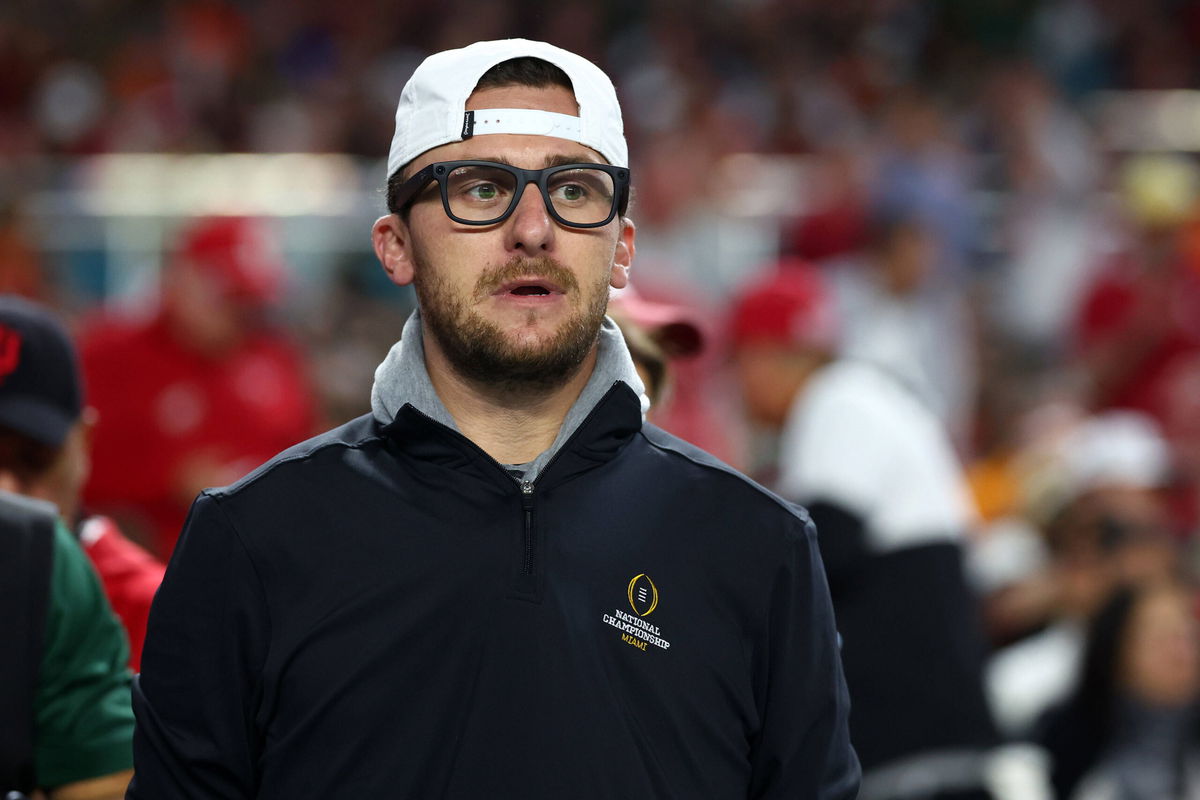
Johnny Manziel remembers the night that ended his career in the pros for a reason that still seems hard for him to believe. It was his birthday; he was in Cleveland, and he assumed the NFL would not test him the following morning. That calculation proved costly.
Watch What’s Trending Now!
Yesterday, a clip from a November 2025 podcast episode of Manziel with his former teammate, Josh Gordon, went viral. In the video, the former Browns QB revisited a December 2015 night out with former NFL receiver Dwayne Bowe.
“Shout out to Dwayne Bowe. 2015 in Cleveland, on my birthday. We went out, and he mixed up some lean, a couple cups of lean,” Manziel said. “I didn’t think they would test me the day after my birthday.”
“I came in like December 7, failed my second test for promethazine. It’s hilarious to even think about. When you fail a drug test in the NFL, they put you in the program. But they give you one more opportunity. And I’ll never forget mine.”
The incident happened just after his 23rd birthday. At the time, he was still trying to establish himself as an NFL quarterback. Less than three months later, Cleveland released him. He never played another regular-season NFL game.
The test was one part of a much bigger collapse. Cleveland took a chance on Johnny Manziel with the 22nd pick in the 2014 draft, hoping his college success would carry over to the NFL.
At Texas A&M, he had become the first freshman to win the Heisman Trophy in 2012. However, he also had several off-field issues before the draft and issues with the NCAA. Because of the history, many teams passed on him until the Browns gave him a chance.
The nickname “Johnny Football” followed him into the NFL. So did the attention that came with it. His rookie season produced little on the field.
He appeared in five games, completing 18 of 35 passes for 175 yards, with no touchdowns and two interceptions. He entered the following season hoping to show that he could become Cleveland’s long-term answer at quarterback.
The problem? Football was becoming only one part of the conversation around him. Manziel had been benched in November 2015 after videos showed him partying during the team’s bye week. Head coach Mike Pettine publicly raised concerns about his behavior.
“I don’t think we anticipated that his problems, his issues, how deep-rooted they were, the extent of it,” Pettine said to the media in 2015. “If something were to occur, I imagine the repercussions would be harsh.”
Before that, in October, Police stopped Manziel in Avon, Ohio, after an argument with his then-girlfriend, Colleen Crowley, spilled onto the interstate roadside. He told officers he had been drinking earlier that day.
Crowley said Manziel had been physically aggressive during the incident, but she chose not to press charges at the time. Finally, when the Browns’ disappointing season ended with a 3-13 record, Manziel didn’t let it linger on his head.
Manziel missed Cleveland’s final game of the 2015 season while in the NFL’s concussion protocol. Rather than stay home and attend his required medical checks at the Browns’ facility, he went to Las Vegas without telling the team.
Reports later placed him at a nightclub in disguise, wearing a blonde wig, a fake mustache, and glasses. He reportedly introduced himself as “Billy.” The birthday incident came against that backdrop.
Manziel was no longer simply a young quarterback struggling to adjust to the NFL. His habits away from the field had become an organizational concern, and the failed test added another problem to an already difficult situation.
Cleveland’s patience finally ran out in March 2016. The Browns waived Manziel on March 11, ending his tenure after two seasons. He finished with 1,675 passing yards, seven touchdowns, and seven interceptions across 14 career appearances.
Manziel later said that leaving Cleveland brought an unexpected sense of relief. By February and March 2016, he was in Los Angeles, watching SportsCenter and seeing stories about himself nearly every day.
“I was cut from the Browns, and I would turn on SportsCenter every day and see a story about myself or this and that,” Manziel said to Gordon. “People never really understood that I felt a weight off my shoulders.
“I felt liberated to not have to be in Cleveland dealing with that s–t anymore and having to be dealing with football or worried about training or anything.”
For college football fans, Manziel’s legacy isn’t so polarized. Many still remember the moments that the former Texas A&M QB created. How ‘Johnny Football’ became a sensation. And how he became a celebrity before NIL.