
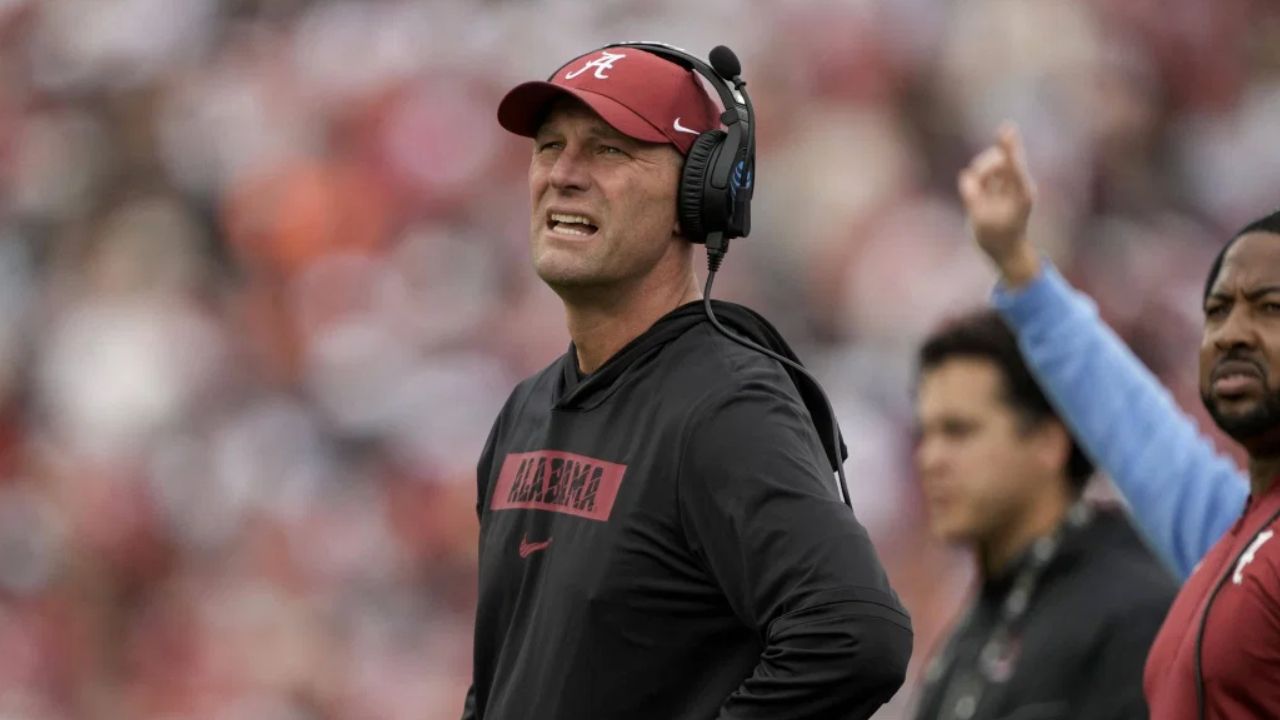
Alabama is not looking to be the program that gets left behind in the rapidly changing world of college football. But Crimson Tide athletic director Greg Byrne has also made it clear that there is a line Alabama is not willing to cross.
Watch What’s Trending Now!
Speaking on Hey Coach, Byrne gave an inside look at how Alabama is approaching the complicated rules surrounding roster building in the post-House settlement era. His message to Kalen DeBoer and the rest of Alabama’s coaching staff was clear: ‘Push the limits, but don’t break them.’
“We’ve told our coaches, if the speed limit is 75, we’re gonna have that needle right up to 75, but we’re not gonna go 95. Trying to find that right balance. The ones that have gone 95 need to have consequences for that,” Bama AD said, per Mike Rodak on X.
“When the House settlement happened, we were hoping it was going to create some guidelines and rules that we were all going to follow. Unfortunately, the enforcement end of that one was very, very slow to come out of the gates,” Byrne added.
The 54-year-old’s comments give a clear idea of how Alabama wants to operate under DeBoer.
The Crimson Tide does not want to hold itself back while other programs push the rules. At the same time, Alabama does not want to cross a line and then wait to see whether the rules are actually enforced.
His comments also come at an interesting time for the SEC, with Lane Kiffin and LSU at the center of a growing debate over how far programs should go when building their rosters.
According to Byrne, the slow start to enforcement after the House settlement created an environment where some programs felt there were not many real restrictions.
Now, he believes the College Sports Commission is starting to make progress on enforcement, although it remains unclear exactly how those rules will be applied.
That uncertainty is now being tested by LSU’s situation.
So far, Kiffin has been painted as the main villain after LSU pursued former NFL defensive lineman Zxavian Harris and DaeQuan Wright.
Kiffin, however, has defended the moves by arguing that these players were put in a difficult position by the eligibility rules. His argument is that players from the 2022 recruiting class did not get the chance to benefit from the NCAA’s new five-year eligibility structure and should not be punished for pursuing professional football before finding out that the courts could potentially give them another college season.
The SEC, however, saw the situation very differently.
The conference responded with a unanimous 16-0 vote to prohibit athletes with certain professional experience from returning to SEC competition.
But the situation may be bigger than just LSU.
According to a report from On3’s Pete Nakos, multiple SEC programs are now exploring the possibility of adding former NFL players to their rosters.
Suddenly, the SEC is not simply dealing with Lane Kiffin.
Other coaches now have to decide whether they can afford to let LSU gain an advantage while they remain on the sidelines. With very little time left to finalize their rosters, those decisions have to be made quickly.
The popular consensus is that if there had been no backlash from SEC officials or higher-ups across the Power Four, we would be seeing almost every available former rookie being pursued by multiple SEC teams.
For Alabama, however, there may not be much reason to make such a move.
Other coaches now have to decide whether they can afford to let LSU gain an advantage while they remain on the sidelines. With very little time left to finalize their rosters, those decisions have to be made quickly.
That is where Byrne’s “75, not 95” analogy becomes especially relevant to Alabama.
The Crimson Tide wants to operate close to the limit of what is allowed, but Byrne is making it clear that there is a difference between pushing the rules and going beyond them.
The bigger question is whether every SEC program will take the same approach.
If LSU’s strategy continues to spread and more teams begin pursuing former NFL players, the SEC could face a difficult choice: enforce its boundaries consistently or risk watching those boundaries become meaningless.