
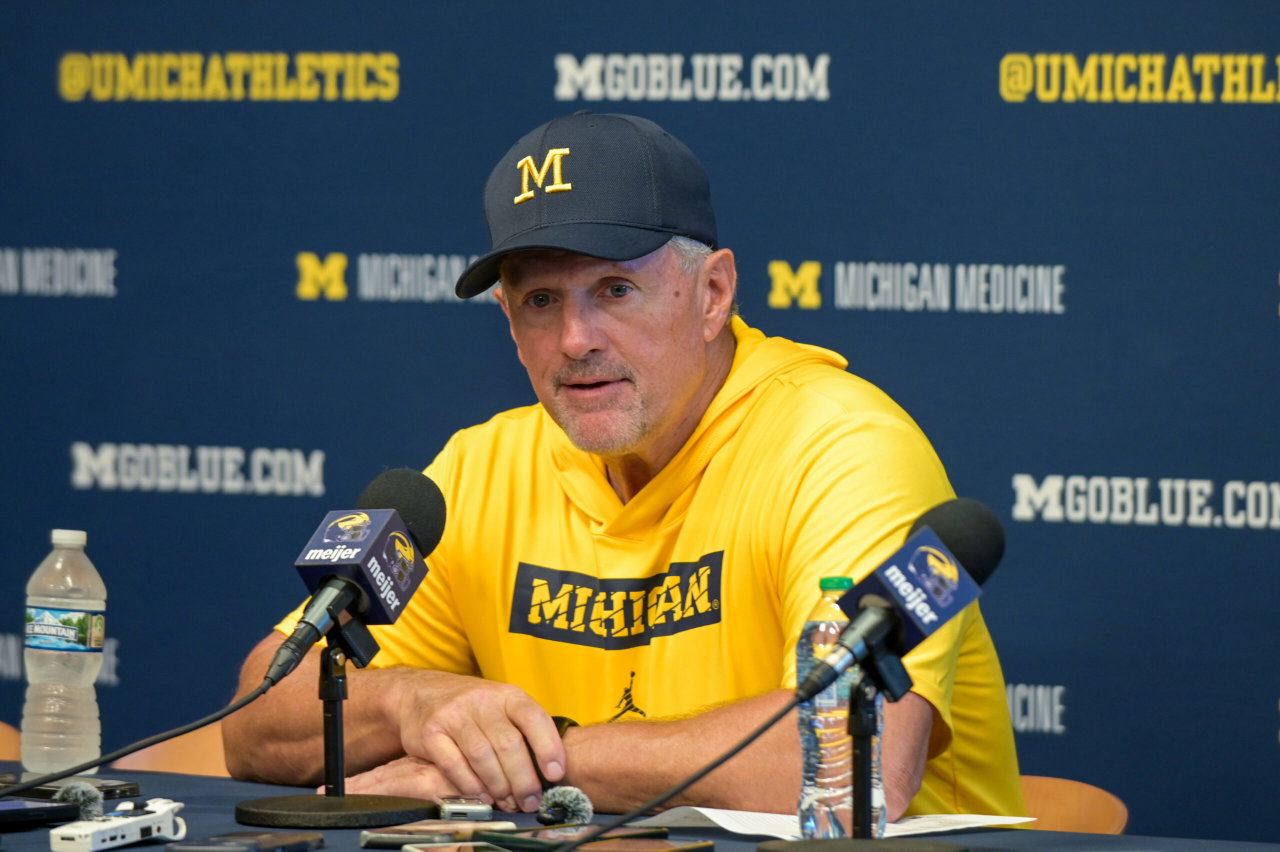
Michigan’s offense has become a complete disaster, and Kyle Whittingham has finally had enough. Another humiliating collapse against in-state rival Michigan State exposed just how badly the Wolverines have fallen apart. With the offense showing no signs of life and the pressure mounting in Ann Arbor, Whittingham pulled the plug on offensive coordinator Jason Beck. But fixing this mess comes with a staggering financial price tag.
Watch What’s Trending Now!
Michigan’s 15-6 defeat against Michigan State exposed the depth of the offensive crisis. The Wolverines managed just 192 yards and went more than 58 minutes without scoring before finally reaching the end zone with 1:35 remaining. By Sunday, Beck was out, leaving Michigan facing a reported buyout of up to $10.1 million, potentially the largest ever for a college football assistant.
“Per the terms of his contract, Jason Beck is set to be owed up to $10.1 million dollars. That’s nearly $7 million in salary and nearly $3.1 in retention bonuses. The contract is subject to offset and mitigation. It’s believed to be the biggest buyout for a college assistant,” ESPN’s Pete Thamel shared details on X on November 8.
Whittingham confirmed the decision in a statement, acknowledging that Michigan’s offensive production had fallen well short of expectations.
“The results have not matched our desired outcome, and I felt that a change in leadership was required for our offense,” Whittingham said. “We need to put our offensive players and the entire team in the best possible position to be successful.”
Offensive line coach Jim Harding will serve as interim offensive coordinator for the Wolverines’ final three regular-season games while Michigan conducts a national search for a permanent replacement.
Interestingly, Whittingham had appeared reluctant to make an immediate change when questioned after Saturday’s loss.
“Not right now. Not as I’m sitting here at this podium, no,” Whittingham said.
However, he acknowledged that patience could only stretch so far.
“But at some point, you’ve got to have results. It’s a result-driven business, and it’s a bottom line business,” he added, indicating that a broader evaluation would follow the season.
Beck arrived in Ann Arbor alongside Whittingham after serving as Utah’s offensive coordinator in 2025. Their partnership had delivered impressive results, with the Utes averaging more than 41 points per game and ranking among the nation’s most productive offenses. Michigan expected similar success, particularly with highly rated quarterback Bryce Underwood leading the attack.
Instead, the numbers painted an embarrassing picture. Through nine games, the Wolverines produced just 2,723 total offensive yards, averaging 302.6 per contest and ranking No. 132 among 138 FBS teams. Their 19.6 points per game placed them among the nation’s lowest-scoring offenses.
Those results were especially difficult to justify given Beck’s reported $3 million annual salary, which made him the country’s highest-paid offensive coordinator. His three-year contract also included retention bonuses, with offset and mitigation provisions potentially reducing Michigan’s final financial obligation if he secures another coaching position.
Quarterback instability only compounded the problems. Underwood opened the season as the starter but completed just 58.06% of his passes (72 of 124) for 924 yards, five touchdowns, and six interceptions before being benched.
Freshman Tommy Carr took over, but the offensive struggles persisted. Across five appearances, Carr completed 67.02% of his passes (63 of 94) for 641 yards, two touchdowns, and three interceptions. Against Michigan State, he went 14 of 26 for 138 yards and threw two interceptions.
Even the ground game failed to provide relief. Michigan ranks No. 109 nationally, averaging 128.7 rushing yards per game despite having Jordan Marshall, Bryson Kuzdzal, and highly rated recruit Savion Hiter in the backfield.
Beck’s play-calling also attracted criticism, particularly his use of the six-offensive-lineman “Rhino” package. Rather than consistently exploiting power-running opportunities between the tackles, the scheme frequently featured outside runs, raising questions about how effectively Michigan was using its personnel.
What Comes Next for Whittingham and Michigan?
The Wolverines enter their final three regular-season games at 5-4 overall and 2-4 in Big Ten play, with Oregon, UCLA, and Ohio State still ahead. Harding faces the immediate challenge of getting more production from a unit that has struggled throughout the season.
The situation also puts Whittingham under increasing scrutiny in his first year at Michigan. He arrived on a five-year, $41 million contract after spending 20 years as Utah’s head coach. According to the terms reported by the Detroit Free Press, firing him without cause could trigger an estimated $24.75 million payout, representing 75% of the $33 million remaining on his deal over the next four years.
That leaves Michigan facing an uncomfortable financial reality. The program could owe millions to an offensive coordinator who lasted just nine games, while its head coach carries an even larger potential termination cost.
For Whittingham, the immediate priority is salvaging the final stretch of a disappointing season. But with three difficult opponents remaining and Michigan’s offense among the nation’s least productive, the pressure to deliver results is only intensifying.