
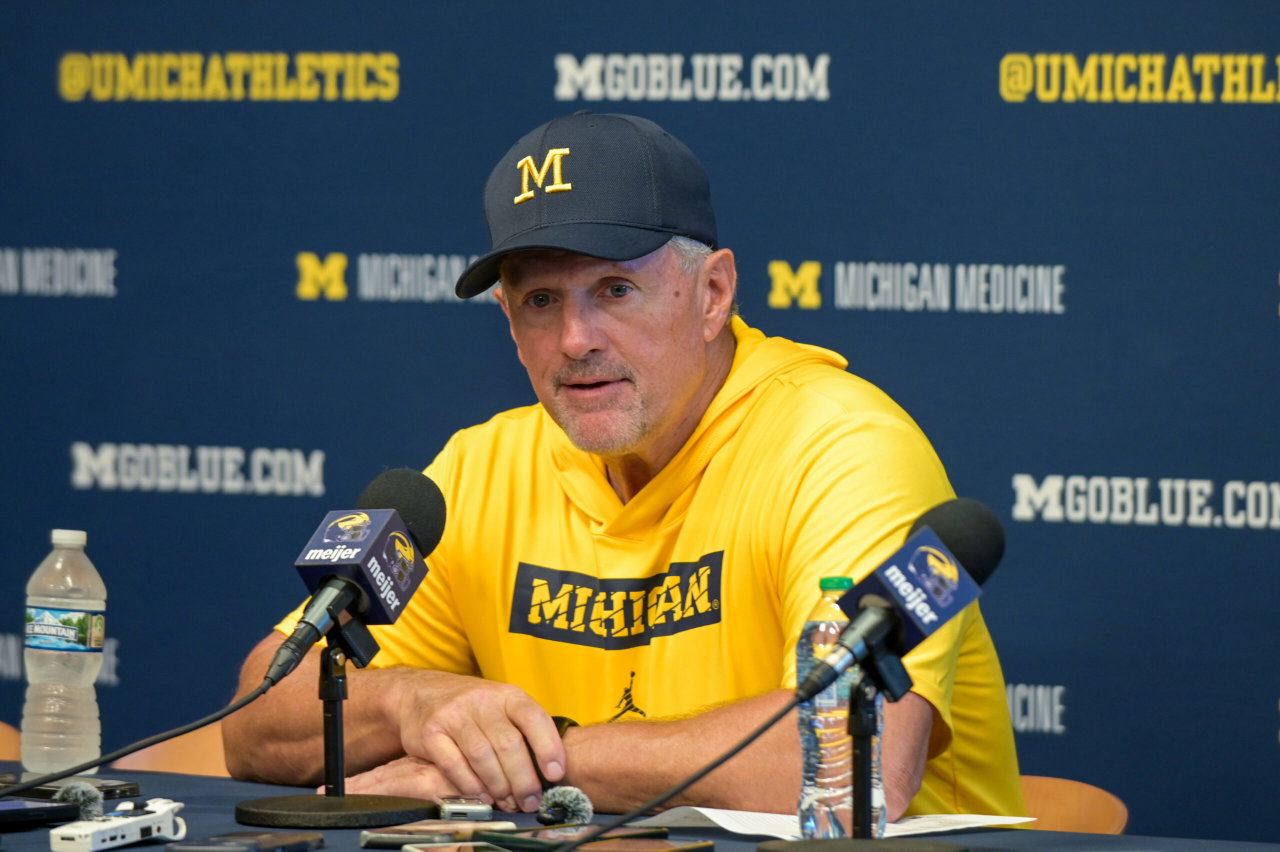
Oregon needed barely two minutes to expose Michigan’s biggest defensive problem. Dylan Raiola found Jeremiah McClellan behind the secondary for a 60-yard touchdown, and the Wolverines spent the rest of the afternoon chasing the game. Kyle Whittingham had a pointed explanation afterward.
Watch What’s Trending Now!
“I think it was more a lot of our problems stem from just trying to do too much,” Whittingham told reporters. “And just not playing within the structure and the framework of the defense.”
Michigan’s first-half coverage problems were not limited to that opening play. No. 18 Oregon hit the Wolverines with explosive passes throughout the half, including touchdown completions of 60 and 59 yards.
The Ducks went into the break with a 21-7 lead and finished with a 31-7 win at Autzen Stadium on November 14. Whittingham did not single out any player when reporters asked why the defense had struggled to contain Oregon.
“Now, you say that our defense has been lights out all year,” Whittingham said. “It’s not like it’s been a recurring problem.”
The Ducks kept finding ways to stretch the field. Raiola finished with 341 passing yards and four touchdowns, while McClellan recorded 105 receiving yards on four catches.
Oregon totaled 467 yards, and its passing attack repeatedly punished Michigan when defenders lost their assignments. Whittingham was particularly unhappy with the touchdown just before halftime.
He said there was no excuse for allowing a receiver to get behind the defense in that situation. With roughly 20 seconds left and Oregon needing 60 or 70 yards, the coverage broke down, and Oregon took the points.
“That’s something we got to look at the tape,” Whittingham said. “Let guys get behind us a couple times, missing some tackles on a couple of the big plays.”
Before the game, Oregon’s offense had been averaging 34.1 points per game. The Ducks scored 31, with most of their damage coming before halftime. Michigan’s defense actually held Oregon to 141 yards and two conversions on six third-down attempts after the break.
So, the defense was not the only reason Michigan left Eugene with a 24-point defeat. The Wolverines managed just seven points and struggled to find any rhythm at quarterback.
Whittingham used both Tommy Carr and Bryce Underwood. He explained that the plan was to give Underwood an opportunity during the third series, then decide which quarterback gave Michigan the better chance to move the ball.
Carr played most of the second half, with Underwood returning later. Neither quarterback gave the offense the lift it needed. Michigan passed for only 71 yards and went 4-for-13 on third down.
Savion Hiter provided the brightest moment, breaking off a 70-yard touchdown run in the second quarter and finishing with 107 rushing yards on 13 carries. Whittingham was not interested in dressing up the offensive performance.
“Not really,” Whittingham said when asked if he felt anything better about the offense. “Numbers weren’t much better. Pretty similar to what we’ve been experiencing all year. …There’s not really much of a spark in that regard.”
That leaves the Wolverines with problems on both sides of the ball. The defense gave up the explosive plays that put them behind, while the offense could not take advantage when the Ducks slowed down after halftime.
Michigan dropped to 5-5 overall and 2-5 in Big Ten play after the loss. The Wolverines have two games left, beginning with No. 4 UCLA at home on November 21 before the regular-season finale against Ohio State on November 28.
One more win would make them bowl-eligible. Whittingham said the players should still be motivated by that target. He acknowledged that the remaining schedule would be difficult but said the players desperately want to get there.