
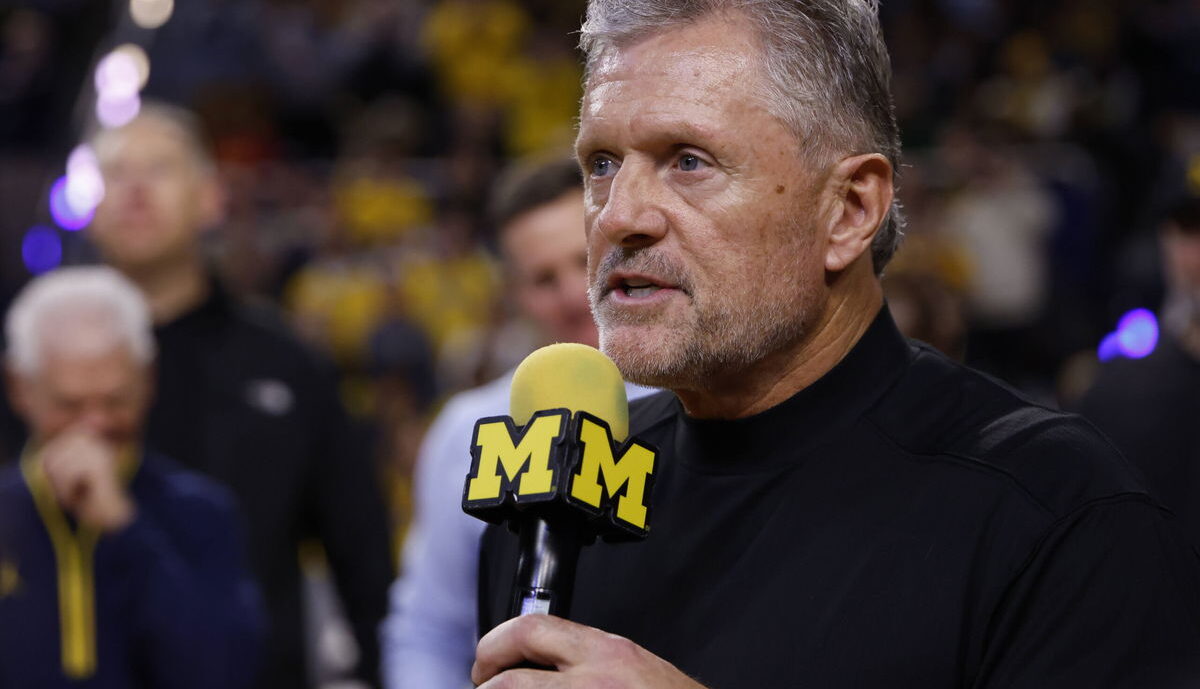
After a legendary 21-season tenure at Utah, Kyle Whittingham moved to Ann Arbor. Since taking over at Michigan, the 66-year-old coach has expressed that he viewed the move as a singular opportunity to pursue a national championship before retiring. But does that mean Michigan is his final chapter? A big hint about that came from the coach himself.
Watch What’s Trending Now!
“They just said, ‘What do you foresee?'” I told them that I feel great, and as long as I feel great and am excited and passionate about what I’m doing, I just want to keep going,” Whittingham told On3, clearing up his feelings on Michigan’s curiosity about how much longer he wanted to coach there. “We never set any kind of timeline. I’ve got a five-year contract here, and that’s fine.”
Whittingham described the move to Michigan as a way to “see this through” and explicitly called it a final challenge. But “this wasn’t a money move or contract move. This was a chance to compete at the highest level,” added the Michigan head coach. At the same time, Whittingham stated clearly that Michigan will be his last coaching job.
In Utah, his openness about a retirement timeline led to the naming of a head-coach-in-waiting and premature exit speculation. Now his Michigan move is not a short-term “bridge” role but a genuine new chapter where he feels he has “enough energy and juice.” Yet, ESPN and SI experts differ on how long he will stay at Michigan, often labeling him a “bridge hire” or a short-term solution for 3–5 years, considering his age.
At 66, he has pushed back against age-related concerns, stating he “feels like he’s 18” and is revitalized by Michigan’s resources and the challenge of the Big Ten. Even he stated his intention is to restore “physicality, toughness, and grit” to Michigan, viewing the program as a “bigger-scale” version of what he built at Utah. Urban Meyer labeled him the “best coach in college football,” suggesting that with Michigan’s superior resources, Whittingham’s ceiling is significantly higher than it was at Utah.
Then, CBS Sports noted he serves as a “rock of stability” to guide the Wolverines through their current crisis following Sherrone Moore’s firing. The 22nd Michigan head coach’s $41 million contract runs through the 2030 season, reinforcing that he is planning for a full cycle of success. While he is grooming staff like Jason Beck, his “intentions” are to be the primary architect of the program’s next era rather than just a temporary placeholder.
That vision is backed by Michigan’s formidable resources, which represent a significant step up from what he had at Utah. Where he typically built top-25 recruiting classes, he can now leverage a deep donor base and superior salary pools to land top-10 talent and bring key staff with him from the West.
Now, when and how he will live up to his plans—that’s a waiting game. But his interest in the Michigan head coaching job runs deep.
Kyle Whittingham was ready to leave
The timing of Kyle Whittingham’s departure from Utah and the Michigan opening was “uncanny.” However, he accepted the role because he viewed it as a “top-five job” and a way to pursue a national championship, which he felt was more achievable with Michigan’s superior resources. He had “significant interest” in the program vacancy immediately following Moore’s firing.
“A day or two later, the change was made here (at Michigan), and my wheels started turning and I thought, ‘Well, hey, that’s interesting,'” said Whittingham. “And then there was some discussion between my agent and Michigan, and things just started to get some traction, and once that happened, things moved along pretty quickly.”
Whittingham admitted that he would have been “pis-ed off” with himself later in life had he not taken this specific opportunity, as it finally allows him to see what he can accomplish with elite national-level support. He revealed that he has held a deep interest in Michigan since he was seven years old, when he first saw the team’s iconic winged helmets while watching CFB alone in his living room.
The Michigan head coach described the program as “special” and said it was one of only a few schools he would have considered leaving his legacy at Utah to lead.