
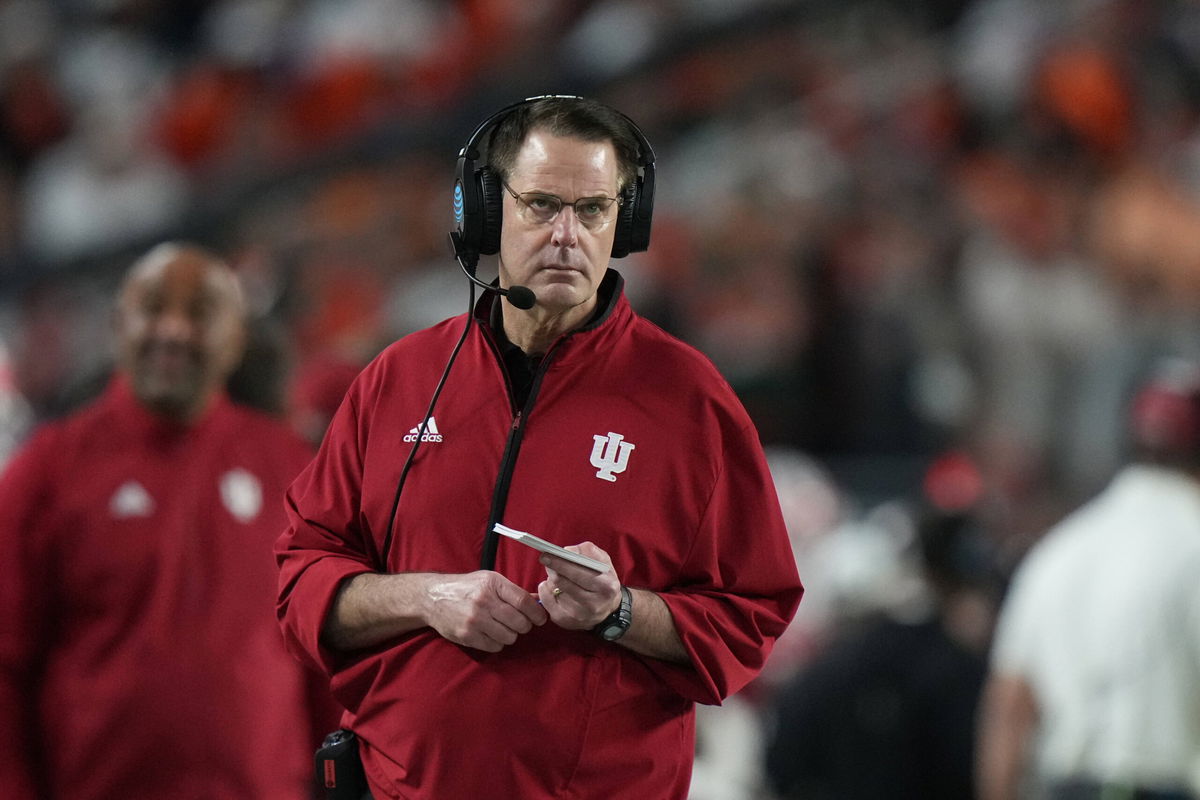
The eligibility for the Class of 2022 athletes is now a complete mess. You don’t have to look beyond Bloomington to see its effects. Just days before the 2026 season kicks off, Curt Cignetti is facing an unexpected situation with his defensive lineup. Two key players who were welcomed back to the field have found themselves blocked from playing on Saturdays.
Watch What’s Trending Now!
Hoosiers defensive linemen Stephen Daley and Kellan Wyatt have been ruled ineligible for the upcoming 2026 season. This change occurred after the U.S. Court of Appeals for the Tenth Circuit stayed a nationwide preliminary injunction that had originally allowed certain Class of 2022 athletes to play a fifth year.
All of this has gotten extremely complicated. So let’s take it back and understand how things got to such a stage.
The Original Ruling
It all started when the NCAA introduced an age-based, five-year eligibility model allowing Division I athletes to play five seasons within a five-year window.
But the catch was that any student who had already exhausted their eligibility won’t be grandfathered into this new plan. This exclusion applied to athletes who had enrolled in 2022, played four straight uninterrupted seasons, and finished by Spring of 2026.
On July 8, Northern Colorado basketball player Brock Wisne led a group of D1 athletes and sued the NCAA. The law being relied upon was the Sherman Antitrust Act of 1890. The athletes argued that the NCAA was illegally stopping them from participating in the world of college athletics and earn compensation.
On July 31, U.S. District Judge Charlotte N. Sweeney sided with the players and issued a nationwide class preliminary injunction.
“Recall, regardless, that on one side of the ledger is an entire class of students’ potential ineligibility to play sports due to the NCAA’s Rule and implementation, certainly a form of irreparable harm,” Sweeney said while rejecting the NCAA’s motion to pause this order on August 10.
She further expressed that the current roster chaos was a product of the NCAA’s own flawed eligibility transition rule in the first place. “This does not absolve the NCAA of its obligation to comply with federal antitrust law, nor does it absolve the Court of its obligation to apply that law to the facts of this—or any—case,” Sweeney said.
The Challenge
This ruling sent athletic departments into a panic just weeks before the fall semester. NCAA Chief Legal Officer Scott Bearby penned an emergency memo to member universities slamming the decision.
“The District Court of Colorado’s decision is egregiously wrong,” Bearby wrote in a memo. “The court’s decision to certify a nationwide class and grant sweeping injunctive relief with virtually no evidence, and without witness testimony or even so much as a hearing, invites further chaos in college sports and irreparably harms thousands of student-athletes already on campus.”
A rapid legal escalation unfolded over the next three weeks, which eventually reached the U.S. Court of Appeals for the 10th Circuit. The NCAA was seeking a stop to the original decision, and they got it.
On August 21, a three-judge panel voted 2-1 to grant the NCAA’s emergency stay. The appellate court basically stated that a case for irreparable harm had been made if the original ruling from Judge Sweeney was allowed to stand.
The Chaos
Now, the entire Class of 2022 is back to being declared ineligible. This bring us back to Indiana where defensive linemen Stephen Daley and Kellan Wyatt had both exhausted their four seasons of eligibility after last season but had returned to the Hoosiers, relying on the federal injunction by Judge Sweeney.
Both athletes can continue practicing with the team, but their status remains unresolved, and an appeal is expected soon.
The Hoosiers spent the last few weeks preparing the defense with these two veterans factored into the game plan. Speaking earlier about the unpredictability of the offseason, head coach Cignetti noted, “Nobody really has a crystal ball and knows what the future holds.”
Daley had transferred from Kent State for the 2025 season. His season ended with a knee injury while celebrating with fans after the team’s Big Ten Championship win over Ohio State.
After transferring from Maryland, Wyatt’s season was also cut short by a knee injury during the Week 8 game against Michigan State.
Both were recovering well in camp, and Cignetti said their return “makes us a better football team.” The head coach added, “I think Daley will be ready to take some 11-on-11 reps next week, with Wyatt a little bit behind him… we’re not rushing either.”
The Exceptions
What we said earlier is not the complete truth. There are some players who will not be affected by this new decision.
The reason is that a federal court’s decision cannot directly overturn a decision reached in any state court. This is a fundamental rule of the American legal system.
So, anticipating that the NCAA might win a stay in the federal case, several groups of players and their lawyers filed entirely separate cases inside state courts. The most prominent example is a group of 16 football players who filed a localized lawsuit in the 19th Judicial District Court of Louisiana.
They won that case which allowed players like tight end Dae’Quan Wright and defensive lineman Zxavian Harris to legally exit their NFL training camps, enter the transfer portal, and rejoin college rosters.
Unfortunately Indiana’s Stephen Daley and Kellan Wyatt were benched because they did not have their own state lawsuits. They were relying entirely on Judge Sweeney’s broad federal umbrella. When that umbrella folded, they had no protection left.
This would sound unfair but a Class of 2022 athlete playing at Ole Miss or Gonzaga may be legally allowed to take the field due to a state-level court order, while an identical Class of 2022 athlete at Indiana University is forced to sit out.
Indiana’s next moves as time runs out
Indiana and the players still have a few possible legal routes to explore. One of the most common options is seeking a temporary restraining order or a preliminary injunction in a state court.
For example, Indiana basketball player Sam Alexis remained eligible through a separate Tennessee state-court injunction, and the NCAA’s attempt to stay that specific order was denied. Daley and Wyatt could take a similar path, or they could wait for the Tenth Circuit’s full ruling on the appeal.
While losing Daley and Wyatt hurts, Indiana’s current roster gives Cignetti enough protection on the field. The Hoosiers brought in additions like Chiddi Obiazor and Tobi Osunsanmi from Kansas State, as well as Josh Burnham from Notre Dame.
Still, welcoming two proven veterans back, only to lose their eligibility a few days before the season has to start, creates a truly frustrating situation for the defending champions.