
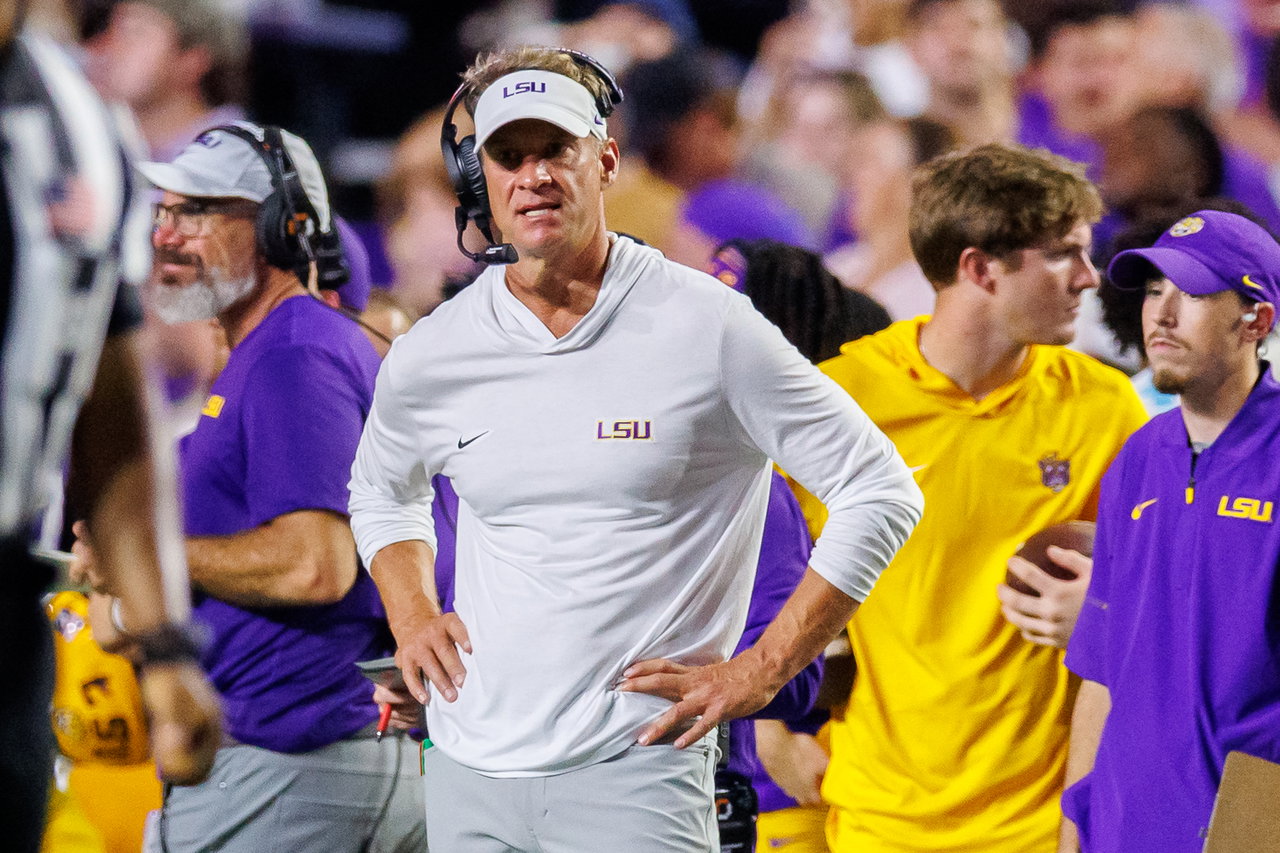
LSU went all-in on the transfer portal in Lane Kiffin’s first season in Baton Rouge. The Tigers brought in a new QB, overhauled the O-line, and added fresh faces across the roster. The early results have been mixed, though, and GM Billy Glasscock has offered a glimpse of how the program intends to approach roster building from here.
Watch What’s Trending Now!
“You’re probably going to be a little more balanced than we were our first year,” Billy Glasscock said on Louisiana Loaded. “I don’t think you’re ever going to have one extremely more than the other.”
That does not mean LSU is abandoning the portal. Instead, the Tigers want to find the right mix of experienced players who can contribute immediately and high school recruits who can develop into long-term starters. But even if Kiffin recruits elite young talent, there’s no guarantee those players will stick around long enough to develop. Glasscock acknowledged that roster stability has become a yearly battle.
“College football is a year-to-year thing now because every single one of these players has the option to go in the portal,” he said. “So every player on your team is technically a free agent every year. Every single year you have to re-sign your entire team.”
Another program could offer a promising freshman more playing time or a more attractive financial package before he reaches his potential. That uncertainty makes roster building increasingly complicated. And with LSU’s championship expectations, patience has never been an especially easy sell.
Billy Glasscock made the pressure facing college football’s roster builders clear. The transfer portal and expanded playoff opportunities have changed the calculation. Coaches are expected to compete every fall, regardless of how recently they arrived.
“Nobody at this table wants to hear us say, ‘Hey, man, we’re young. We’re going to be good in three years,’” he said. “And so, you have to make decisions that allow you to be as good as you possibly can be every single fall.”
LSU has already shown what happens when expectations aren’t met. Brian Kelly was fired in October 2025 with a 34-14 record and two 10-win seasons, leaving the Tigers facing a buyout exceeding $53 million. His replacement, Lane Kiffin, received a seven-year, $91 million contract. And Kelly issued a warning in September: “At the end of the day, you gotta win a national championship, and Lane will be held to that same standard.”
But there’s another challenge: making sure LSU’s investment in talent actually pays off on the field.
“We want the money to be on the field playing in the games, not stay on the sideline next to me,” he said. “It needs to be playing on the field. And so you have to spend your resources the right way.”
It is a blunt way of describing the job. LSU has resources to spend, but signing talented players means little if those investments do not make an impact on Saturdays.
LSU sits at 5-2 after seven games. The Tigers made a statement against Clemson, smashing the visitors 51-10, then handled Louisiana Tech 45-14. The road got rougher after that, with losses to Ole Miss and Kentucky.
Home wins over McNeese State, Texas A&M, and Mississippi State kept the season from slipping off track. Five wins is a decent start, but those defeats show the catch with bringing in a pile of new players. Talent can arrive overnight, but team chemistry takes longer.
More than 60 new players arrived this year, and LSU brought in the nation’s top transfer class. Through seven games, 39 transfers had seen the field. Just 12 true freshmen had played. That gap tells you what Lane Kiffin was dealing with, especially on offense. He needed players who could help right away.
And Kiffin had every reason to trust the portal. At Ole Miss, he secured four consecutive top-six transfer classes, including the nation’s No. 1 group in 2024, and helped the Rebels deliver three straight 10-win seasons from 2023 through 2025. But he wasn’t blind to the limitations. At SEC Media Days in July 2026, Kiffin acknowledged the importance of combining elite high school recruits with proven transfers while insisting the portal would remain central to LSU’s plans.
That doesn’t mean LSU’s transfer experiment has failed. But constantly replacing large portions of the roster makes continuity harder to establish. Glasscock’s next challenge is keeping good players in Baton Rouge long enough to build something that lasts.