
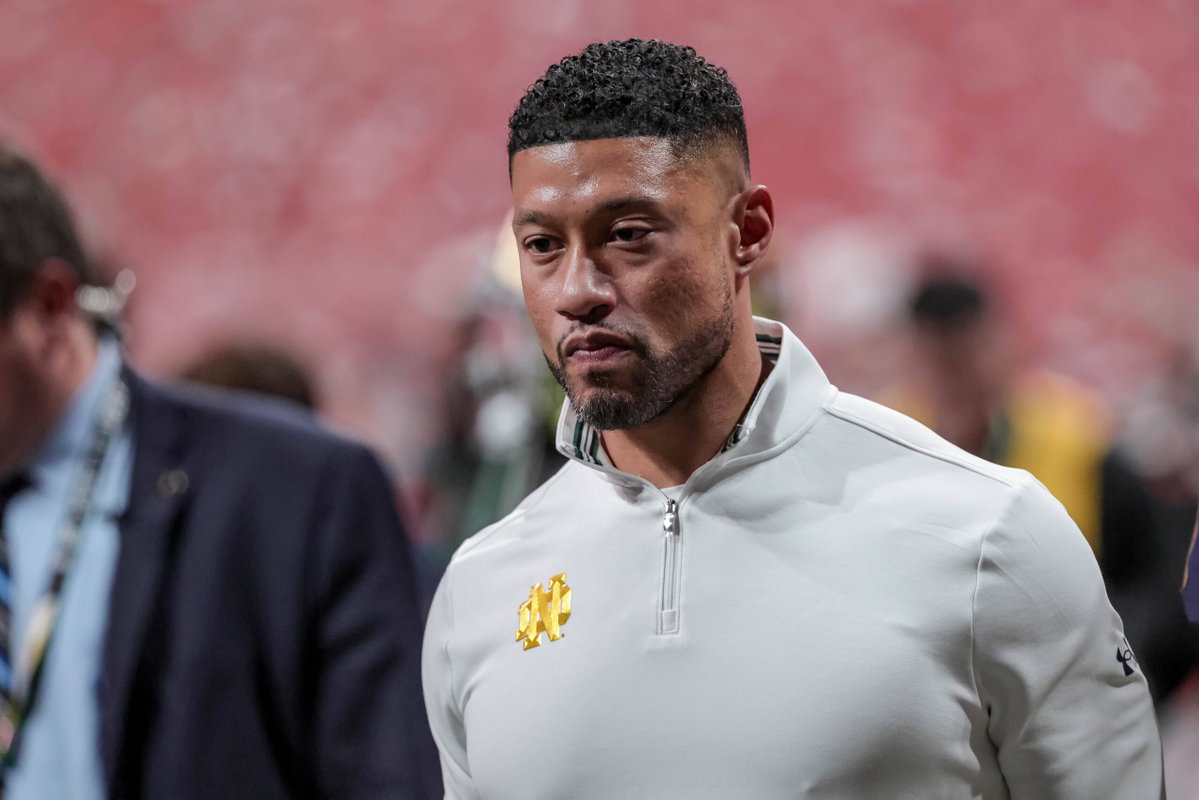
The ‘Tape Grinder’ routine for college football coaches has officially come to an end. In the age of artificial intelligence, coaches no longer need to spend hours in dark rooms manually cueing and fast-forwarding through physical tapes. Now, AI software can see the film for you, analyze it, identify the skill sets, and even grade players based on that. Notre Dame head coach Marcus Freeman uses AI for just that, but with some caution.
Watch What’s Trending Now!
“We use it,” Freeman said about using AI to Mike Berardino of the Notre Dame Insider. “I mean, it’s all over the place. But you can’t let it paralyze you. And you can’t only depend on it. It’s helped in the evaluation of recruits and prospects. It’s helped in the evaluation of opponents (and) self-evaluation. There’s so much feedback that you can become lazy and just depend on what a robot is telling you.”
Before the age of AI, the whole recruiting scene relied on immense trust and established pipelines through high school coaches. The programs kept tabs on prospects through relationships with coaches and also relied on their regional alumni bases to build a widespread network. Many of those elements are still there in recruiting. However, advanced AI software has made evaluation far easier for coaches.
Now, coaches rarely need to sift through hundreds of recruits’ profiles. The programs have the existing profiles and feed them to the AI agent, which also watches the film. The agent analyzes the profiles, forms a grade, and coaches pursue players with “good enough grades.” In some way, the use of AI has also made things more equal for G-5 schools, which might not have the same recruiting networks as power-4 programs.

NEW: Football recruits are figuring out how to use AI to fabricate FAKE highlight plays. All these plays were generated by artificial intelligence. This will completely SHAKE up the football world 🤯
“How can we use AI to generate a better list so instead of watching 5,000 kids — who I have no clue who’s good enough, who’s not — we filter it down to 1,000?” A G-5 GM said to The Athletic’s Antonio Morales. “AI can sort through it, and instead of us sorting through 5,000, just give us the top 500 that we should be paying attention to, and that’ll save us time so we’re evaluating the right ones and not evaluating everyone.”
Still, depending on AI entirely for recruitment, performance breakdown, and analysis is detrimental in the long run. Marcus Freeman, for instance, used AI tools to help his coaches in recruiting for the 2027 class. The head coach admitted to recruiting some through AI evaluation. But that didn’t mean the Irish head coach never used traditional recruiting methods. For him, it’s always going to be a mix of both now.
Marcus Freeman opened up about media scrutiny for using AI
Despite the advantages AI agents offer, there are downsides, too. Many recruits reportedly use AI to doctor their films, and an X video that has garnered 2.4 million views shows plays generated entirely by AI. Interestingly, at first glance, it didn’t look like the case, and no AI agent evaluating the film would have treated it as AI. So, in-person recruiting will remain paramount.
“That’s not going to be sufficient for you guys (in the media) if I get in front of a mic and say, ‘Well, I listened to the robot,'” Marcus Freeman said. “You guys would eat me alive more than you already do. But we do use it. There’s too much information not to use it.”
Despite everything, the usage of artificial intelligence won’t wane any time soon in college football. Today, programs are not just building elite facilities to attract recruits but also a holistic database of players, especially for the portal. The USC Trojans, for instance, have already promoted Conor McQuiston to the director of artificial intelligence this year. The move came after the program received a $200 million gift from alum Mark Stevens for AI research.
According to On3‘s Pete Nakos, McQuiston now builds AI models from the program’s “own data set,” plans games in advance, and uses AI to scout players. By all means, now, college football coaching is rapidly changing; Marcus Freeman is only riding the wave. That doesn’t mean, though, that he will depend on it fully.