
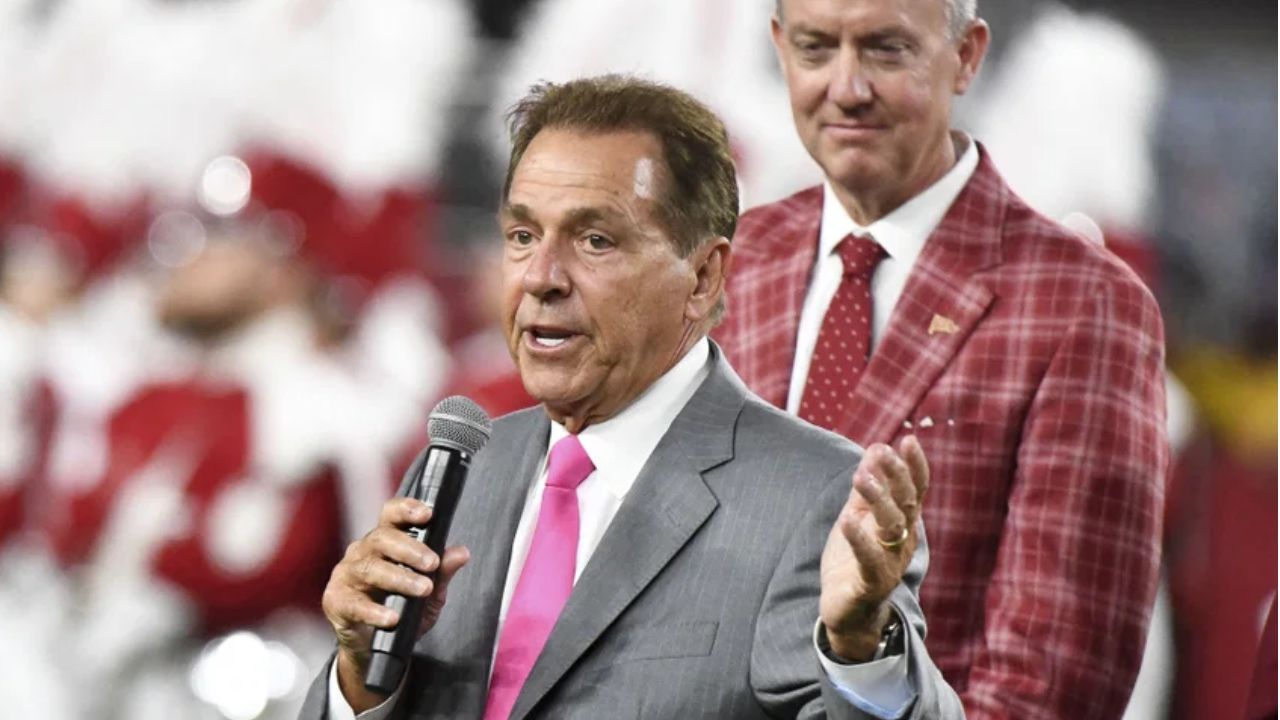
Seven national championships later, Nick Saban stands nearly untouchable in the college football coaching conversation. But Alabama wasn’t always Saban’s kingdom. His first season was a disaster, and before the titles came, he had to establish something far less glamorous: discipline inside the Crimson Tide locker room.
Watch What’s Trending Now!
Former Alabama head coach Nick Saban recently sat down with Alabama Director of Athletics Greg Byrne on the college’s podcast to discuss the glory days of the Crimson Tide. During the conversation, Saban was asked about his coaching philosophy, and his answer was simple: discipline.
“People ask me about the first year we’re here. We lost to ULM. We probably had 12 players suspended for that game. Probably more than half of them starters,” said Saban.
“But I’m not sure if we didn’t do that to fix some of the discipline problems that we had internally on the team, whether it was behavior off the field, inability to play with discipline on the field, whatever those problems were, I don’t think we would have gone 12-0 the next year,” he further added.
The suspensions came at a critical juncture in Alabama’s 2007 season. Sitting at 5–2, the Crimson Tide entered its October 20 matchup against Tennessee on the heels of a narrow 27–24 victory over Ole Miss, with momentum seemingly on its side.
But the textbook scandal that emerged in October forced Alabama to take action, suspending five players just before the Tennessee game. The Crimson Tide lost two starting offensive linemen, Antoine Caldwell and Marlon Davis, along with backup running back Glen Coffee. Reserve defensive backs Chris Rogers and Marquis Johnson were also suspended.
Despite losing those players, Alabama responded with a dominant 41–17 victory over Tennessee, improving to 6–2. However, the situation quickly spiraled. The five players remained suspended for Alabama’s games against LSU, Mississippi State, and Louisiana-Monroe.
The Crimson Tide lost next four games, including the infamous 21–14 upset to Louisiana-Monroe. The five players returned for the Auburn game, while the NCAA later vacated Alabama’s first five wins. The Tennessee and Colorado victories stood because the players had already been suspended. After the sanctions, Alabama’s official 2007 record stood at 2–6.
It was a difficult year for Saban in 2007, but what happened afterward became history. When Saban took over the Crimson Tide, he inherited a college football program in decline. A 6–7 record in the 2006 season had left Alabama struggling near the bottom, but Saban saw what many coaches before him couldn’t: the talent was there. What the team lacked was discipline.
“From a player standpoint, you know, discipline to me is not punishment. Discipline is, what can I do to change someone’s behavior to make them better? It’s the same approach that I would use at home with my two children,” said Saban back when he joined Crimson Tide.
“You know, we can punish them and have no effect on what they do, how they change their behavior. Or, if we take something significant away from them that is meaningful, educate them on how to do it correctly, we probably have a chance to get better results.”
The 2007 season was a reminder and an experiment for Nick Saban to ensure that his team understood the importance of discipline. What followed was six national championships for Alabama.
Saban may have sacrificed one season, but he built a program that is still feared by its opponents, with discipline remaining at the heart of the team.