
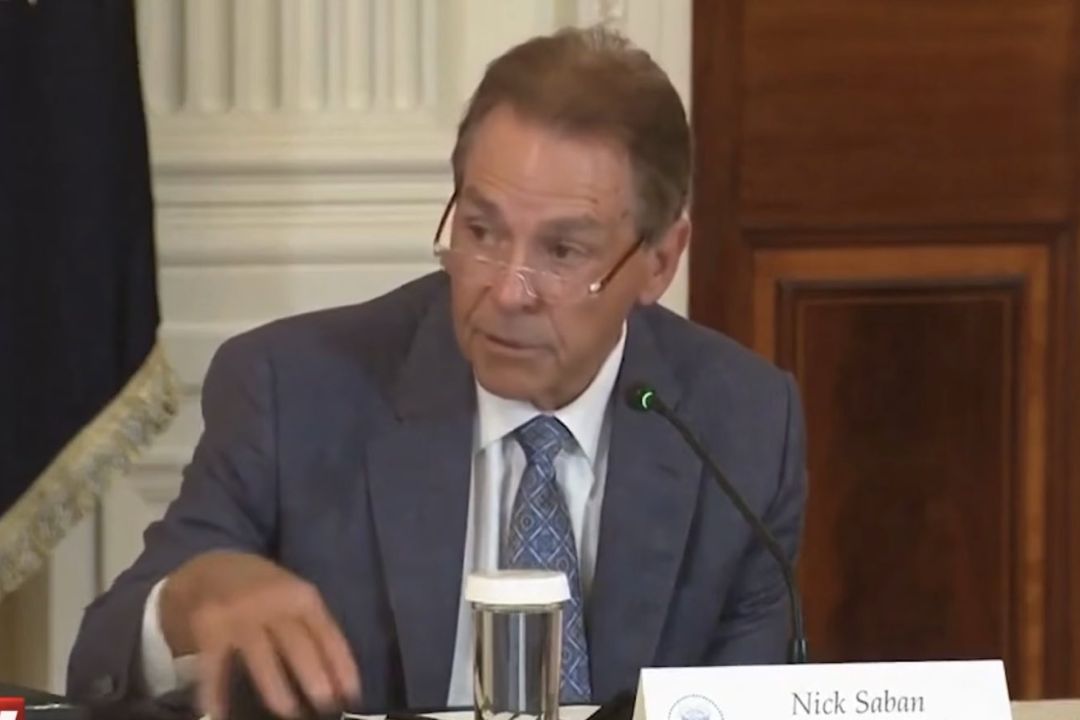
The Protect College Sports Act has been met with polarizing opinions since its introduction across college football. Barring Nick Saban and other witnesses, there was a lot of opposition to the bill. Despite the scrutiny, another major update has been added to the bill, and with this, all Power Four conferences are at the receiving end, with FSU taking the most damaging blow.
Watch What’s Trending Now!
Per Yahoo Sports’ Ross Dellenger, the terms of the Protect College Sports Act’s anti-expansion provision has been significantly adjusted. The provision has been expanded, and now applies to leagues earning at least $700 million. As a result, even the Big 12 and the Atlantic Coast Conference will be added to the provision of anti-expansion. With this, conference membership will be frozen if the bill becomes law.


A significant change has been made to the Protect College Sports Act’s anti-expansion provision, sources tell @YahooSports. The provision, at first only targeting SEC/B1G, now applies to leagues earning $700 M in revenue, down from $1 billion. It now incorporates ACC and Big 12.
The Protect College Sports Act is a bipartisan legislative bill introduced in the Senate as a governmental intervention to the many problems plaguing college athletics. The bill was introduced to touch all core areas of college sports, including Name, Image and Likeness (NIL) practices, revenue-sharing, agent fees, media rights, transfer portal limits and coaching movements. Senators Ted Cruz, Maria Cantwell, Chris Coons, and Eric Schmitt were the main brains behind the bill. It also works to stop the formation of an alternative Super League.
Under the anti-expansion provision, the Protect College Sports Act bill would prevent the Big Ten and the SEC from forming a Super League. Such a formation would involve them acquiring or merging the media rights, assets, or membership of another conference. The idea seemed sensible, seeing that the Big Ten and SEC are the only two athletic conferences in college football to generate more than $1 billion in the previous fiscal year.
However, the latest amendment now targets both the ACC and the Big 12. Senator Ted Cruz called it a “more balanced approach to the Super League issue,” claiming the established framework is to stabilize college athletics. The Big 12 had a total revenue of $610.9 million in the previous fiscal year and is projected to surpass $700 million in the next fiscal year. On the other hand, the ACC did better with a record $826.5 million.
The SEC set a total revenue record in the fiscal year, generating $1.11 billion. The league then distributed $1.03 billion among its 16 member schools, with the 14 schools with full financial participation receiving an average of $72.4 million each — which is an upgrade from the $53.8 million that was distributed in the previous fiscal year. On the other hand, the Big Ten also set a revenue record of $1.47 billion, and distributed $1.37 billion to its 18 member schools. This was a massive improvement from the $883 million distribution record in the previous fiscal year. The average payout for the 16 fully vested programs was between $76 million and $80 million.
Former Alabama football coach Nick Saban was one of the witnesses who testified before the Senate Committee on Commerce, Science, and Transportation to support the bill. While Saban was mainly in support of players earning money, he also wanted limits on the earnings per school. Saban was joined by Notre Dame AD Pete Bevacqua and other athletic officials.
While the bill has been expanded to affect all Power Four conferences, the SEC and the Big Ten have taken the bold step of opposing the legislation. Together, they have released a statement to Yahoo Sports, that they will “continue to believe revisions are needed to secure our support for the bill. Despite our sustained engagement and good faith efforts, these critical revisions have not been accepted”. With this amendment, the Florida State Seminoles would be the most disadvantaged program.
Consequences for FSU
FSU has been one program that has tried to exit from the ACC for years, to join either the SEC or the Big 10. But if the bill becomes a law, they will be locked in the conference’s grant of rights.
Their quest for an exit is primarily motivated by the financial benefits of the Big Ten and SEC, which puts them at a better position to compete with the best programs in the nation. The stability and exposure the top two conferences afford the Seminoles are unavailable in the ACC.
With the new amendment, FSU would have no choice but to remain in the ACC, even beyond 2036. Before the amendment, the exit fee was estimated to be $165 million, and then, a court battle to challenge the existing grant of rights would come afterwards.