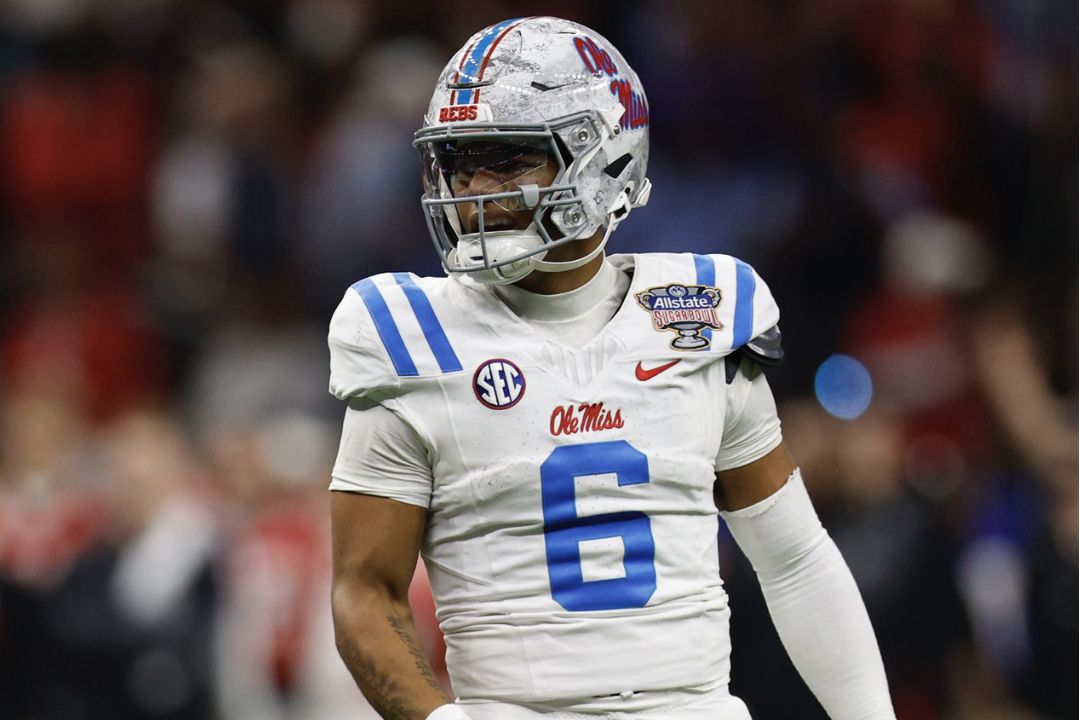
Ole Miss didn’t think twice about dismissing the NCAA’s decision to deny Trinidad Chambliss another year of eligibility as “indefensible.” The case is officially headed to court, with a hearing scheduled for February 12. And it’s not just his program that is supporting the QB’s case. A high-profile attorney also weighed in on the matter in his favor.


“Not sure what the NCAA is trying to do with the Chambliss case, other than taking the position that it will fight any eligibility case despite the facts,” Mit Winter wrote. “But the case is just providing more and more evidence about its decision-making process being arbitrary and capricious.”
Watch What’s Trending Now!
That frustration comes from a former Division I student-athlete and an attorney who has over 10 years of experience in college sports law. Winter has worked for the NCAA, represented conferences and athletes, and argued against it.
And the facts of the Chambliss case are exactly why Winter is so bothered. After a verbal rejection in December, the NCAA officially denied Chambliss a sixth year of eligibility in January. The NCAA’s justification has been extremely rigid. Chambliss’ waiver was based on his 2022 Division II season at Ferris State, during which he was unable to play due to health issues, including chronic tonsillitis, heart palpitations, and breathing difficulties.
Ole Miss requested a retroactive medical redshirt. But the NCAA said that the documentation was insufficient. The only note from December 2022 stated that Chambliss was “doing very well,” but there were no injury reports from Ferris State or any sort of medical records from a physician.
Not sure what the NCAA is trying to do with the Chambliss case, other than taking the position that it will fight any eligibility case despite the facts.
But the case is just providing more and more evidence about its decision making process being arbitrary and capricious. https://t.co/cBuvEWh4I2
— Mit Winter (@WinterSportsLaw) February 8, 2026
For years, he has opposed NCAA eligibility regulations, supporting legal actions such as the one taken by OSU basketball player Puff Johnson, who argued that the hardship waiver system was illegal under antitrust law. Recently, Johnson was granted a temporary restraining order (TRO), allowing him to play while the case moves through the courts and that brings some hope for Chambliss and Ole Miss as they look forward to challenging the NCAA’s decision.
Ole Miss stands by Chambliss
Ole Miss’s support for Trinidad Chambliss has only grown louder. Center Brycen Sanders didn’t hold back, pointing to Charles Bediako’s situation as a pretty glaring example of inconsistency.
“If a guy who played in the NBA can come back and play college basketball, I don’t understand why Trinidad can’t play,” Sanders said. “What’s really bothering people is that the rules keep changing depending on who you are.”
The return of Bediako, who left for a two-way NBA contract and came back to play against the Tigers yesterday, makes Chambliss’ case seem unfair to the team.
Analysts have weighed in, too. “His attorney, Tom Mars, is very bullish on being able to get him that extra year,” ESPN analyst Kirk Herbstreit said. “I do know Tom Mars feels very confident that he’s going to win this case and that Trinidad Chambliss will have an extra year.”
Although Mars has a well-known record of defeating the NCAA, the case is not as simple as that. The NCAA upholds that the medical records from Chambliss’ 2022 Ferris State season were not submitted by Ole Miss.
The legal battle is proceeding strategically. On January 16, Chambliss’ lawyers filed a lawsuit in Lafayette County Chancery Court, seeking both a preliminary and a permanent injunction. That hearing is scheduled for February 12. According to On3 analyst Andy Staples, Ole Miss may have a “home-field advantage” in court as a result of the county’s selection because of the local voters and elected judges.
“They’ve got a hearing next week and what they want is an injunction,” Staples said. “And what the injunction would do is it would keep the NCAA from enforcing its own rules and allow Trinidad Chambliss to play while this is all pending.”
All eyes will be on the courtroom. But a lingering question remains: if the rules change depending on the player, what does fair play truly mean in the modern NCAA?
Written by

Edited by

Amit