
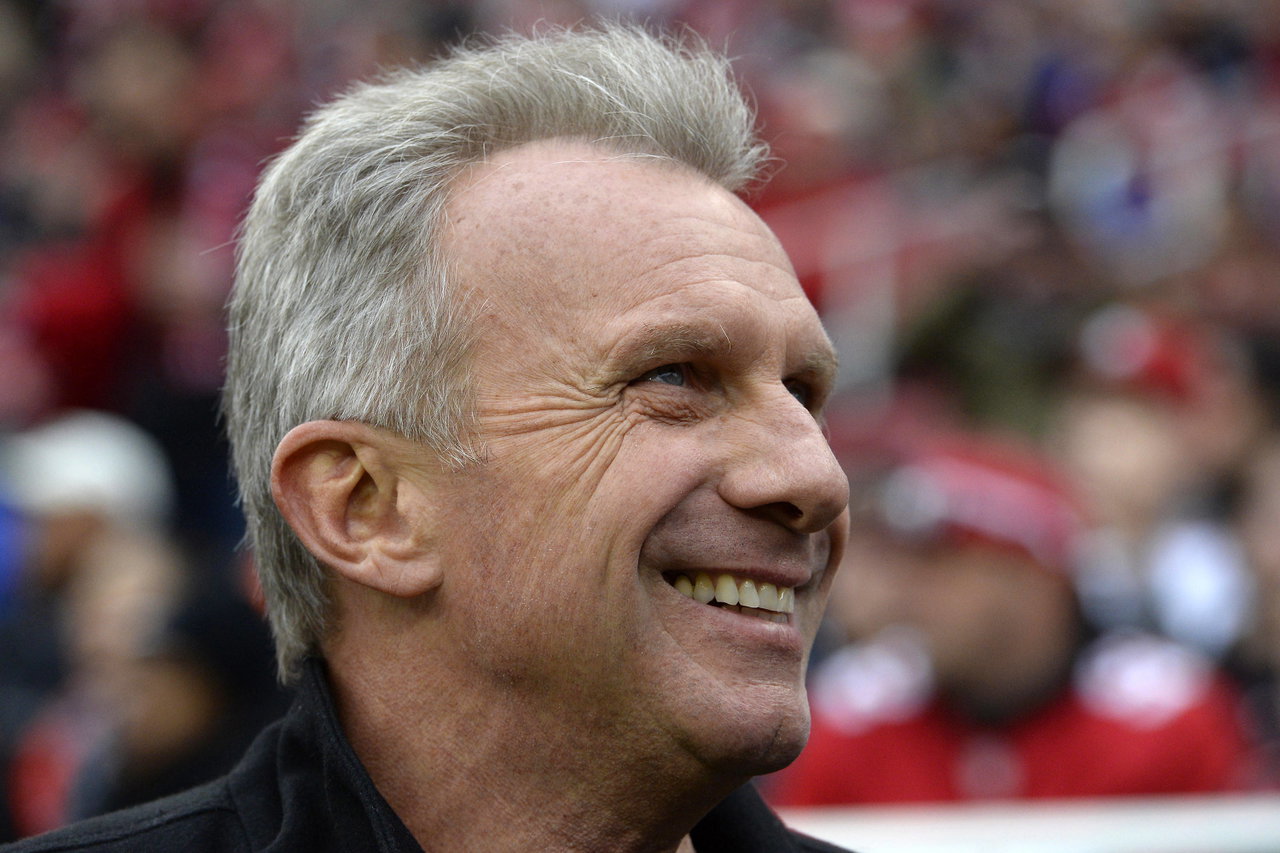
Scouts did not see this coming. At one pre-draft combine, a quarterback out of Notre Dame graded at six and a half overall, with a six in arm strength, while Washington State’s Jack Thompson earned an eight, the highest mark among eligible passers. When the 1979 draft arrived, he was the fourth quarterback off the board, taken in the third round at No. 82, behind Thompson, Phil Simms, and Steve Fuller. Four Super Bowl rings, three Super Bowl MVP awards, and two NFL MVP trophies later, that grade reads as one of the great misjudgments in football history.
Watch What’s Trending Now!
Yet the challenge that unsettled him most had nothing to do with defenses. On a recent appearance on ESPN’s College GameDay, the Hall of Famer was asked to name the hardest thing he ever had to prepare for. His answer skipped every championship game and went straight to a delivery room, a reminder that even the most composed player in league history has moments where nothing in his résumé helps.
“Actually, my first child when she was born. Just doing something for the first time and wanting to make sure you do it right, but I had a great partner with Jennifer. She took care of it all,” Joe Montana said in an interview with ESPN’s Katie Feeney, according to a clip posted on Instagram.
The exchange spread after creator Katie Feeney posted it on Instagram and Threads with the caption, “Not even four Super Bowl rings can prepare you for parenthood.” Fans responded by revisiting how devoted Montana was to his family during his playing days, and the clip became a talking point for a sport that rarely sees its legends speak this plainly about home life.
That devotion was documented by NFL Films. In an interview with the network, Montana described discovering that the sideline phones, normally used to reach coordinators upstairs, could dial out.
“I don’t know what made me do it. But one day, I had hung up, and I’m sitting there going, ‘Hmm, I wonder if these things call out?’ So I pick up the phone, I hit 9, got a dial tone, and I dial my house,” Montana said.
His wife, Jennifer, remembers the calls.
“The phone rang, I picked it up, and it was Joe. He would say, ‘I’m calling you to say I love you,’” Jennifer said.
From then on, Montana checked every stadium he visited to see whether the phones could reach home.
The composure that earned him the nicknames “Joe Cool” and “the Comeback Kid” was evident long before the NFL. At Notre Dame, he led the Fighting Irish to the 1977 national championship, capped by a 38-10 Cotton Bowl win over top-ranked Texas.
On Jan. 1, 1979, in the “Chicken Soup Game,” he battled hypothermia, with his body temperature dropping to 96 degrees, left the field at halftime for warmed fluids, blankets, and chicken soup, and returned in the third quarter with Notre Dame trailing Houston 34-12. The Irish won 35-34.
In San Francisco, Montana built a reputation for remarkable late-game heroics, including “The Catch” to Dwight Clark in the 1981 NFC Championship Game and a 92-yard drive that beat Cincinnati in Super Bowl XXIII. In his four Super Bowls, he threw 122 passes without an interception and posted a 127.8 passer rating. He became the first player to win three Super Bowl MVP awards, in Super Bowls XVI, XIX, and XXIV.
Over 16 seasons, with the 49ers and then the Kansas City Chiefs, he threw for 40,551 yards and 273 touchdowns, earned eight Pro Bowl selections, and was inducted into the Pro Football Hall of Fame in 2000. His No. 16 was retired by San Francisco.
Former 49ers owner Edward DeBartolo Jr. described Montana’s impact in sweeping terms.
“Joe Montana, simply stated, was the greatest quarterback ever to play the game. And I don’t think we’ll see the likes of him again,” DeBartolo said.
DeBartolo added that, to Montana, what would have been a career-making highlight for anyone else was “just another day at the office.” Bill Walsh once called him “the greatest quarterback today, maybe the greatest quarterback of all time.”
Montana still shows up at major college football events, mixing football insight with grounded personal perspective. Away from the game, he co-founded the venture capital firm Liquid 2 Ventures in 2015. When San Francisco honored him with a street at the former Candlestick Park site, Montana requested that “Joe Montana Drive” be renamed “Montana-Clark Drive” to honor his longtime teammate Dwight Clark.