
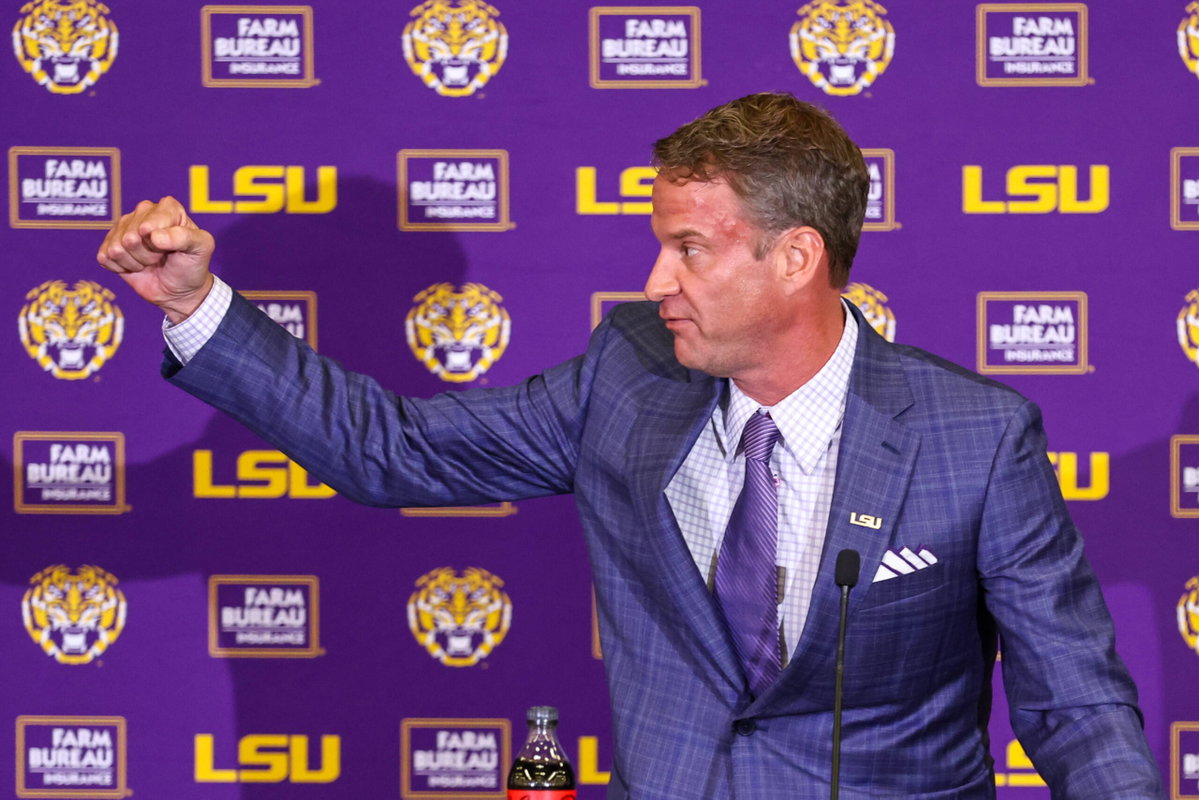
Lane Kiffin’s LSU landed two major transfers from Ole Miss, defensive end Princewill Umanmielen and offensive lineman Devin Harper, but the deal isn’t finished yet. The Tigers have to pay buyouts to the Rebels on behalf of these two. Six months have passed since the transfers, and Ole Miss now says it may have no choice but to take the matter to court.
Watch What’s Trending Now!
Speaking with the Clarion Ledger, Ole Miss athletic director Keith Carter said, “That would be an option, going and asking a court to get that money for you. Contracts are with the players. LSU could pay that on behalf of the players. So we’re kind of exploring all of that right now.”
The transfers involve two players who bet on their relationship with Kiffin, and a program that promised them a fresh start. Ole Miss sees this as bigger than the dollars involved. The school wants to show players that contracts mean something in Oxford.
Umanmielen recorded 45 tackles last season as Ole Miss reached the College Football Playoff, then chose to follow Kiffin to LSU. The money issue traces back to a revenue-sharing deal Umanmielen signed before entering the portal. In fact, he declared he would return for the Rebels this season.
Umanmielen announced he was staying at Ole Miss, but changed his mind within nine days, right after Kiffin left for Baton Rouge. That now puts Umanmielen and LSU in this concerning situation. Harper, a freshman offensive lineman, played in six games and also signed an NIL agreement with Ole Miss before transferring. For a freshman still adjusting to college football, the choice to follow Kiffin carried both opportunity and risk.
The real question: who gets named in the lawsuit? LSU, the players, or both? In either case, a lawsuit could be filed against LSU, and as per ON3’s Pete Nakos, “within the next two weeks.” For a program like Ole Miss, letting nearly a million dollars walk away without a fight could invite more departures. If LSU writes the check, it signals the program will do whatever it takes to land and keep top talent. A lawsuit would add an unusual dimension to the LSU-Ole Miss rivalry: a contract dispute playing out in court. Any transfer between these programs going forward will be viewed in light of this precedent.
Kiffin has already made waves this offseason, publicly criticizing Ole Miss on recruiting and their playoff showing, adding fuel before the September matchup. And when Ole Miss hosts the Tigers in September, it will be intense. For Kiffin, it will be his first season at LSU. Meanwhile, for Ole Miss head coach Pete Golding, it’s his first test against a previous boss.
Both programs have also invested heavily at quarterback. On3 values LSU’s Sam Leavitt at $4 million, while Ole Miss’ Trinidad Chambliss sits near $5 million. Yet both programs face extra costs: LSU for the buyouts, and Ole Miss for its own portal additions.
Breaking down the numbers
On3 reports the total buyout obligation sits near $1 million, roughly $550,000 for Umanmielen, with Harper’s making up the remainder. However, Ole Miss refused to reveal the exact amount. When asked for specifics, Carter declined. “I don’t really want to comment on that. It was significant. They were good players,” he said.
In today’s transfer-heavy landscape, Ole Miss is making an example. Their play could help LSU compete for a 2026 championship, but the unpaid buyouts create a legal problem the program must resolve. Carter said Ole Miss doesn’t want to make the players pay personally, but the contracts leave the school little choice.
With NIL deals now central to roster building, Ole Miss feels it must enforce these agreements. “Those two we’re going to continue to figure out how to collect. We feel like, based on the contract, we deserve to collect,” added Carter.