Imago
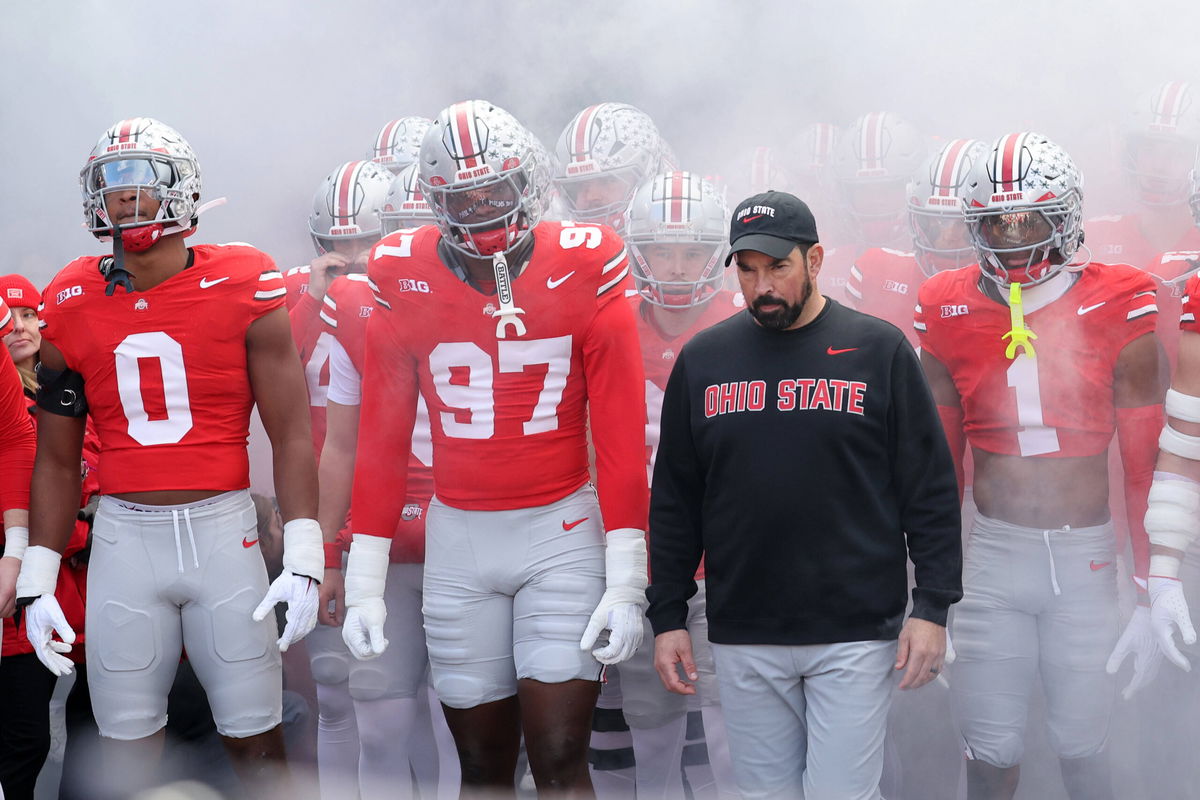
Ohio State Buckeyes head coach Ryan Day leads Sonny Styles 0, Kenyatta Jackson Jr. 97, Brandon Inniss 1 and the Buckeyes onto the field against the Rutgers Scarlet Knights in Columbus, Ohio on Saturday, November 22, 2025. PUBLICATIONxNOTxINxUSA COL20251122118 AaronxJosefczyk
Imago
Ohio State Buckeyes head coach Ryan Day leads Sonny Styles 0, Kenyatta Jackson Jr. 97, Brandon Inniss 1 and the Buckeyes onto the field against the Rutgers Scarlet Knights in Columbus, Ohio on Saturday, November 22, 2025. PUBLICATIONxNOTxINxUSA COL20251122118 AaronxJosefczyk
Imago
Ohio State Buckeyes head coach Ryan Day leads Sonny Styles 0, Kenyatta Jackson Jr. 97, Brandon Inniss 1 and the Buckeyes onto the field against the Rutgers Scarlet Knights in Columbus, Ohio on Saturday, November 22, 2025. PUBLICATIONxNOTxINxUSA COL20251122118 AaronxJosefczyk
Imago
Ohio State Buckeyes head coach Ryan Day leads Sonny Styles 0, Kenyatta Jackson Jr. 97, Brandon Inniss 1 and the Buckeyes onto the field against the Rutgers Scarlet Knights in Columbus, Ohio on Saturday, November 22, 2025. PUBLICATIONxNOTxINxUSA COL20251122118 AaronxJosefczyk
As Ryan Day watches 30 scholarship players exit the program, the instinct around the sport is to ask why Ohio State is not moving faster, louder, or looser with money. As of now, the College Sports Commission is still in the developing stage but that doesn’t mean the rules should be disregarded as AD Ross Bjork insisted. The Buckeyes are choosing discipline in a system that currently rewards chaos. That choice is deliberate, and it is already shaping the roster.
Watch What’s Trending Now!
“We are being aggressive, but we’re also doing it the right way,” Ross Bjork said during a January 13 interview with 10TV’s Adam King and 97.1 The Fan’s Timmy Hall. “The last I checked, our Board of Trustees, our university leadership, they expect us to win at a high level, but do it with integrity. And that’s what we’re going to do… I know we’re being extremely aggressive in the portal, in the retention, in the money, in the sponsorship, in support from the community. We have an amazing apparatus here, and it’s being very well equipped, very well supported.”
“We are being aggressive but we’re also doing it the right way… they expect us to win at a high level, but do it with integrity.”
Ross Bjork says OSU is aggressively working to be at the top of NIL world, but they are going to follow the College Sports Commission rules: pic.twitter.com/qLc24UYWEK
— Adam King (@AdamKing10TV) January 13, 2026
The core of Ross Bjork’s argument centers on enforcement, or the lack of it. The newly formed College Sports Commission is not fully staffed, leaving programs to interpret rules in an environment where consequences feel distant. The AD acknowledged the temptation that creates across the sport but his firm message was that compliance is not optional, even if competitors decide otherwise. That distinction becomes sharper when money enters the conversation.
Ross Bjork pointed to the House settlement, which set revenue sharing at roughly 22 percent, equating to about $20 million. That figure, he noted, was outdated almost immediately. The market surged past it through collectives, front-loading deals, and third-party arrangements. Attempts to restrict compensation, he argued, only push money underground.
“The frustrating thing is we can’t get our arms around the money piece and we can’t govern that piece because we’ll probably end up back in a courtroom,” he said. “And we all thought the house case settlement was going to capture enough of the upside. We were all worried about how are we going to pay for $20.5 million. Well, now we’re trying to create third-party, and we have here, to go way above that.”


From a football perspective, Ross Bjork emphasized balance. Ohio State continues to prioritize high school recruiting while using the portal as a supplement, not a replacement. He noted that nine of 11 offensive starters are returning, the Buckeyes signed 28 high school players, and the program is adjusting to a 105-player roster cap. Development timelines, however, are shrinking. Patience is no longer guaranteed, and retention is often more difficult than acquisition. That reality frames the current attrition in Columbus.
“Anytime we try to codify the money, it leads to this,” he added. “It leads to chaos. It leads to angst. It leads to, ‘do we have enough? Do we not have enough?’ And so-and-so’s doing this over here, and how come we’re not doing this? And so, to me, that’s the place that I’m in as we go into 2026.”
And that philosophy explains why Ohio State’s portal losses, while eye-catching, are not being treated as a crisis inside the Woody Hayes Athletic Center.
Ryan Day loses 30 players to the portal
The latest Buckeye departure underscores the trend. Trajen Odom, the final freshman DT from Ohio State’s 2025 class, entered the transfer portal this week, becoming the program’s 30th scholarship exit since the season ended. He played just 10 snaps across three games and recorded no statistics in his lone year. A 3-star recruit, he followed classmates Jarquez Carter, now at Miami, and Maxwell Roy, headed to UCLA, out the door.
Trajen Odom is also the fourth DT to leave this cycle, joining redshirt sophomore Eric Mensah, who transferred to Virginia Tech. He is the eighth member of the 2025 freshman class to depart early, part of a broader pattern that reflects the sport’s impatience economy. Despite the turnover, Ohio State still carries nine defensive tackles for 2026, including transfer additions James Smith from Alabama and John Walker from UCF.
Losses, however, have been paired with targeted gains. Ohio State has added 11 transfer players, highlighted by All-ACC safety Earl Little Jr. from Florida State. He brings experience and production to a secondary that needed stability after Caleb Downs’ NFL departure. Additional portal additions include Dalton Riggs, John Walker, Devin McCuin, and Christian Alliegro.
Recruiting momentum has not slowed. Ryan Day landed five commits in a nine-hour window, including 5-star James Smith, 4-stars Qua Russaw and Justyn Martin, and 3-stars Hunter Welcing and Terry Moore. Ohio State’s roster may be changing but it is not thinning. Ross Bjork’s stance suggests the Buckeyes are betting that structure will matter most as college football heads toward 2026.
Related Newsletters