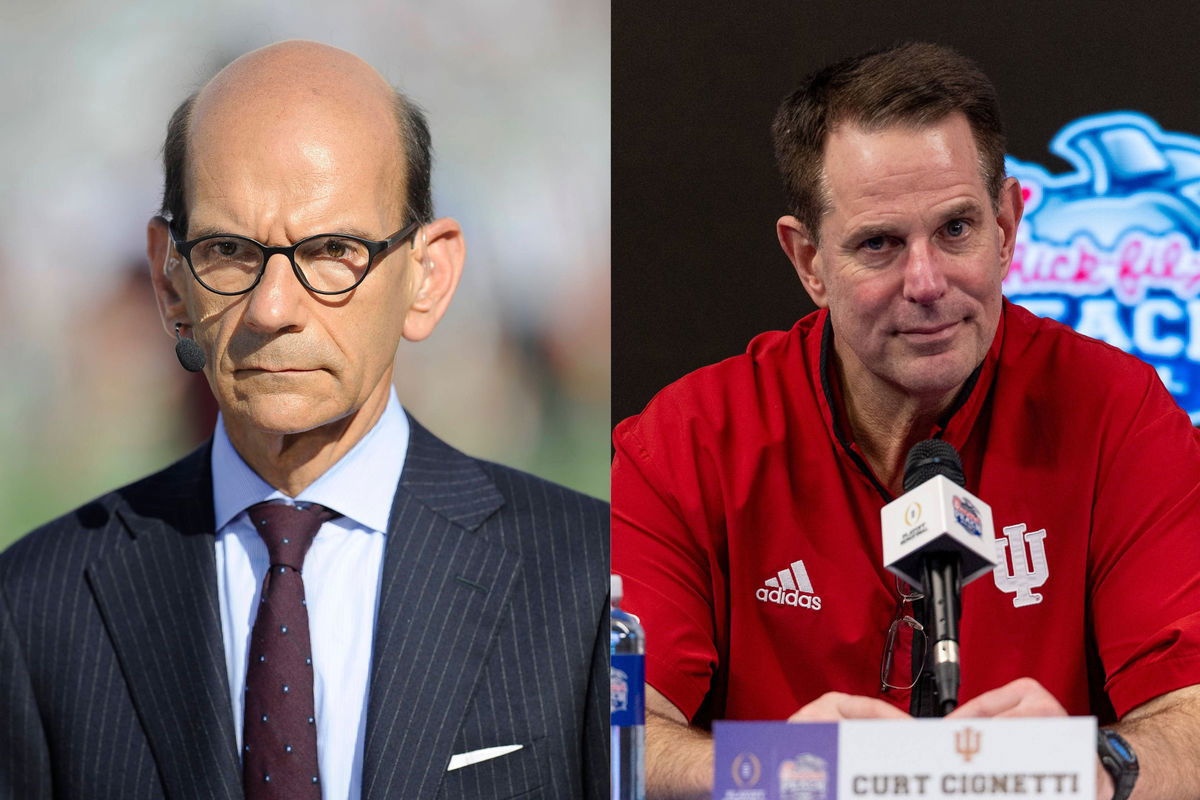
Indiana’s Natty win added more fuel to the debate on the Big 10’s dominance over the SEC. While SEC Network host Paul Finebaum, who once called Curt Cignetti “annoying,” was forced to eat his words after the Hoosiers’ stunning turnaround, he did not hesitate to launch some fresh criticism on the Big 10.
The Big 10 teams have now won the national championships 3 times in a row. That’s Big 10 dominance at its peak. Finebaum attributes the success to the Big 10’s immense billionaire backing and the conference being “flush with money.” “We’re talking billionaires, and outside of Texas and Texas A&M, the list of billionaires starts to get really thin,” Finebaum said.
Watch What’s Trending Now!
“I can tell you in the state of Alabama, there are only two billionaires, two in the entire state. They’re both Auburn supporters. Alabama doesn’t have a billionaire, and why is a billionaire important? Because they can throw around money if you’re worth 800 billion,” the 70-year-old added. Looking at both conferences’ revenue data, the Big 10 unquestionably edges the SEC slightly.
The Big 10 reported a whopping $928 million in revenue for the 2023-2024 fiscal year. SEC, on the other hand, reported a $840 million sum for the same period. In terms of revenue distribution to programs, SEC schools got about $10 million less than the Big 10, which distributed $61-63 million each to its schools.
Paul Finebaum and ESPN’s Matt Barrie admits that the SEC is broke when compared to the Big Ten’s cash. Is it true the SEC is having a money problem trying to compete with the Big Ten deep pockets? pic.twitter.com/nRbebPXyAi
— JBook. (@JBook_37) January 20, 2026
Moreover, the Big 10 also has a historic $7 billion media rights 7-year deal with Fox, NBC, and CBS for 7 years. Because of that, projection estimates the Big 10 to be distributing around $90 million annually to its programs at some point of the entire contract. In contrast, the SEC’s media rights contract with Disney provides the conference with a $3 billion sum over 10 years, paying approximately $300 million annually. But does that mean the SEC is lagging behind, and Indiana won because of NIL?
“Indiana wasn’t helped by the Big Ten, but Indiana got to the national championship by itself,” Finebaum said. “It’s a little bit easier if you’re a billionaire to give to your school, not only to put your father’s name on the business building, but to give your NIL fund whatever it needs. And you (SEC) just can’t. You can’t call the commissioner of the SEC and say. Hey, you have to solve this problem,” Finebaum added.
Indiana, of course, got the annual revenue sum that all Big 10 programs were getting. However, that was the case with SEC schools, too. The Hoosiers, in truth, weren’t helped by billionares and even Mark Cuban jumped in after Indiana made the playoffs in 2025. Having a good NIL collective helps, and Indiana has built something sustainable in that regard. But they didn’t have elite talent like Ohio State, Oregon, or what Michigan boasts, courtesy of having unprecedented financial resources.
Indiana built its squad through world-class talent identification and grassroots-level scouting. A year back, no one was willing to take in a Cal reject QB Fernando Mendoza; Miami even declined him to be a walk-on recruit during high school recruitment. Curt Cignetti took him in, developed him, perfected his mechanics, and in no time, the Heisman came along with a stellar performance against Miami in the championship. That’s not NIL money speaking, but a pure coaching masterclass by Cignetti.
Finebaum’s argument that the SEC has weak financial pull is far-fetched
As for the NIL argument, SEC schools aren’t lagging too much behind the Big 10 schools. As per 247 Sports, the Texas Longhorns lead the NIL game with its NIL collective being valued at $22.4 million. LSU, another SEC program, is 3rd nationally, with a $20.1 million valuation. The program landed Sam Leavitt on a $5 milion deal, and made Lane Kiffin the third-highest-paid head coach in the country. It is evidence of the SEC’s financial muscle.
Imago
Source: Imago
Even Kirby Smart’s UGA, often showing reluctance to hand high-profile NIL offers, boasts $18.3 million value for its collective. The money is there, it’s just that this isn’t the time when Kirby Smart could keep 5-stars as backups. Now, a Big 10 program could easily offer him more and land him. The only thing that can explain Finebaum’s take is his SEC bias, which showed when he criticized Cignetti
“They just gave him an extension and a contract raise at the end of last season. We are barely at the midpoint. Let it play out before you completely send the Brinks truck up,” the SEC Network host said. “There are very few generational talents. … I’m still not convinced that Curt Cignetti is one of the top coaches in America.”
Indiana’s win is easily one of the most iconic achievements in sporting history, period. No matter what Finebaum says or argues. SEC’s declining dominance isn’t linked to its weak financial muscle, but increased parity within CFB, owing to the NIL and revenue sharing. College football is truly a level playing field now. As a result, Indiana won despite being the losingest program in FBS when Cignetti joined. Translation: Anyone can dream big now in college football, and the SEC should brace for a storm.
Related Newsletters