
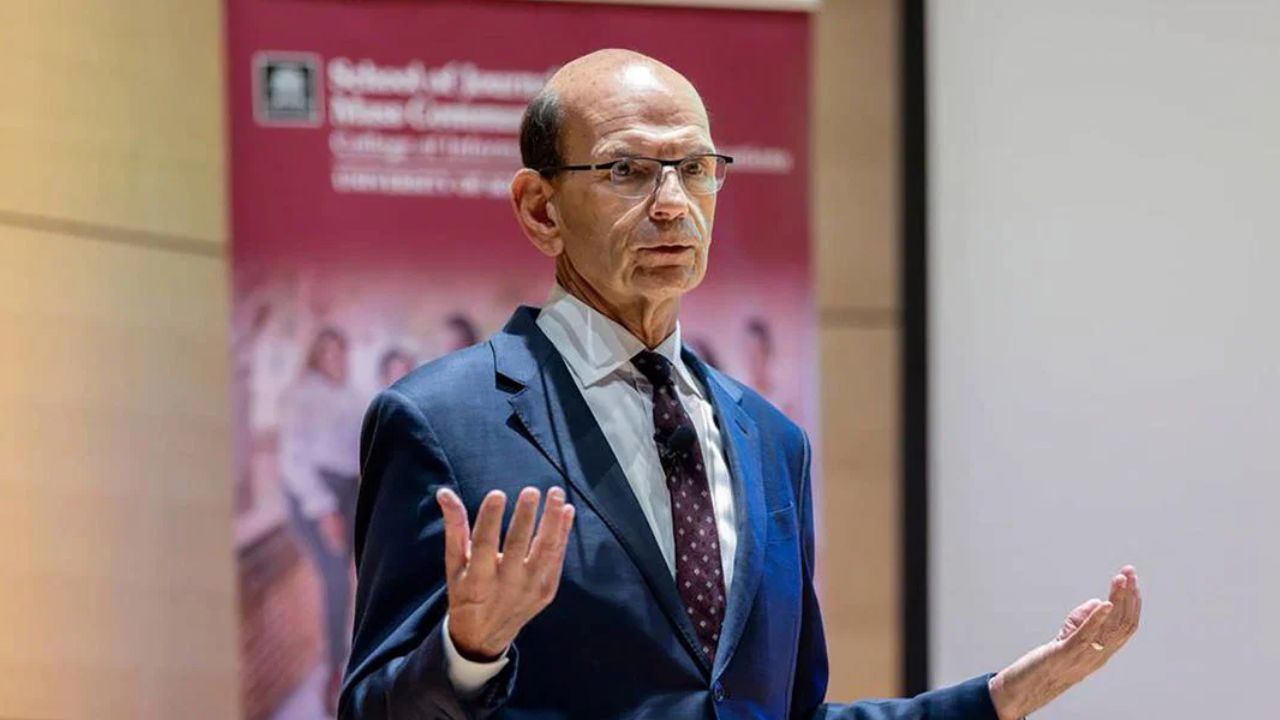
Paul Finebaum has watched enough rankings shows to recognize the difference between a careful read and a locked-in take. Earlier this week, the College Football Playoff committee delivered numbers that undercut the confident projections coming out of the ESPN studios only days earlier. Georgia held at No. 1, Utah stayed at No. 2, Texas climbed to No. 3, and Notre Dame moved to No. 4.
Watch What’s Trending Now!
Then the real movement arrived. Tennessee jumped to No. 5. Alabama dropped to No. 6. Indiana, the defending national champions, fell all the way to No. 14 after an overtime loss at Washington and sat outside the projected 12-team field with one regular-season game left.
Finebaum had sat through the same pre-ranking conversations as everyone else. He had heard the same explanations about resume metrics, previous committee comments, and which wins carried the most weight. By the time the actual ranking appeared, the gap between those explanations and the final order was clear enough that he did not bother softening the point.
“I have never seen her miss one,” Finebaum said. “I have no idea why she was so adamant about her position. It turned out to be incorrect.”
The colleague was Heather Dinich, ESPN’s primary College Football Playoff reporter since the system began in 2014. In the days leading into the rankings, Dinich had projected Alabama at No. 4 and Tennessee at No. 8. She also kept Indiana inside the top 12, placing the Hoosiers around No. 11.
Dinich pointed to the committee’s earlier praise for Alabama and noted that both Alabama and Texas had won the previous weekend convincingly. On Tennessee, she argued that a win over a struggling LSU team did not move the needle the same way. For Indiana, she highlighted the earlier victory over USC and strength-of-record numbers as reasons the Hoosiers could still hold a relatively safe spot even after the Washington loss.
Finebaum said the certainty of that projection stood out. “I felt pretty strongly,” he said. “And I mean the only, I was a little surprised by Alabama because of what the committee chairman said last week, praising Alabama for a miserable game. You kind of, you had to wonder. I think somebody finally took that room over. I’m assuming it’s one of those coaches who just finally just gave them the ride.”
The ranking that followed matched the head-to-head result from October more closely than the pre-ranking projection. Tennessee had beaten Alabama by 16 points in Neyland Stadium earlier in the season. For the first time all year, the Volunteers sat ahead of the Tide in the committee’s order.
Indiana’s drop of six spots moved the Hoosiers behind both Oregon and Iowa. Finebaum had already called Indiana’s resume unimpressive after the Washington game and said the program did not belong in the Playoff conversation even with a win against Purdue still ahead. The new ranking lined up with that harder assessment.
He did not limit the criticism to one missed projection. “I think we’re making, we’re being made fools out of by people on TV,” Finebaum said.
The line carried weight because Finebaum and Dinich have shared the same studio shows throughout the season, breaking down the same bracket each week. Dinich has long been the network’s main voice on how the 13-member committee weighs resumes, metrics, and eye test. Finebaum has spent years arguing that those evaluations often reward the wrong teams. This week the two views collided in plain view. Dinich’s projection had Alabama fourth and Tennessee eighth. The committee put Tennessee fifth and Alabama sixth. She had Indiana inside the field. The committee put them at 14.
Finebaum returned to the same observation near the end of the segment. The projections had been delivered with clear confidence. The ranking moved in a different direction. “It turned out to be incorrect,” he said. “I felt pretty strongly.”
Alabama still has Auburn left on the schedule. Tennessee travels to Vanderbilt. Indiana hosts Purdue. Those results will shape the next set of rankings. Finebaum made it plain he was not waiting on another round of television projections to decide what he had already seen on Tuesday night. The numbers had already answered the question about the adamant take from the days before.